
A good code agent isn't the one that looks good in a demo. It's the one that passes repeatable tests, with clear specifications and metrics you can compare from one week to the next.
Dicas6 min
5 best GitHub repositories for testing code agents
Spec Kit, promptfoo, mini-swe-agent, SWE-bench, and Langfuse: 5 GitHub repositories to specify, test, and measure code agents with real data.
The biggest AI newsletter in the World
Get AI articles in your inbox
Technical curation on models, agents and coding tools. No spam, unsubscribe anytime.
I've selected 5 GitHub repositories that help at each stage of this cycle: specifying the task, evaluating prompts and models, measuring against a benchmark, running a reference agent, and observing execution. I checked the README, license, and recent activity for each on 11/25/2026.
In this article you'll see:
- How each repository fits into an agent's test cycle
- License, recent activity, and install command for each project
- A usage example for each tool
- How to combine everything into a single workflow
Why test code agents before trusting them
An agent that gets it right once can get it wrong the next round. Without repeatable tests, you swap models or prompts in the dark and only discover the regression in production.
The five projects below cover different stages. None solves everything alone, and that's exactly why the combination builds confidence in the result.
If you're still choosing the agent itself, it's worth reading the list of terminal code agent repositories first. The focus here is different: how to measure and control what they deliver.
1. Spec Kit: specification before code
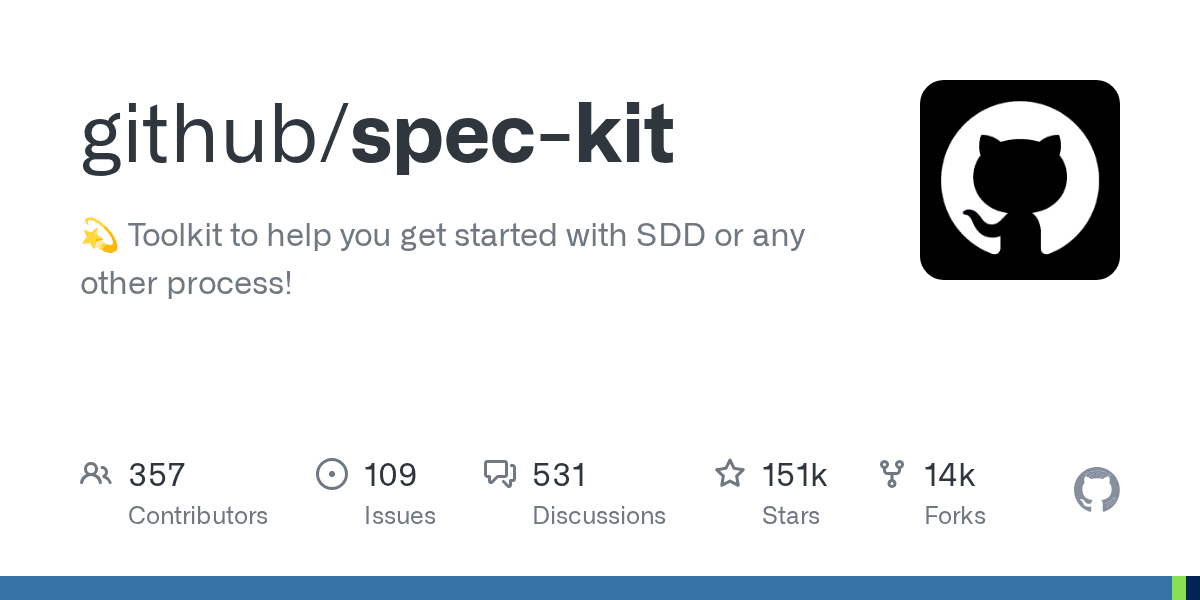
Spec Kit is a GitHub toolkit for specification-driven development (SDD). The idea is to write the specification first and let the agent implement from it.
- License: MIT
- Activity: last push on 11/24/2026, over 151k stars
- For: teams using agents who want to reduce improvisation in requests
Installation follows the official README, which requires Python 3.11+ and uv:
Terminal
uv tool install specify-cli
specify init my-project --integration copilot
cd my-projectUsage example: create a project with specify init, open the agent in the folder, and ask for the functionality based on the generated spec. The acceptance test becomes the spec text itself.
2. promptfoo: LLM evaluations and red teaming
promptfoo is a CLI and library for evaluating and red-teaming LLM applications. You declare test cases in configuration and compare models like GPT, Claude, Gemini, and DeepSeek.
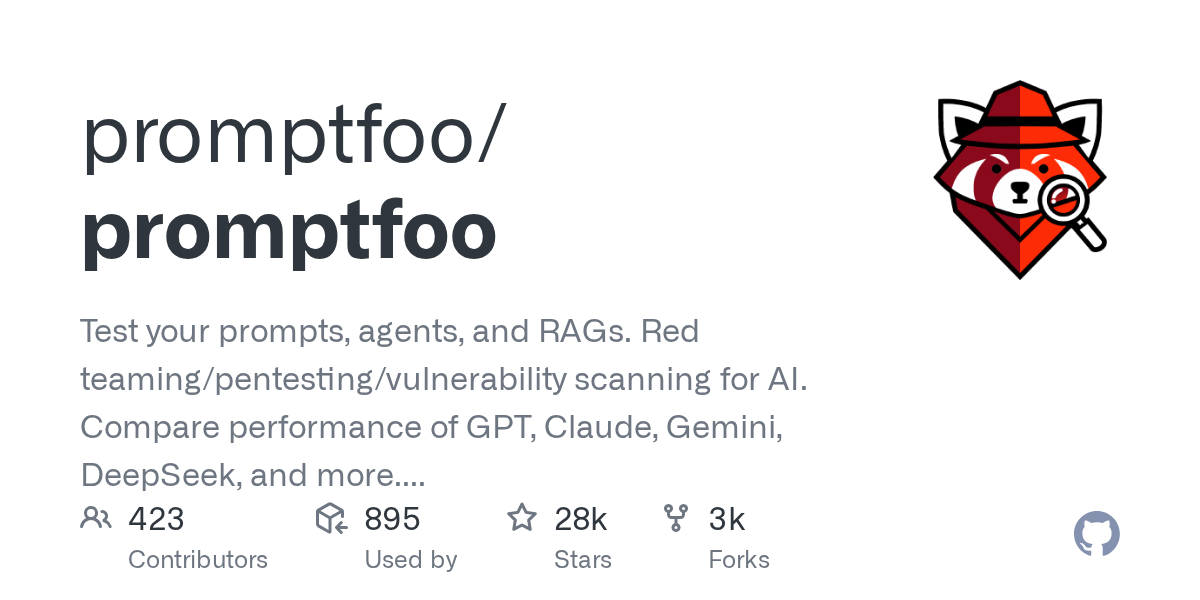
- License: MIT (README notes the project is now part of OpenAI and remains open source)
- Activity: push on 11/25/2026, around 27.6k stars
- For: teams needing automated prompt tests in CI/CD
Terminal
npm install -g promptfoo
promptfoo init --example getting-started
promptfoo eval
promptfoo viewUsage example: build 20 test cases with real tasks from your team, run promptfoo eval on every model swap, and see in promptfoo view where quality dropped.
3. mini-swe-agent: a reference agent in 100 lines
mini-swe-agent comes from the team that created SWE-bench and SWE-agent. The agent class is about 100 lines of Python, no fancy dependencies.
- License: MIT
- Activity: push on 11/23/2026, over 10k stars
- For: anyone who wants to understand how an agent works or have a simple comparison baseline
The README reports it passes 74% on SWE-bench Verified. To test:
Terminal
pip install mini-swe-agent
miniUsage example: run mini on the same task as your main agent and compare the final diff. If the simple agent reaches the same result, yours might be overcomplicated.
4. SWE-bench: the real-issue benchmark
SWE-bench asks whether language models can solve real GitHub issues. The repository collects the evaluation code and data, cited in papers accepted at ICLR.
- License: MIT, per the README badge
- Activity: last commit on 09/02/2026, well within the 180-day window
- Who it's for: anyone evaluating models against a public, comparable standard
Terminal
git clone [email protected]:SWE-bench/SWE-bench.git
cd SWE-bench
pip install -e .The README also shows that evaluation can run in the cloud with Modal, and that SWE-bench Verified exists, with 500 problems confirmed as solvable by engineers.
Usage example: run a small subset with your agent and record the resolution rate. Use that number as a baseline before tweaking prompts.
5. Langfuse: observability and evaluation in production
Langfuse is an open-source AI engineering platform, with a gateway, agent observability, evaluations, and prompt management, built on OpenTelemetry.
- License: MIT, per the README badge
- Activity: commit on 11/25/2026 and over 11,000 commits in history
- Who it's for: teams that need to see traces, costs, and errors from agents after deploy
You can use the project's cloud or self-host. The README documents the project's telemetry and allows disabling it with TELEMETRY_ENABLED=false.
Usage example: send agent traces to Langfuse and filter failed runs. Turn each failure into a new test case in promptfoo.
How to combine the five repositories into a single flow
A simple flow looks like this: Spec Kit defines what to build, promptfoo validates prompts and models on every change, SWE-bench provides the public yardstick, and mini-swe-agent serves as a control.
Langfuse closes the loop in production. What fails there comes back as a test case. That loop is what separates a demo agent from a reliable one.
When the work involves multiple agents at once, the challenge shifts to coordination. The guide on how to run Claude Code and Codex together in the same repository shows how to avoid conflicts between them.
For agents that use external tools, it also helps to understand what MCP is and how to connect agents to data and tools.
Caveats before adopting any repository
Read the README and the license before installing. Run first in an isolated environment, without production credentials.
Star counts and commit numbers change daily. The data in this article is current as of 11/25/2026. Two projects left out deserve mention: Continue is read-only per its own README, and Aider had its last push in May 2026.
Frequently asked questions about repositories for testing code agents
Which repository should you use to start testing a code agent?
Start with promptfoo. It runs with npm install -g promptfoo, uses simple config files, and compares models side by side without requiring your own infrastructure.
What is SWE-bench for?
SWE-bench measures whether a model resolves real GitHub issues. The repository provides the evaluation code and data, which can run locally or in the cloud with Modal.
Does mini-swe-agent replace Claude Code or Codex?
Not necessarily. It is a minimal agent, with about 100 lines in the main class, useful as a baseline for comparison and research. The README says it scores over 74% on SWE-bench Verified.
Does Spec Kit only work with GitHub Copilot?
No. The README example uses Copilot, but the project has integrations for other agents, described in the official documentation.
How can you observe what an agent did after execution?
Use an observability platform like Langfuse, which records traces, enables evaluations, and manages prompts, with a self-host option.
Which repository to pick first
If you only adopt one today, start with promptfoo. It's the fastest way to get a repeatable test with your own material.
Then add Spec Kit to standardize requests and SWE-bench when you need a public comparison. Observability comes in when you have an agent in production.
Stop switching between ten AI tools. Coordinate your agents in a single flow on bridgecode.
Source: GitHub
Tags:#github#agentes de código#avaliação#SWE-bench#promptfoo

Developer and creator of bridgecode, an agentic development environment for orchestrating squads of AI agents. Helps people going from vibe coding to professional development move from idea to shipped product.
Related articles
Dicas
5 best GitHub repositories for MCP servers for agents
Context7, Playwright MCP, GitHub MCP Server, Chrome DevTools MCP, and MCP reference servers: 5 verified repositories to equip agents with tools.
6 min
Dicas
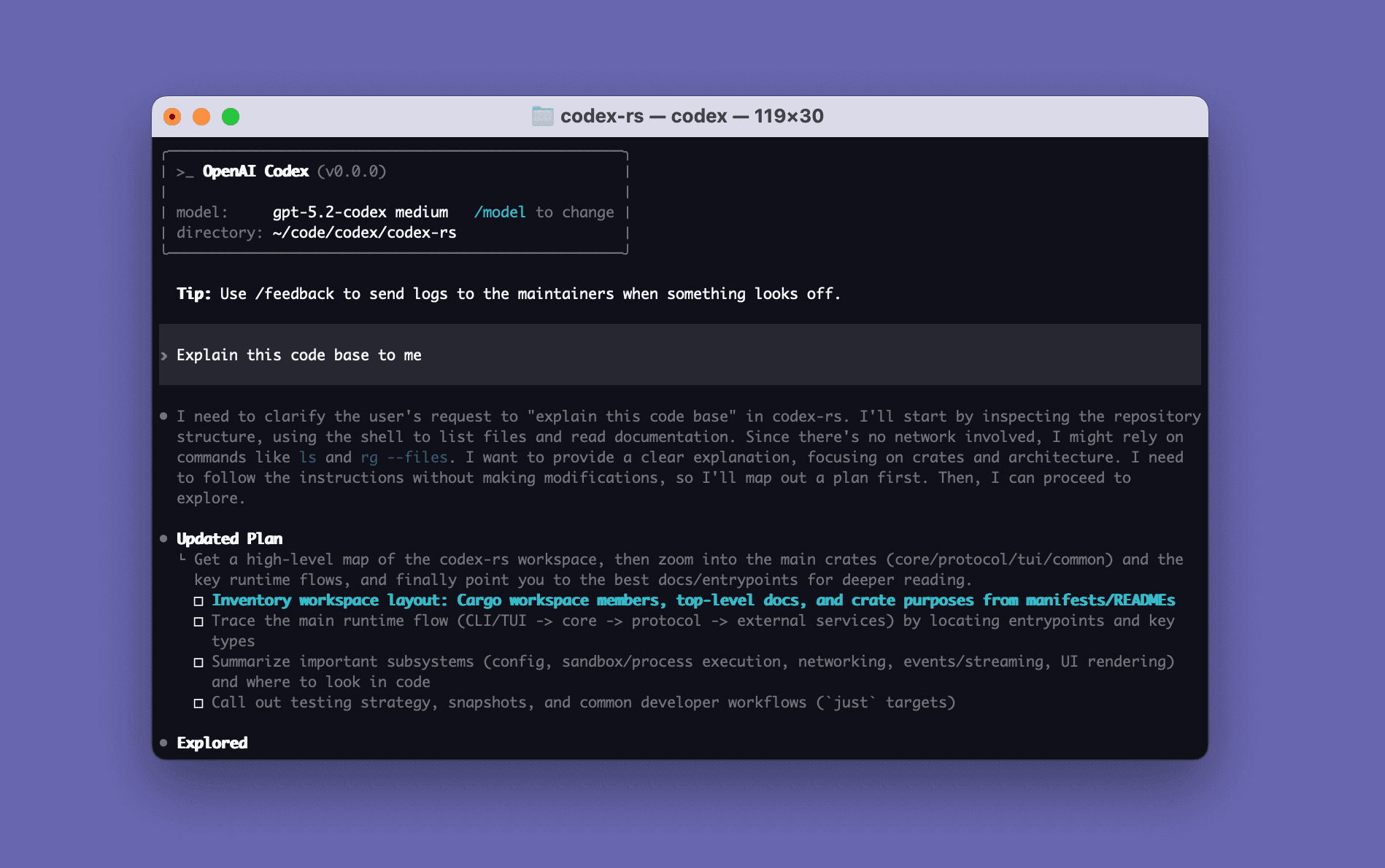
Top 3 GitHub repositories for terminal code agents
Compare Codex CLI, OpenCode, and Kilo Code: license, stars, installation, and a usage example from each open-source code agent repository.
5 min
Dicas
5 best GitHub repositories for creating videos with AI
Compare 5 open source repositories for creating videos with AI: ComfyUI, Remotion, LTX-2, MoneyPrinterTurbo, and MoviePy. License, stars, and usage example.
6 min