
Summary
Tether released the QVAC BotPsy-0.8B on November 11, 2026, an open 0.8 billion parameter model for tool calling. The company says it nearly doubles the base model scores on four agent benchmarks. All figures are self-reported.
Tether has released QVAC BotPsy-0.8B, an open model for tool use that, according to the company, nearly doubles the base model's scores across four benchmarks. See the numbers and the limitations.
Tether released the QVAC BotPsy-0.8B on November 11, 2026, an open 0.8 billion parameter model for tool calling. The company says it nearly doubles the base model scores on four agent benchmarks. All figures are self-reported.
Get AI articles in your inbox
Technical curation on models, agents and coding tools. No spam, unsubscribe anytime.
According to Tether's announcement, BotPsy is a 0.8 billion parameter model built to act. It receives a request and the tools an app offers, then turns the request into the right calls, across multiple steps when one is not enough.
It is built on Alibaba's Qwen3.5-0.8B and designed to run on phones, laptops, and desktops. The idea is to process the request on the device itself, without sending emails, calendars, and contacts to third-party servers.
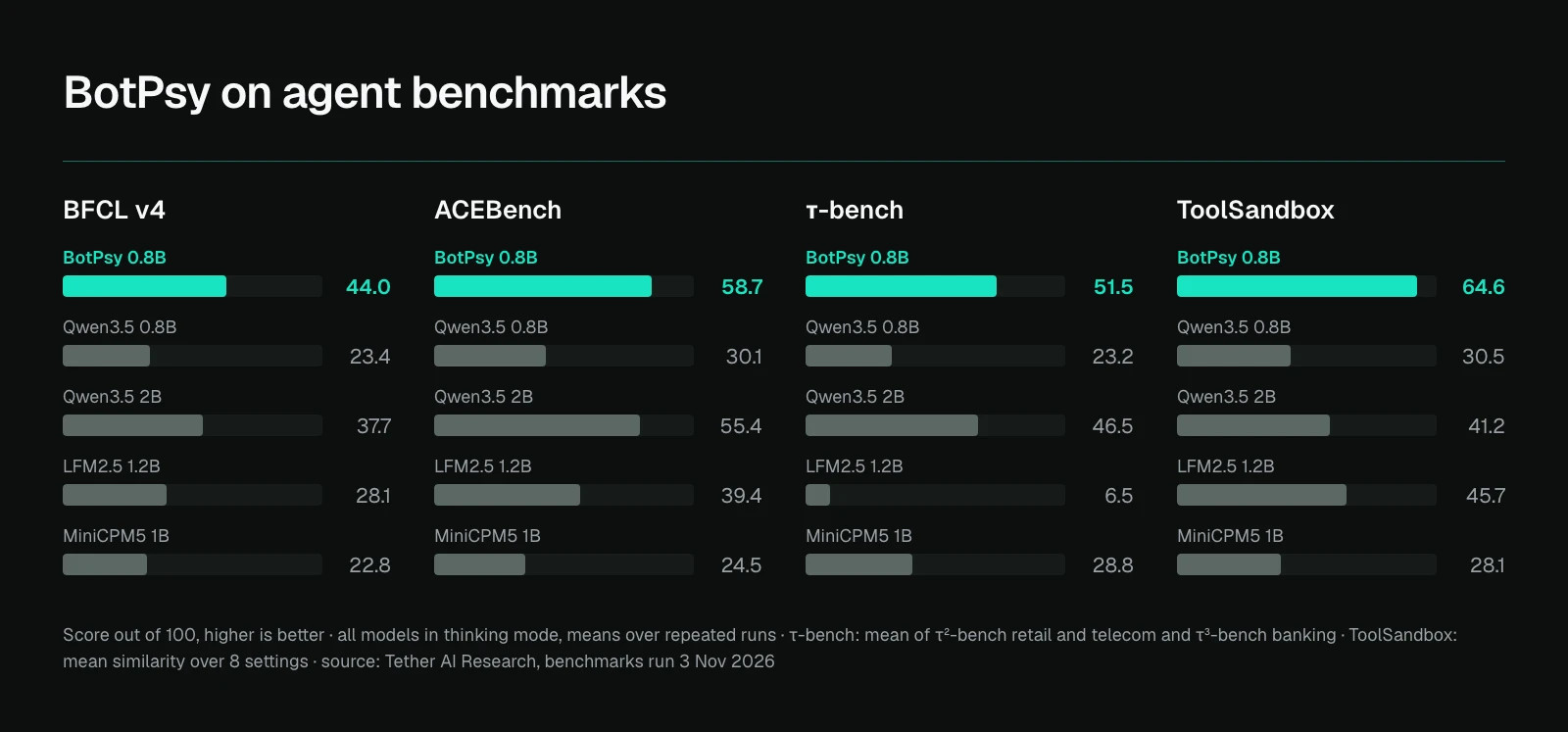
Tether says it tested six benchmarks: BFCL v4, ACEBench, τ-bench, Claw-Eval, BrowseComp-Plus, and ToolSandbox. According to the company, BotPsy leads all tested models up to 1.2 billion parameters.
| Benchmark | Qwen3.5-0.8B-Think | BotPsy-0.8B |
|---|---|---|
| BFCL v4 | 23.4 | 44.0 |
| ACEBench | 30.1 | 58.7 |
| τ-bench | 23.2 | 51.5 |
| ToolSandbox | 30.5 | 64.6 |
On the model page, Tether lists the overall BFCL v4 as follows: BotPsy 44.0, Qwen3.5-2B 37.7, LFM2.5-1.2B 28.1, Qwen3.5-0.8B 23.4, and MiniCPM5-1B 22.8. The company claims it beats Qwen3.5-2B, which is 2.5 times larger.
The biggest difference, according to Tether, appeared in the multi-turn BFCL: 46.1 versus 23.8 for Qwen3.5-2B-Think and 7.5 for the base model. This test measures tool use across successive interactions.
On τ-bench telecom, BotPsy scored 82.5, ahead of MiniCPM5-1B-Think (74.0) and Qwen3.5-2B-Think (69.3). On the BFCL v4 hallucination test, which evaluates whether the model knows not to call a non-existent tool, the score was 86.1, the highest among those tested.
The model page describes four stages: fine-tuning with solved examples, distillation from three larger teacher models, and two rounds of reinforcement learning. Tether abbreviates the pipeline as SFT, MOPD, and RL.
An example from the announcement comes from ACEBench: a message failed because Wi-Fi was off and then because the inbox was full. BotPsy turned Wi-Fi on and freed space before sending, while the base model kept retrying the same send.
Weights are open under Apache 2.0 and available on Hugging Face. The full-precision version (BF16) is 1.73 GB, and the GGUF version for llama.cpp is 2.86 GB, with BF16 and 8-bit options.
Tether notes that the model keeps the Qwen3.5 architecture, so llama.cpp and Hugging Face libraries run it without custom code. Training code and training data are not part of the release, according to the official model page.
Tether itself limits use to low-to-medium difficulty tasks such as alarms, calendar, email, search, and maps. Research requiring many sequential searches remains hard for a model of this size. The company also does not recommend it for high-stakes decisions.
We could not verify the Claw-Eval and BrowseComp-Plus scores, which appear in the technical documentation, and we did not review the full model card on Hugging Face. None of the comparisons have been independently reproduced.
Our recommendation is to assemble 20 to 30 real requests from your app, with the tools it actually exposes, including cases where no tool fits. Measure hits, hallucinated calls, and latency on your device, and compare against the current model.
To read other tool-use tests, see the tau2-Bench Airline and the Kimi K3.1 Pro debut on Agent Arena. To understand how role division affects agents, read RoleRouteBench.
According to Tether, it is an open 0.8 billion parameter model based on Qwen3.5-0.8B, trained to turn requests into tool calls, including multi-step ones.
The company reports BFCL v4 from 23.4 to 44.0, ACEBench from 30.1 to 58.7, τ-bench from 23.2 to 51.5, and ToolSandbox from 30.5 to 64.6, compared to Qwen3.5-0.8B-Think.
Yes. The weights are open under Apache 2.0 and free on Hugging Face, in BF16 (1.73 GB) and GGUF (2.86 GB). Code and training data have not been released.
According to the official page, low to medium difficulty tasks such as alarms, calendar, email, messaging, search, weather, media, maps, and shopping.
No. The scores are published by Tether and have not been reproduced by us. Test with your own tools before adopting.
BotPsy shows the path of specializing small models for a single function, accepting clear limits in exchange for running close to the user. The question remains how it behaves with your tools, in your languages, and on your hardware.
Testing a tool-use model requires simulating many apps and scenarios, each with its own state and files. If one test alters another's environment, a correct call can look wrong and the result loses credibility.
Evaluating multiple tool-use configurations calls for AI agents in parallel, each in its own isolated space. Run your agents on bridgecode.
Source: Tether, QVAC BotPsy and QVAC, BotPsy model page

Developer and creator of bridgecode, an agentic development environment for orchestrating squads of AI agents. Helps people going from vibe coding to professional development move from idea to shipped product.

ByteDance released Axion 1.0, an open agent model recipe with two SFT stages and RL. See the reported results, what the repository includes, and the limitations.
Ai2 released RoboTrack-Bench and RoboTracker. Leading trackers lose 3.0 to 6.6 AJ on real robotic manipulation videos. See the method and limitations.
inclusionAI released Ling-3.2-air: 124B total, 5.5B active, 1M context, MIT license, and 23 on the Intelligence Index. See the numbers and the limits.