
Ai2 published on 11/23/2026 RoboTrack, a benchmark and a training dataset for point tracking in robotic manipulation. The core finding: leading trackers score significantly lower on real robot videos than on older benchmarks.

Benchmarks5 min
RoboTrack-Bench: point trackers fall short in real-world robotics
Ai2 released RoboTrack-Bench and RoboTracker. Leading trackers lose 3.0 to 6.6 AJ on real robotic manipulation videos. See the method and limitations.
The biggest AI newsletter in the World
Get AI articles in your inbox
Technical curation on models, agents and coding tools. No spam, unsubscribe anytime.
Ai2 also released two models, RoboTracker and RoboTracker-Warp. This post covers the method, the numbers, and the limits of what was measured.
In this article you will see:
- what RoboTrack-Bench is and how it was built
- how much each tracker lost on the new test
- what the RoboTracker models improve
- the limits Ai2 itself acknowledges
What is RoboTrack-Bench, Ai2's point tracking benchmark
Point tracking is the task of picking a point in a video frame and estimating where it appears in subsequent frames, including when it disappears behind another object and when it reappears. Robots use this to learn from demonstrations and guide movements.
RoboTrack-Bench has 307 human-annotated videos, with 2,522 point trajectories. The videos come from the DROID, Ego-Exo4D, MolmoAct 2, and EgoVerse datasets and show robots and human hands in cluttered scenes, in first and third person.
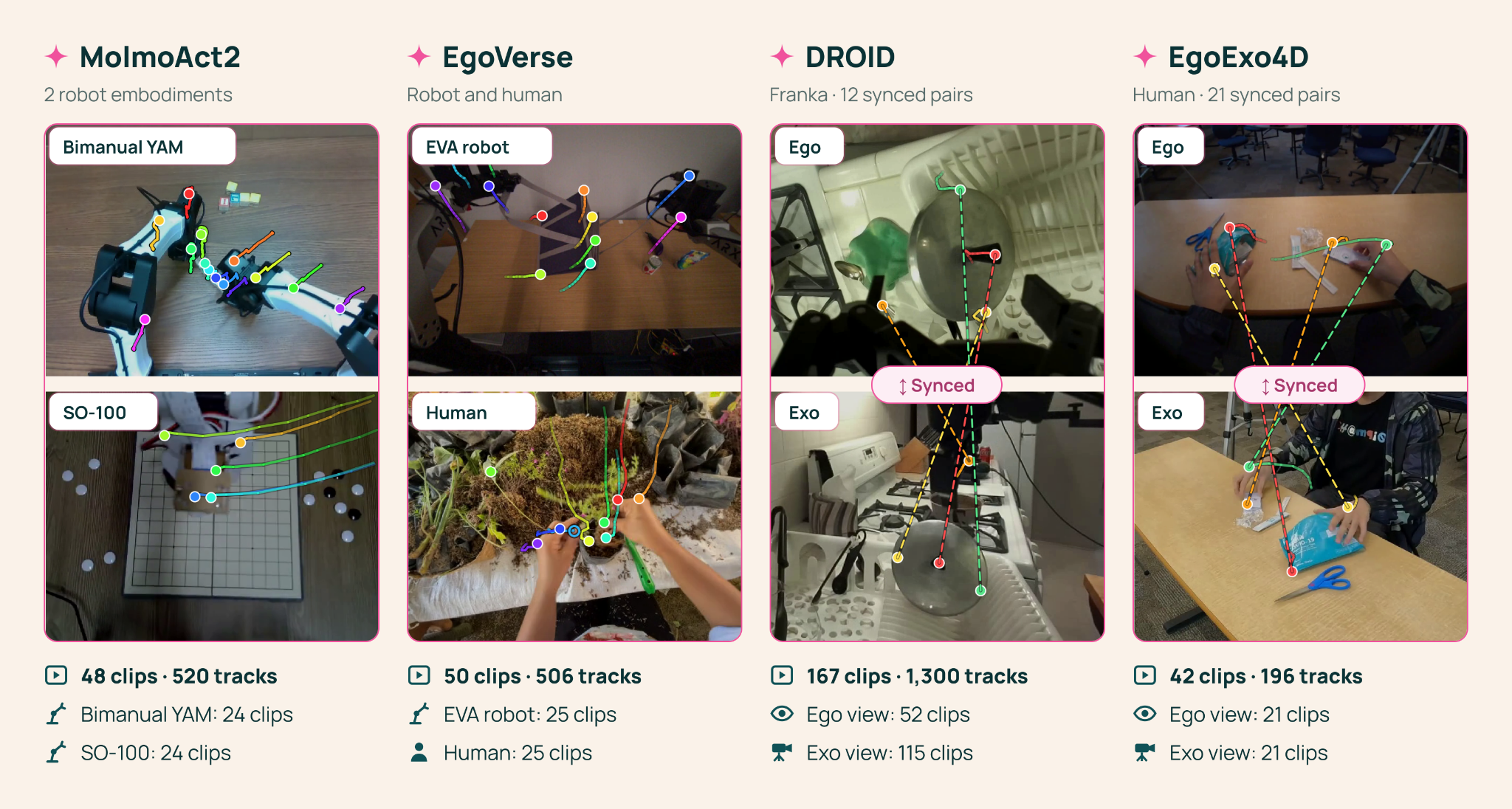
Each trajectory was annotated by one person and verified by another group, frame by frame. Annotators prioritized points that move or become occluded, not the static background points that make up the majority of robot videos.
The benchmark also includes 33 pairs of videos recorded simultaneously by two cameras, useful for research on cross-view point correspondence.
How Ai2 tested: Average Jaccard across five benchmarks
Ai2 evaluated four leading trackers: CoTracker3, BootsTAPNext, AllTracker, and CoWTracker. Each ran with its authors' own settings and was scored the same way.
Tests ran on RoboTrack-Bench and four other benchmarks: RoboTAP (real tabletop manipulation), RGB-Stacking (simulated), DAVIS, and Kinetics (general video). The metric is Average Jaccard (AJ), which measures position accuracy and visibility prediction. Higher is better.
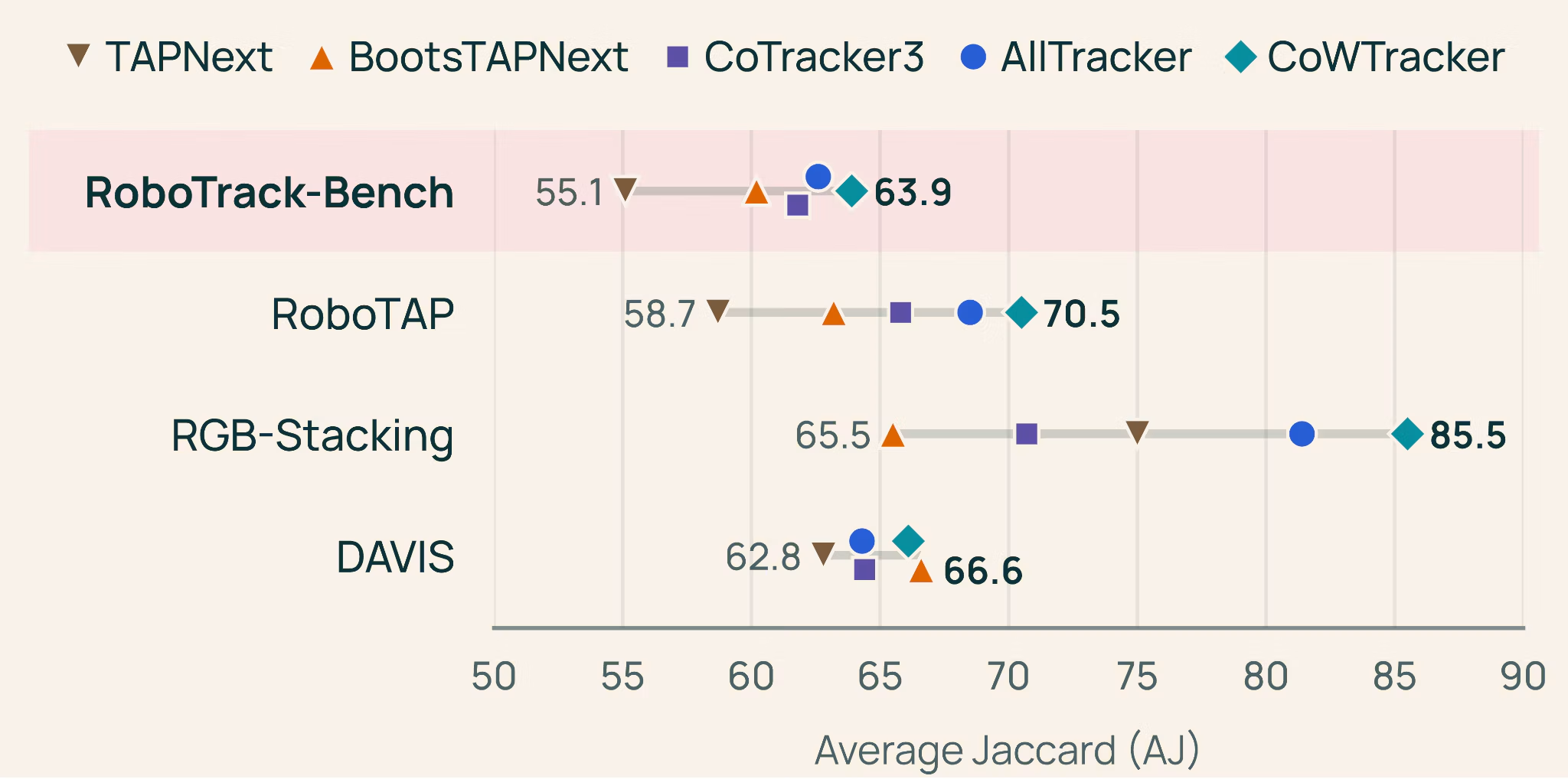
Trackers lose 3.0 to 6.6 AJ on real robotics test
All evaluated trackers scored lower on RoboTrack-Bench than on RoboTAP, the only other robotics benchmark with real video. The drop ranged from 3.0 to 6.6 AJ.
The best off-the-shelf tracker, CoWTracker, went from 70.5 AJ on RoboTAP to 63.9 on RoboTrack-Bench.
Leaders on old tests don't repeat the feat
CoWTracker beats CoTracker3 by 4.7 AJ on RoboTAP, but by only 2.1 AJ on RoboTrack-Bench. AllTracker's advantage drops from 2.7 to 0.8 AJ.
BootsTAPNext is the strongest on DAVIS, but trails CoWTracker by 3.7 AJ on the new test. It also loses to AllTracker trained only on synthetic Kubric data: 60.2 versus 61.4 AJ.
RGB-Stacking rewards synthetic data
Training BootsTAPNext on 15 million real videos raised RoboTrack-Bench by 5.1 AJ (from 55.1 to 60.2). On RGB-Stacking, based on simulated blocks, the same swap dropped the score by 9.5 AJ (from 75.0 to 65.5). In other words, the old benchmark ranks models opposite to real video.
RoboTracker and RoboTrack-15M: what improves with simulation data
Ai2 extended MolmoSpaces, its simulation environment, to generate RoboTrack-15M. That is 3,000 videos from 300 simulated houses, with 5,000 trajectories per video, totaling 15 million trajectories, without human annotation.
Then it fine-tuned two existing trackers with this data plus the original training:
- RoboTracker, based on AllTracker, with 17 million parameters
- RoboTracker-Warp, based on CoWTracker, with about 1 billion parameters
On RoboTrack-Bench, RoboTracker rose from 62.6 to 63.4 AJ and RoboTracker-Warp from 63.9 to 66.0 AJ. On general video, both stay on par with the base models. RoboTracker-Warp achieves the highest AJ on four of the five benchmarks, and the exception is DAVIS.
One methodological finding stands out: the first version of the synthetic data brought no gain at all. The reason was that points were sampled on walls and furniture, which do not move. Only by sampling points on the robot and on manipulated objects did the motion distribution approach that of real video.
Practical test: lab pipetting with 20 layouts
Ai2 also tested RoboTracker on a robot that pipettes liquid between two vials, learning from a single demonstration. There were 20 vial layouts, 10 with free view and 10 with partial occlusion.
- Point tracking: 17 of 20 complete runs
- Object masks (SAM3): 8 of 20
- Optical flow (RAFT): 5 of 20
Tracking succeeded on all 10 free-view cases and 7 of 10 with occlusion, while the mask method succeeded on only 1 with occlusion. This is a small sample, from a single scenario.
RoboTrack limits and what is still missing
Ai2 itself lists the failures that persist: long occlusions, re-acquiring points that reappear, and tracking small objects on cluttered backgrounds. Training on RoboTrack-15M helps, but does not solve them.
There are other caveats. RoboTracker-Warp weights are for non-commercial use only. The simulation covers picking everyday objects, not fine motions like pipetting. The numbers come from Ai2's own report, and Ai2 notes that it fixed a scoring bug in the AllTracker evaluation code, so its values differ slightly from the published ones.
How to test RoboTrack today
The models are in the RoboTrack collection on Hugging Face. The benchmark and the training set are at RoboTrack-Bench and RoboTrack-15M, and the code is on Ai2's GitHub.
To compare this kind of result with other open models, see the Ling-3.2-air analysis on the Intelligence Index and the latest model news in the bridgecode benchmarks category. If you want to follow code model releases, also read the post about Z.ai's GLM-5.4.
Frequently asked questions about Ai2's RoboTrack
What is RoboTrack-Bench?
It is an Ai2 benchmark for point tracking in robotic manipulation. It contains 307 videos with 2,522 human-annotated and verified trajectories, sourced from DROID, Ego-Exo4D, MolmoAct 2, and EgoVerse.
How much do trackers lose on RoboTrack-Bench?
They lose 3.0 to 6.6 AJ relative to RoboTAP. CoWTracker, the best off-the-shelf tracker, dropped from 70.5 to 63.9 AJ.
What is RoboTracker-Warp?
It is CoWTracker, with about 1 billion parameters, fine-tuned on RoboTrack-15M. It went from 63.9 to 66.0 AJ on RoboTrack-Bench, but its weights are for non-commercial use only.
What is Average Jaccard (AJ)?
It is the metric that measures the accuracy of each point's estimated position and the prediction of when it is visible. Higher values indicate a better tracker.
Are the RoboTrack results independent?
No. The numbers come from Ai2's own report, with no independent reproduction as of the publication date of November 23, 2026. The pipetting test used 20 layouts in a single scenario.
What RoboTrack changes for model evaluators
The lesson goes beyond robotics: a saturated or synthetic benchmark can invert the true ranking of models. Before choosing a tracker, or any model, it is worth testing with data similar to your use case.
RoboTrack-Bench provides a tougher, open-source ruler for that, and shows there is still large room for improvement on occlusion and small objects.
It is not just code. At bridgecode you orchestrate AI agents to create, develop, and operate whatever you imagine.
Source: Ai2
Tags:#benchmark#robótica#Ai2#point tracking#RoboTracker

Developer and creator of bridgecode, an agentic development environment for orchestrating squads of AI agents. Helps people going from vibe coding to professional development move from idea to shipped product.
Related articles
Benchmarks
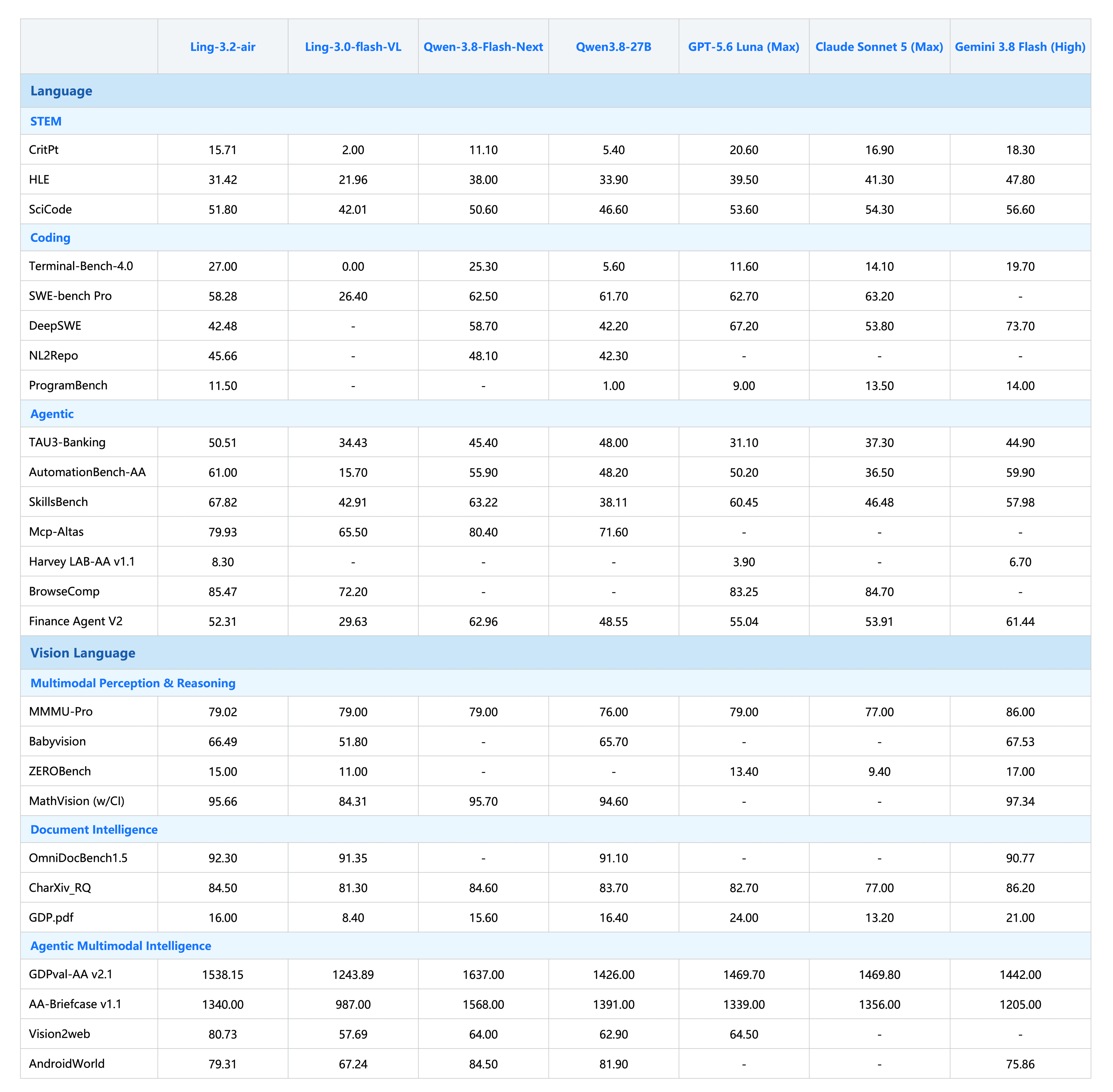
Ling-3.2-air scores 23 on Intelligence Index with 5.5B active
inclusionAI released Ling-3.2-air: 124B total, 5.5B active, 1M context, MIT license, and 23 on the Intelligence Index. See the numbers and the limits.
5 min
Benchmarks
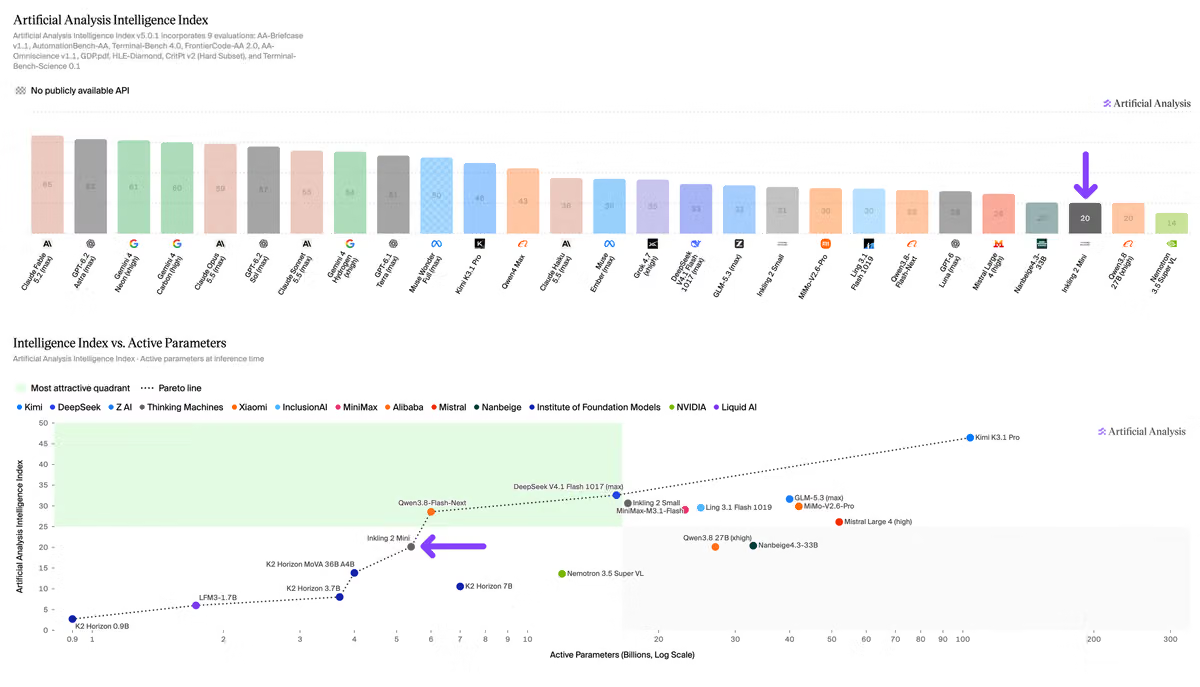
Inkling 2 Mini scores 20 on Intelligence Index with 5.4B active parameters
Artificial Analysis measured the Inkling 2 Mini, an open model from Thinking Machines: 20 on the Intelligence Index, 5.4B active parameters, and a per-task cost six times lower than Qwen3.8 27B.
5 min
Benchmarks
Nemotron 3.5 Bolt: 21 benchmarks and 2.74x faster
Nemotron 3.5 Bolt E4B 4GB from NVIDIA: a 4 GB model with the highest average across 21 benchmarks and 2.74x faster decoding speed with DFlash.
5 min