
The Ling-3.2-air, an open model from inclusionAI (Ant Group), appeared on November 23, 2026 with 23 points on the Artificial Analysis Intelligence Index v5.0.1. It has 124B total parameters and only 5.5B active per token, which weighs on runtime.
Benchmarks5 min
Ling-3.2-air scores 23 on Intelligence Index with 5.5B active
inclusionAI released Ling-3.2-air: 124B total, 5.5B active, 1M context, MIT license, and 23 on the Intelligence Index. See the numbers and the limits.
The biggest AI newsletter in the World
Get AI articles in your inbox
Technical curation on models, agents and coding tools. No spam, unsubscribe anytime.
The number matters because Artificial Analysis places it well above the median of 5 among open models of similar size. But part of the results comes from the company itself, and that changes how to read each score.
In this article you will see:
- What Ling-3.2-air is and its spec sheet
- Which benchmarks rose compared to its predecessor
- What independent measurement says and where it stops
- How to run the model today with SGLang or vLLM
What is Ling-3.2-air, inclusionAI's open model
Ling-3.2-air splits the native multimodal architecture of Ling-3.0-flash-VL. This means vision is part of the model, not an external module bolted on later.
According to the model card on Hugging Face, it uses a hybrid linear architecture with Mixture of Experts. Mixture of Experts is the design where each token passes through only a subset of experts, not the entire network.
There are 512 routed experts, 1 shared, and 8 activated per token. The layers combine 35 KDA blocks with 7 Gated MLA attention blocks, in a 5-to-1 ratio.
Ling-3.2-air spec sheet
The sheet below combines the model card and the Artificial Analysis analysis page.
- Parameters: 124B total, 5.5B active per token
- Context: 1 million tokens
- Input and output: text and image in, text out
- Reasoning: yes, with toggleable thinking mode
- License: MIT, commercial use permitted
- Weights: Hugging Face and ModelScope
Artificial Analysis does not list a public API for it. Therefore the page does not show cost per task or time per task, and the model is designed for self-hosting.
Ling-3.2-air results: what rose compared to the predecessor
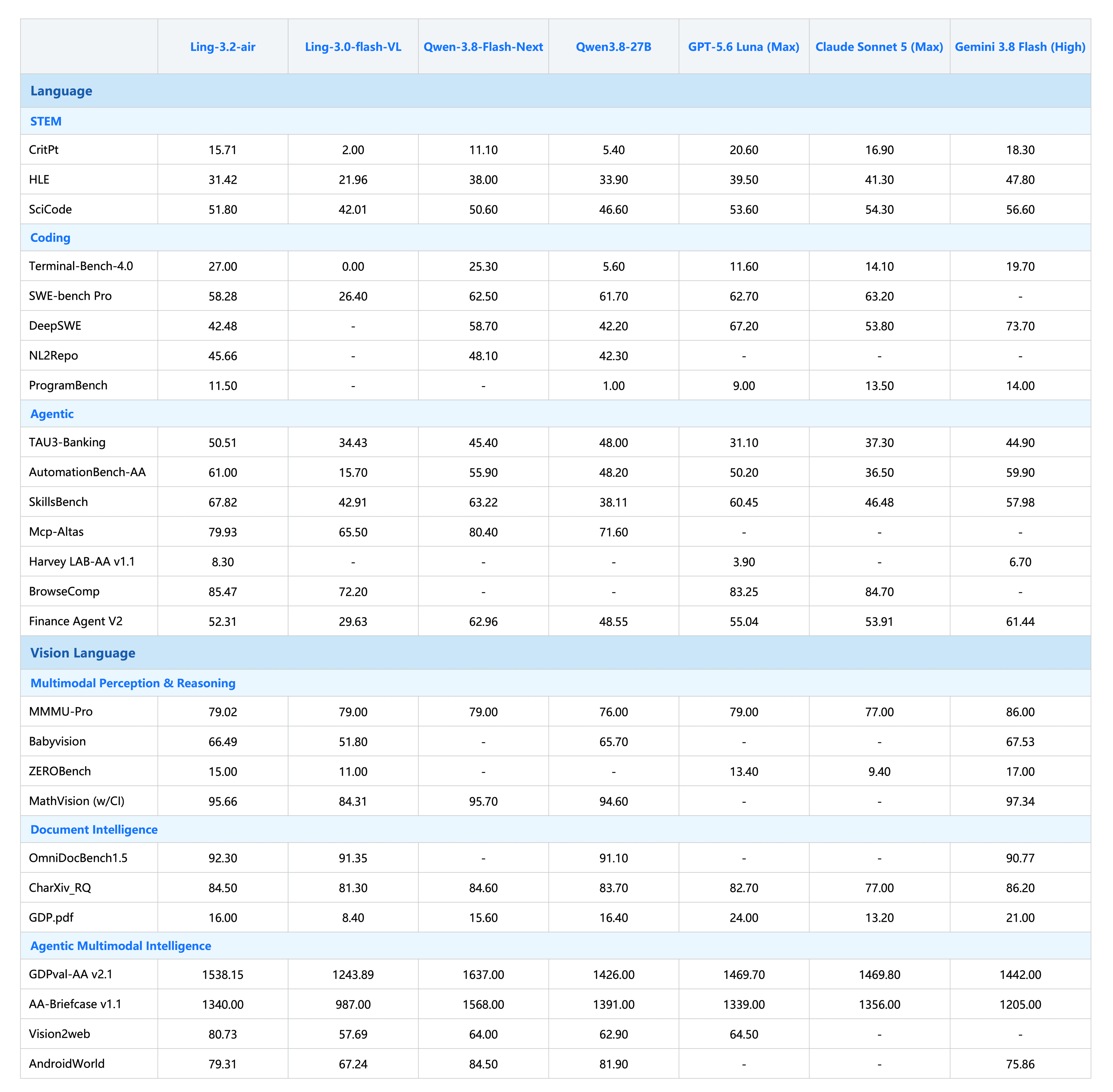
The model card compares Ling-3.2-air with Ling-3.0-flash-VL. The gains are large, but they are numbers released by inclusionAI itself.
- AutomationBench-AA: from 15.7% to 61%
- GDP.pdf (total accuracy rate): from 8.4% to 16%
- AA-Briefcase v1.1: Elo from 987 to 1340, a gain of 353 points
- Terminal-Bench 4.0: from 0% to 27% of terminal tasks
AutomationBench-AA measures workflow automation. GDP.pdf evaluates reasoning over professional documents, and Terminal-Bench 4.0 measures tasks performed on the command line.
In the legal domain, the model scores 87.7% of criteria met on Harvey LAB-AA v1.1. The total pass rate is 8.3% before the material hallucination check and 0.8% after it.
This last pair is the most useful data point in the batch. It shows that meeting most criteria does not mean delivering a document without serious error.
What Artificial Analysis measured independently
The score of 23 on the Intelligence Index v5.0.1 comes from Artificial Analysis measurement. The index aggregates 9 evaluations: AA-Briefcase, AutomationBench-AA, Terminal-Bench 4.0, FrontierCode-AA 2.0, AA-Omniscience, GDP.pdf, HLE-Diamond, CritPt v2, and Terminal-Bench-Science 0.1.
The page places Ling-3.2-air first among comparable open models it compares on screen, ahead of Nemotron 3.5 Super VL, Mistral Medium 3.5, Mistral Small 4, and gpt-oss-120b (high).
There is a cost to consider: the model generated 199 million tokens to complete the index, against a median of 72.4 million. The analysis classifies it as very verbose, and that weighs on time and GPU spend.
To compare with another recent open model, see the analysis of Inkling 2 Mini, which scored 20 on the same index. There, cost per task is a central point.
How to run Ling-3.2-air today with SGLang and vLLM
The model card recommends SGLang, with a Docker image that already includes support for Ling-3.2-air and MTP speculative decoding. Speculative decoding is the technique where a fast draft proposes tokens and the large model validates them.
Terminal
docker pull lmsysorg/sglang:dev-Ling-3.0-flash-VLThe recommended recipe uses 256K context on 4 GPUs with 141 GB, such as H20-3e or H200, or on 4-GPU Blackwell nodes. On 80 GB cards like H100, the guidance is to scale up to --tp 8.
vLLM is also supported, but via a project fork, the inclusionAI vllm-ling-v3 repository. The recommended sampling settings are temperature 1.0, top_p 0.95, and top_k 20, with enable_thinking enabled.
This is not a notebook model. Those looking for something smaller can check out the Nemotron 3.5 Bolt, at 4 GB, or the open family described in K2-Horizon.
Limits: what still cannot be claimed
The gains from 15.7% to 61% and from 0% to 27% come from the model card, with no independent reproduction so far. Treat them as directional, not as guarantees.
There is also no published API pricing in the analysis, and the score of 23 measures general capability, not performance in Portuguese or on your code. Before switching models, run your own task suite.
Frequently asked questions about inclusionAI's Ling-3.2-air
What is Ling-3.2-air?
It is an open model from inclusionAI, Ant Group's AI arm, with 124B total parameters and 5.5B active per token. It accepts text and images and has a 1 million token context window.
What is Ling-3.2-air's score on the Intelligence Index?
23 points on the Artificial Analysis Intelligence Index v5.0.1. The analysis places it well above the median for open models of similar size, which is 5.
Does Ling-3.2-air have a free license?
Yes. The license is MIT, which permits commercial use, and the weights are on Hugging Face and ModelScope.
What hardware does Ling-3.2-air require?
The model card's recommended recipe uses 4 GPUs with 141 GB (H20-3e or H200) or 4-GPU Blackwell nodes with 256K context. On 80 GB cards, the recommendation is to use tensor parallel 8.
Are Ling-3.2-air's numbers independent?
Partly. The Intelligence Index is from Artificial Analysis, but the gains over its predecessor come from inclusionAI's own model card and have not yet been independently reproduced.
What changes for those building agents with open models
An MIT-licensed model with 5.5B active parameters and 1M context expands the options for automation and document analysis workflows, provided you have data center GPUs on hand.
The watchout is verbosity: more tokens per task mean longer execution time. Measure this in your case before scaling.
From draft to production-ready: split the work among specialist agents and track every step in bridgecode.
Source: Hugging Face
Tags:#Ling-3.2-air#inclusionAI#Ant Group#modelo aberto#benchmark

Developer and creator of bridgecode, an agentic development environment for orchestrating squads of AI agents. Helps people going from vibe coding to professional development move from idea to shipped product.
Related articles

Benchmarks
RoboTrack-Bench: point trackers fall short in real-world robotics
Ai2 released RoboTrack-Bench and RoboTracker. Leading trackers lose 3.0 to 6.6 AJ on real robotic manipulation videos. See the method and limitations.
5 min
Benchmarks
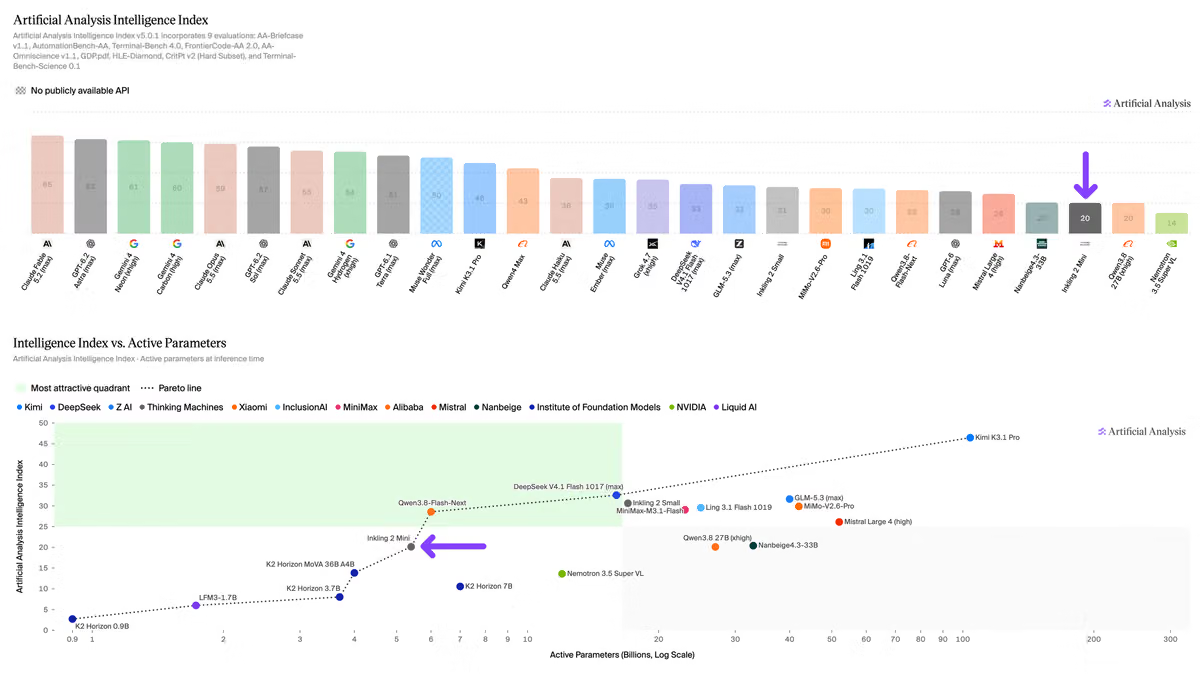
Inkling 2 Mini scores 20 on Intelligence Index with 5.4B active parameters
Artificial Analysis measured the Inkling 2 Mini, an open model from Thinking Machines: 20 on the Intelligence Index, 5.4B active parameters, and a per-task cost six times lower than Qwen3.8 27B.
5 min
Benchmarks
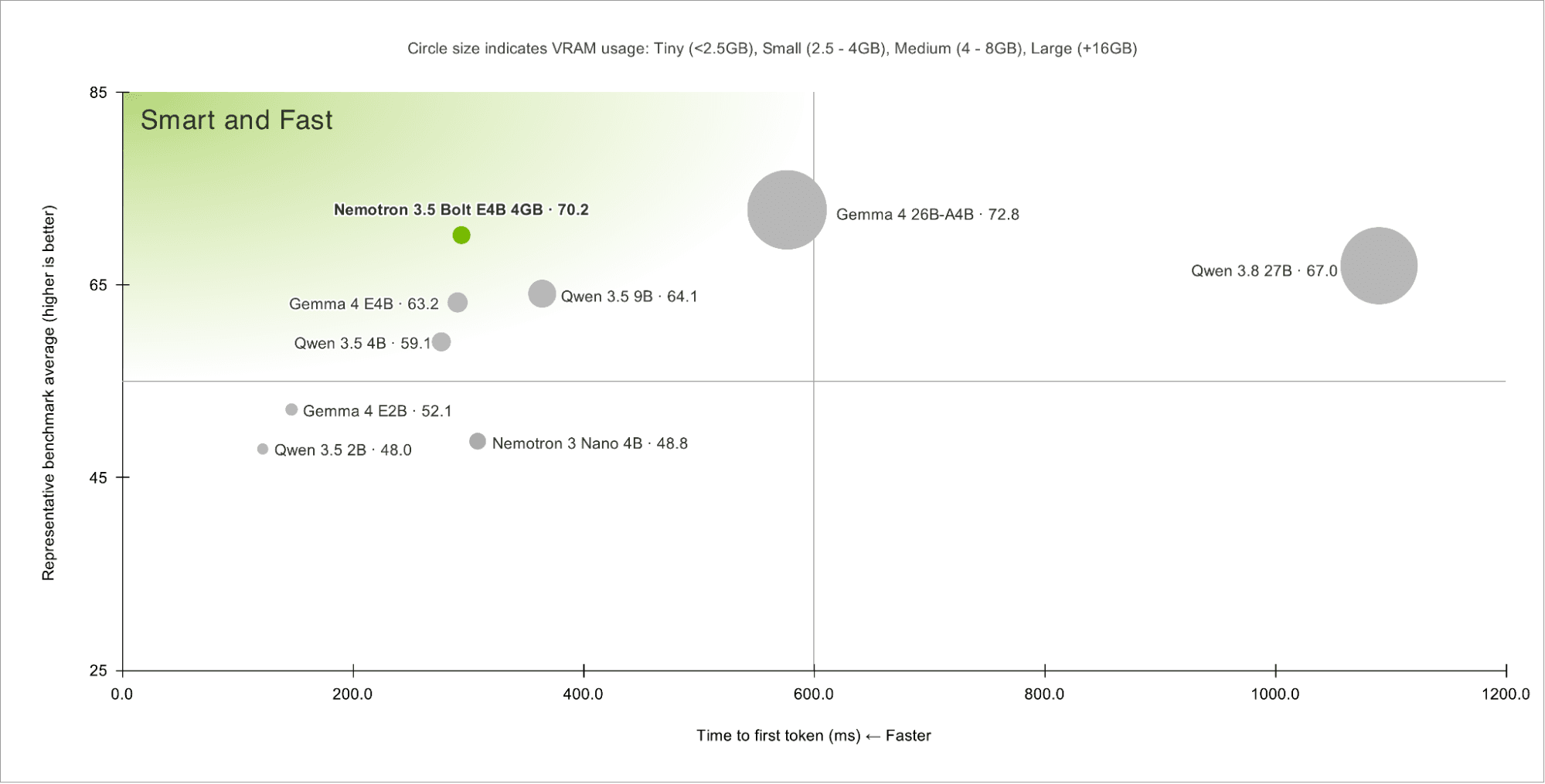
Nemotron 3.5 Bolt: 21 benchmarks and 2.74x faster
Nemotron 3.5 Bolt E4B 4GB from NVIDIA: a 4 GB model with the highest average across 21 benchmarks and 2.74x faster decoding speed with DFlash.
5 min