
Summary
MiniMax released H3-Image on November 11, 2026, an open-weight image generation and editing model. The company says it generates a 4K image in under 10 seconds and accepts up to 16 reference images. The figures come from the company itself.

MiniMax has launched H3-Image, an open-weight image model that, according to the company, generates 4K in under 10 seconds. See the numbers, the license, and the limits. Company-reported 4K medians: 16.0 s on Standard and 10.3 s on Highspeed.
MiniMax released H3-Image on November 11, 2026, an open-weight image generation and editing model. The company says it generates a 4K image in under 10 seconds and accepts up to 16 reference images. The figures come from the company itself.
Get AI articles in your inbox
Technical curation on models, agents and coding tools. No spam, unsubscribe anytime.
H3-Image is an open image model built on top of MiniMax's H3. According to the official announcement, it handles text-to-image, reference-based generation, and image editing.
On the Hugging Face page, MiniMax explains that generation and editing are unified in a single checkpoint. It creates images from text and edits one or more reference images without needing to switch models between the two tasks.
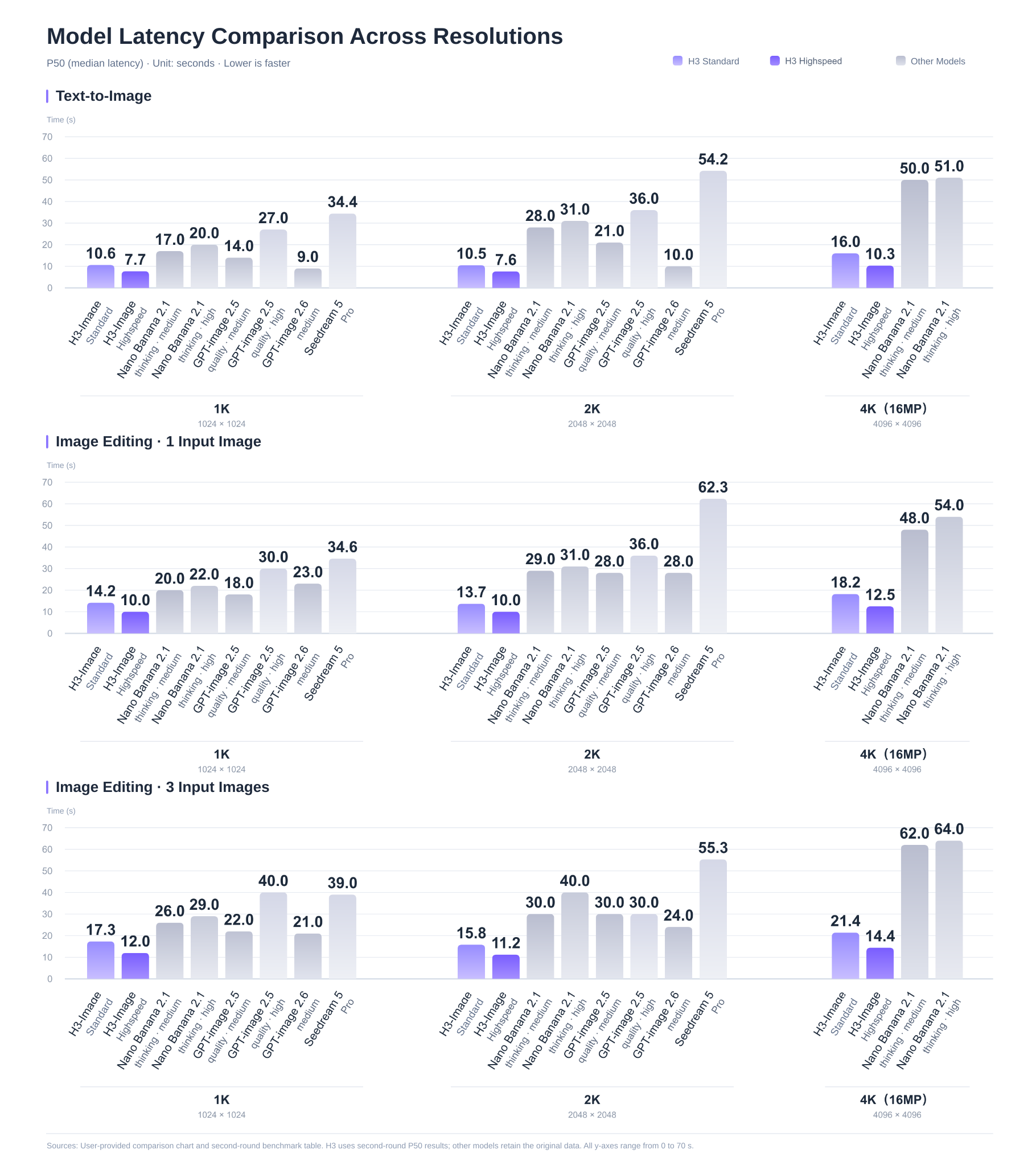
The company claims the model generates a 4K image, 4096 by 4096 pixels, in under 10 seconds, at up to 5x the speed of common alternatives. It compares against 1K or 2K outputs, which carry far less detail.
In the official chart, the company-reported medians (P50) for text-to-image at 4K are 16.0 s in Standard mode and 10.3 s in Highspeed mode.
In the technical documentation, MiniMax states outputs of roughly 16 megapixels at any aspect ratio, from 4096x4096 (1:1) to 6272x2688 (21:9), directly and without an upscaler. The checkpoint is distilled to 6 sampling steps, without classifier-free guidance.
The diffusion transformer has 33.1 billion parameters, 50 layers, and a dense single-stream architecture, the same as H3 minus the audio layers. The text encoder is Qwen3-VL from MiniMax-H3, unchanged.
The main model weights are 68.65 GB in BF16. The text encoder, at 66.7 GB, sits outside the repository and comes from MiniMax-H3. There is also an optional prompt expander, H3-Image-PE, at 17.9 GB in NVFP4.
The Hugging Face page lists the license as minimax-h3-image-community-license-agreement. It is not Apache 2.0, so read the terms before using in a commercial product. This point is not detailed in the announcement.
To run locally, MiniMax recommends SGLang, vLLM-Omni, diffusers, LightX2V, DiffSynth-Studio, and ComfyUI. The vLLM-Omni recipe cites NVIDIA accelerators such as H200 and RTX PRO 6000 Blackwell, and AMD accelerators such as Instinct MI350X.
Besides the weights, H3-Image is available on the MiniMax API, in MiniMax Code, and in Hailuo AI. The company says Standard mode is 1.5 to 2x faster than common alternatives, and Highspeed reaches 3 to 4x.
The stated price is 50% to 70% of comparable offerings. During launch week, there is a 50% discount off the standard price for 4K or higher orders. The announcement does not provide dollar values or the list of competitors used.
MiniMax claims H3-Image has the best instruction following among open models, but the consulted pages do not show a table, score, or ranking to back that statement. There is also no named comparison or prompts used in the speed tests.
For this reason, we treat speed, price, and quality as company claims. The sub-10-second claim is not accompanied, on these pages, by the hardware used for the measurement. Without that data, you cannot compare against your own GPU.
Our recommendation is to set up a short test with 10 prompts from your real work, including text inside the image and editing with references. Run at 4K and at 1K, note the time on your machine, and compare with the model you use today.
To see how other image evaluations are read, check out MAI Image 2.7 on Artificial Analysis and Arena and VIALS-AA. For open models and their limits, see Vals CyberOffense.
According to MiniMax, it is an open-weight image model built on H3 that handles text-to-image, reference-based generation, and editing in a single checkpoint.
The company claims it generates a 4K (4096 x 4096) image in under 10 seconds, up to 5 times faster than common alternatives. This is a company-reported figure, with no detailed hardware information on the pages consulted.
The Hugging Face page lists the minimax-h3-image-community-license-agreement, not Apache 2.0. Read the terms before using in commercial products.
The main model is 68.65 GB in BF16, and the text encoder, at 66.7 GB, comes from the MiniMax-H3 repository. There is an optional prompt expander of 17.9 GB.
According to MiniMax, pricing is 50% to 70% of comparable offerings, with a 50% discount on 4K or higher during launch week. The announcement does not provide dollar values.
H3-Image puts high resolution and open weights in the same release, but its custom license and large files require planning before any adoption. The right decision comes from measuring time and quality on your infrastructure.
Comparing image generators in batch means running multiple configurations at the same time, each with its own files and results. When everything runs in the same directory, one test overwrites another and the comparison loses value.
Comparing image models in batch calls for parallel AI agents, each in its own isolated space. Orchestrate your agents on bridgecode.
Source: MiniMax, H3-Image and Hugging Face, MiniMax-H3-Image

Developer and creator of bridgecode, an agentic development environment for orchestrating squads of AI agents. Helps people going from vibe coding to professional development move from idea to shipped product.
Tencent has open-sourced Hy-MT3, a translation family with 1.8B, 7B, and 30B-A3B parameters covering 102 languages. See what the numbers say, how they were measured, and the limitations.
Cognition released SWE-2.1: 50.0 on Terminal-Bench 4.1 and 41.3 on FrontierCode 2.0, versus 24.2 and 24.1 for SWE-2. See the numbers, method, and limits.
Ai2 released RoboTrack-Bench and RoboTracker. Leading trackers lose 3.0 to 6.6 AJ on real robotic manipulation videos. See the method and limitations.