
Tencent open-sourced Hy-MT3, the third generation of its translation model family, on November 24, 2026. The standout is Hy-MT3-30B-A3B, which activates only 3 billion parameters per token and, according to the company, leads among models evaluated in non-reasoning mode.
Benchmarks6 min
Tencent's Hy-MT3: translation in 102 languages, open
Tencent has open-sourced Hy-MT3, a translation family with 1.8B, 7B, and 30B-A3B parameters covering 102 languages. See what the numbers say, how they were measured, and the limitations.
The biggest AI newsletter in the World
Get AI articles in your inbox
Technical curation on models, agents and coding tools. No spam, unsubscribe anytime.
The number that catches the eye is the coverage jump: from 38 to 102 languages. The weights are on Hugging Face and ModelScope.
In this article you will see:
- What Hy-MT3 is and what sizes exist
- What the benchmark shows and how it was measured
- The limits of the published numbers
- How to test the model today
What is Hy-MT3, Tencent's open translation family
Hy-MT3 comprises three models: 1.8B, 7B, and 30B-A3B. The last uses Mixture of Experts, an architecture where only a portion of the parameters (here, about 3 billion) is activated for each generated token, reducing inference cost.
Each size has an FP8 quantized version and a GGUF version for llama.cpp. Quantization is the compression of weights so the model fits in less memory, with a small precision loss.
According to the official Hugging Face page, the new generation translates with more accuracy, completeness, and fidelity to user instructions than Hy-MT2, released in May.
Hy-MT3 on the benchmark: what Tencent measured
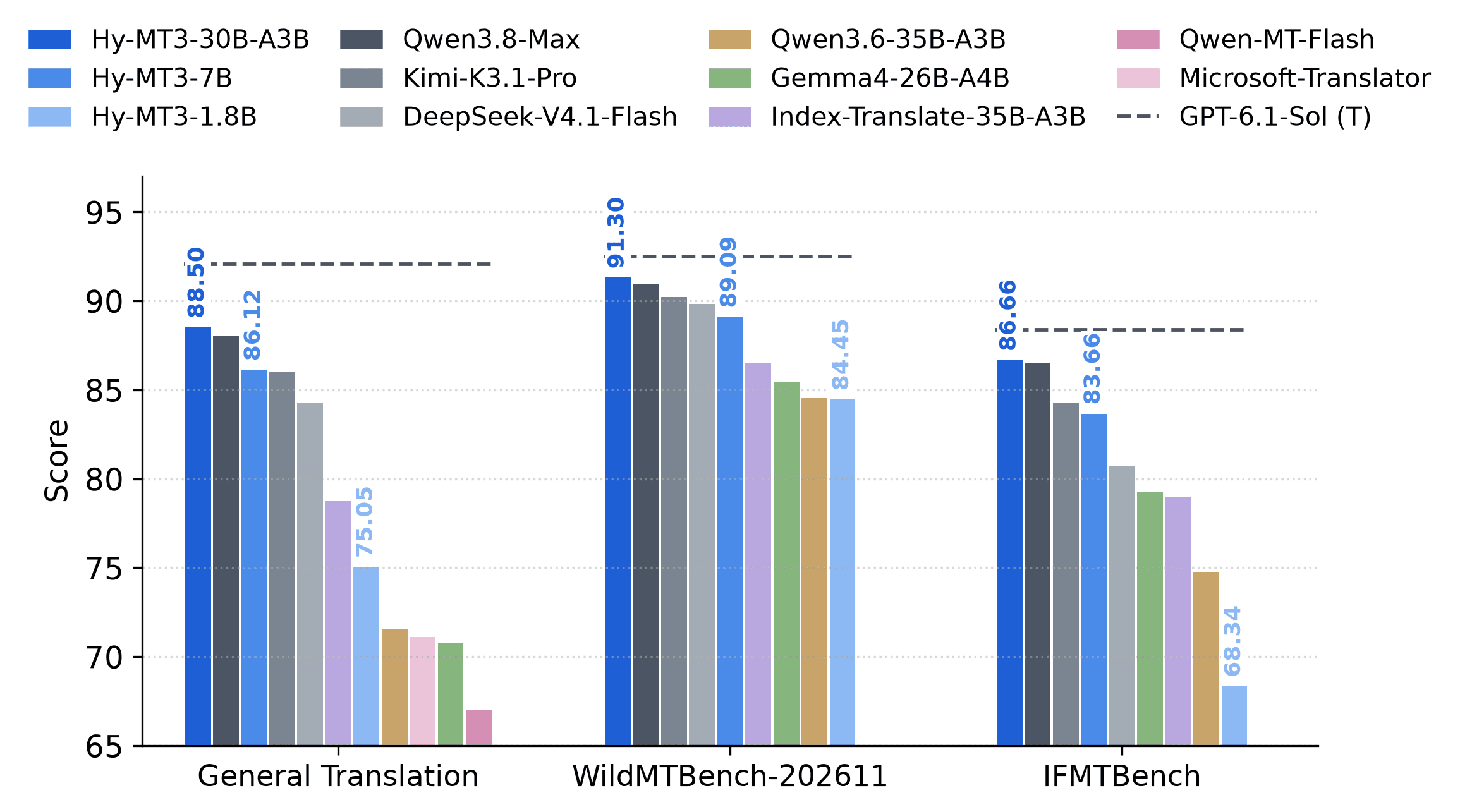
Tencent compares the model on three fronts. The first is general translation, an average of FLORES-200, FLORES-200 low-resource languages, WMT26, and translation between Mandarin and minority languages.
The second is WildMTBench-202611, built with recent real-world scenario data. The third is IFMTBench, which measures whether the translation follows instructions such as terminology, style, and delimiters.
General translation and WildMTBench are scored by TransRubric, an automatic rubric-based evaluation suite that Tencent also open-sourced on GitHub. All models in the chart run without reasoning, except those marked with (T).
Hy-MT3-30B-A3B results against larger models
Tencent claims the 30B-A3B has the best overall performance among models evaluated in non-reasoning mode. Among them are Qwen3.8-Max, Kimi-K3.1-Pro, and DeepSeek-V4.1-Flash.
Regarding the strongest closed models with reasoning, such as GPT-6.1-Sol and Gemini-4-Argon, the company says only that Hy-MT3 gets close. In other words, there is no claim of victory in that group.
Efficiency: under 1 TFLOP per sample
The second chart relates translation quality and inference compute per sample, estimated as 2 times active parameters times generated tokens.
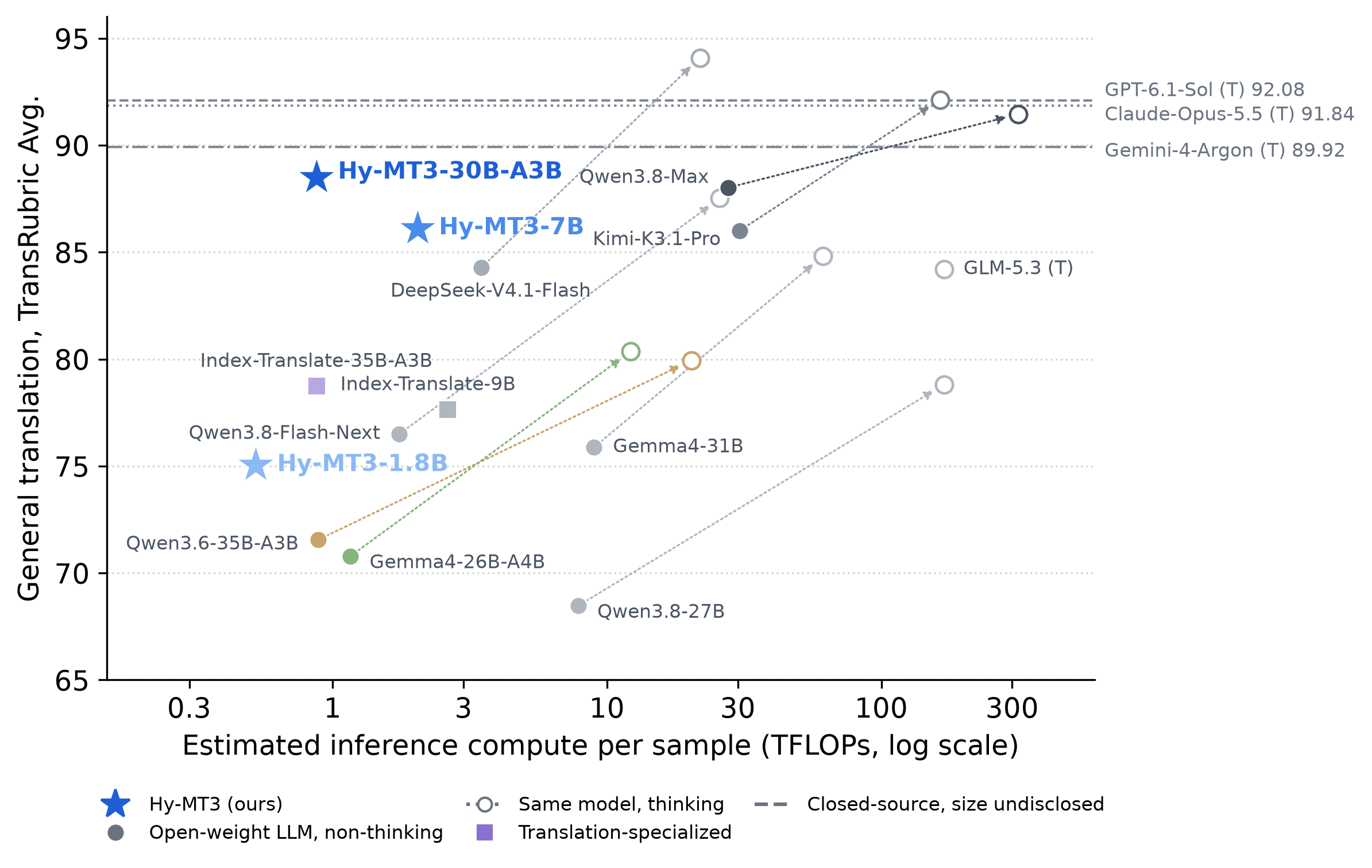
By this measure, the 30B-A3B requires less than 1 TFLOP per sample and outperforms models that consume more than 30 times that compute. The lightweight 1.8B model, according to Tencent, also beats commercial APIs such as iFlytek Translator, Microsoft Translator, and Qwen-MT-Flash in general translation.
Fewer errors than Hy-MT2
Against Hy-MT2, on real-world scenario data, Tencent reports a 43% drop in the share of samples with translation errors. Omissions or additions fall 74%, and instruction errors fall 40%.
What Hy-MT3 was optimized for: games and image translation
There are two industrial use cases in focus. In game localization, the model was built with data and an evaluation system from the Honor of Kings team.
Tencent says the 30B-A3B matches or surpasses closed models such as Gemini 3.1 Pro on core metrics: target language error, placeholder error, rich text error, and terminology error. It can enter game pipelines via TiMiHOKGameTranslator.
The second use case is cascaded image translation with OCR. The model tolerates OCR errors better and, according to the company, achieves the best result among comparable-sized models on VISTA-Bench.
Limits of Hy-MT3 numbers
All results come from Tencent itself. The main score uses TransRubric, created by the same team, and the company claims it outperforms other methods on the WMT26 shared metrics task test. This does not replace an independent evaluation.
In addition, the set of compared models was chosen by Tencent, and the efficiency chart uses a compute estimate, not real latency measurement. Low-resource languages may vary widely in quality.
If translation is part of your product, run your own texts, with your glossary and your languages, before switching models. For other code benchmarks, see the analysis of Cognition's SWE-2.1 and Inkling 2 Small. More comparisons are in the blog's Benchmarks category.
How to test Hy-MT3 today
The official page lists three approaches. With transformers (version 5.6.0 or higher), loading uses AutoModelForCausalLM with trust_remote_code=True. Review the remote code before running in a sensitive environment.
With vLLM, the documentation says to build from source and start the server:
Terminal
vllm serve tencent/Hy-MT3-30B-A3B --tensor-parallel-size 1With SGLang, also built from source:
Terminal
python3 -m sglang.launch_server --model tencent/Hy-MT3-30B-A3B --tp 1The default prompt asks for the target language spelled out and that only the translation be returned. There are instruction models for terminology, style, customization, and delimiter preservation.
The technical report is on arXiv. The license does not appear in the consulted page excerpt, so check the license file in the repository before commercial use.
Frequently asked questions about Tencent's Hy-MT3
What is Tencent's Hy-MT3?
It is the third generation of Tencent's Hy multilingual translation models. The family comes in three sizes (1.8B, 7B, and 30B-A3B) and covers 102 languages, up from 38 in Hy-MT2.
Is Hy-MT3 better than GPT-6.1 Sol?
No, according to Tencent itself. The 30B-A3B model leads among those evaluated in non-reasoning mode, but it only approaches the best closed reasoning models such as GPT-6.1 Sol and Gemini 4 Argon.
How to run Hy-MT3 locally?
Via the transformers library (version 5.6.0 or later), vLLM, or SGLang. FP8 and GGUF versions for llama.cpp are also available, which reduces the cost of running on your own hardware.
Are Hy-MT3's results independent?
No. The numbers come from Tencent and use TransRubric, an evaluation tool created by the team itself. It's worth rerunning the test with your own texts and languages.
What changed compared to Hy-MT2?
On real-world scenario data, Tencent reports 43% fewer samples with translation errors, 74% fewer omissions or additions, and 40% fewer instruction-following errors.
What Hy-MT3 changes for those building AI products
A 3B active-parameter model that translates 102 languages and runs on your own hardware changes the equation for anyone localizing apps, documentation, and games. The decision is no longer just about quality; it now includes cost per sample.
The prudent approach is to build your own test set, compare Hy-MT3 with the service you use today, and measure terminology errors and omissions.
Selling a digital product or service? Build an agent squad on bridgecode that works with you every day.
Source: Tencent Hy on Hugging Face
Tags:#Hy-MT3#Tencent#tradução#modelo aberto#benchmark

Developer and creator of bridgecode, an agentic development environment for orchestrating squads of AI agents. Helps people going from vibe coding to professional development move from idea to shipped product.
Related articles
Benchmarks
Ling-3.2-air scores 23 on Intelligence Index with 5.5B active
inclusionAI released Ling-3.2-air: 124B total, 5.5B active, 1M context, MIT license, and 23 on the Intelligence Index. See the numbers and the limits.
5 min
Benchmarks
Cognition's SWE-2.1: Terminal-Bench 4.1 and FrontierCode
Cognition released SWE-2.1: 50.0 on Terminal-Bench 4.1 and 41.3 on FrontierCode 2.0, versus 24.2 and 24.1 for SWE-2. See the numbers, method, and limits.
5 min
Benchmarks
RoboTrack-Bench: point trackers fall short in real-world robotics
Ai2 released RoboTrack-Bench and RoboTracker. Leading trackers lose 3.0 to 6.6 AJ on real robotic manipulation videos. See the method and limitations.
5 min