Zyphra has open-sourced ZONOS3-Mini, a TTS model with voice cloning and an 800M-parameter MoE (100M active) under Apache 2.0. See latency, features, and limits, according to the company.
Zyphra open-sourced ZONOS3-Mini on November 9, 2026, a voice model (TTS) with voice cloning, mixture of experts, and an Apache 2.0 license. It has 800 million total parameters and roughly 100 million active per token. The figures come from the company.
The biggest AI newsletter in the World
Get AI articles in your inbox
Technical curation on models, agents and coding tools. No spam, unsubscribe anytime.
Table of Contents
What is ZONOS3-Mini
Reported latency and throughput
Voice cloning and controls
Architecture in brief
Where to run it
What could not be confirmed
How to test
What is ZONOS3-Mini
According to Zyphra, ZONOS3-Mini is a compact text-to-speech model with zero-shot voice cloning, designed to run in real time on the device itself. It is a sparse mixture-of-experts (MoE) model under Apache 2.0.
The company reports 800 million total parameters and 100 million active, trained on 112 NVIDIA H100 GPUs for 2.5 days. The Hugging Face page lists support for 43 languages, including Portuguese, and cites the technical report on arXiv under number 2611.16525.
Reported latency and throughput
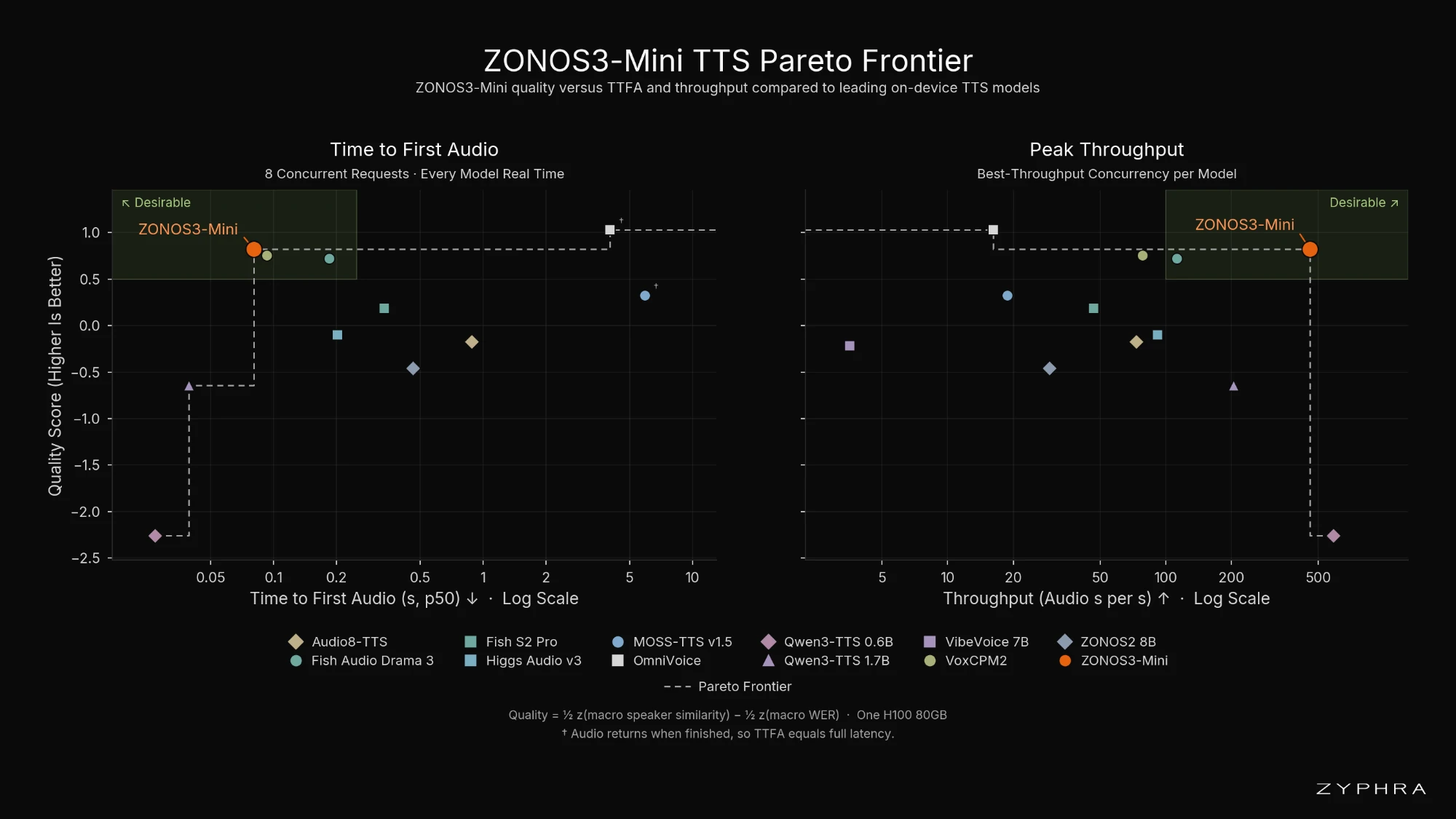
Zyphra states that the model runs in real time in the browser, with under 570 ms to first audio on a Pixel 9 and under 150 ms on a MacBook Air M3. These are the numbers from the launch post.
On Hugging Face, the measurement on an 80 GB H100 shows a median of 80 ms to first audio with 8 concurrent requests. The reported peak throughput is 457 seconds of audio per second. Both data points are disclosed by the company.
Imagem: Zyphra
Voice cloning and controls
To clone a voice, the official example uses a 5 to 10 second reference clip. The documentation says the speaker prompt accepts up to 60 seconds of audio and that generation reaches up to 10 minutes of audio.
It is also possible to design a voice by adjusting age, accent, and vocal texture, as well as emotion and pacing, even on individual words. The company mentions word-level delivery control, with demos in audio samples on the page.
Architecture in brief
Text passes through normalization and an 8,192-entry SuperBPE tokenizer. The language model generates audio frames at 15 Hz, with 10 codebooks, and a causal iSTFT head renders audio at 44.1 kHz.
The backbone has 11 layers, with 9 Gated DeltaNet layers and 2 global attention layers. According to Zyphra, the MoE has 64 experts with top-2 routing. For comparison, the company notes that ZONOS2 used 8 billion parameters and an 86 Hz codec.
Where to run it
Zyphra cites runtimes for browser via WebGPU, servers with SGLang and vLLM, and execution via GGML, plus a CUDA server and an MLX server for Apple Silicon. There is also hosted access via Zyphra Cloud.
SGLang-Omni serves the model at the /v1/audio/speech endpoint, compatible with the OpenAI API, with streaming and cloning from a reference audio clip, no transcription required. The weights are on Hugging Face.
What could not be confirmed
Zyphra describes ZONOS3-Mini as state-of-the-art and compares samples with Fish Audio, Qwen, Cartesia, ElevenLabs, and OmniVoice, but the main comparison is by ear. The full ZTTS2 index tables were not legible on the pages we opened.
For that reason, we do not cite speaker similarity scores or word error rates. We also did not verify the Zyphra news list, because the news URL did not load. The November 9 date comes from the model page itself.
How to test
Our recommendation is to test with 20 sentences from your domain, including proper nouns and numbers in Portuguese. Clone two voices with short clips, measure the time to first audio on your machine, and ask listeners to compare with your current TTS.
Frequently asked questions about Zyphra's ZONOS3-Mini
What is ZONOS3-Mini?
+
According to Zyphra, it is a text-to-speech model with zero-shot voice cloning, a sparse mixture of experts, 800 million total parameters and 100 million active, under Apache 2.0.
How many languages does it support?
+
The Hugging Face page lists 43 languages, including Portuguese, English, Spanish, French, German, Mandarin, Japanese, and Hindi.
What is the reported latency?
+
The company reports under 570 ms to first audio in a Pixel 9 browser and under 150 ms on a MacBook Air M3, plus a median of 80 ms on an H100 with 8 concurrent requests.
Does ZONOS3-Mini clone voices?
+
Yes. The model clones a voice from a reference clip and allows adjusting age, accent, texture, emotion, and pacing, according to Zyphra.
Can I use it for free and run it locally?
+
Yes. The weights are released under Apache 2.0 on Hugging Face, and Zyphra also offers hosted access via Zyphra Cloud.
Conclusion
ZONOS3-Mini bets on efficiency: few active parameters, permissive license, and execution even in the browser. The practical gain depends on your language, your voices, and the hardware, and only a local test tells whether the promise holds.
A voice test involves a lot of repetition: multiple voices, languages, and settings, each generating its own files. Mixing everything in a single folder makes it hard to know which configuration produced which audio.
Comparing voices and languages in batch calls for parallel AI agents, each in its own isolated space. Try bridgecode.
Developer and creator of bridgecode, an agentic development environment for orchestrating squads of AI agents. Helps people going from vibe coding to professional development move from idea to shipped product.