
Reson8 opened Rumble-2-Flash on November 18, 2026, a speech recognition model with 0.5 billion parameters, Apache 2.0 license, and support for over 40 languages. According to the company, it competes with models 3 to 60 times its size.

Benchmarks5 min
Rumble-2-Flash: 0.5B open speech model with 6.96% WER
Reson8 has open-sourced Rumble-2-Flash, a 0.5B speech model under Apache 2.0 with 40+ languages. See WER on the Open ASR Leaderboard and in real calls.
The biggest AI newsletter in the World
Get AI articles in your inbox
Technical curation on models, agents and coding tools. No spam, unsubscribe anytime.
For anyone building meeting transcription, phone support, or voice assistants, the key point is the balance between size and error. A small model that runs on Transformers and vLLM without custom code reduces the cost of testing.
In this article you will see:
- What Rumble-2-Flash is and how it was built
- The error rate on the Open ASR Leaderboard and in real calls
- The reported speed and what it means
- How to test the model today
What is Rumble-2-Flash, Reson8's open speech model
Rumble-2-Flash is an ASR model, short for automatic speech recognition: it takes audio and returns text. It has 0.5B parameters, detects language automatically, and covers more than 40 languages.
The model offers output control: numbers as digits or spelled out, speech fillers, verbatim repetitions, and forced language. These adjustments help when the transcription feeds another system, such as search or call analysis.
What the announcement does not include: API pricing in dollars, or an independent comparison. The numbers come from Reson8 and the Open ASR Leaderboard, a public leaderboard on Hugging Face.
How Rumble-2-Flash was made: on-policy distillation with GOLD
The model uses the Qwen3-ASR architecture, which guarantees day-one support. Anyone already running Transformers or vLLM runs Rumble-2-Flash, no modified runtime and no trust_remote_code.
To find out how small the model could get before losing accuracy, Reson8 distilled Rumble-2, its larger production model, into the new model. Distillation is the technique where a smaller model learns from a larger one.
In the on-policy version, the student does not train on transcripts written by the teacher. It transcribes the audio on its own, and the teacher evaluates the text token by token. This way the student is corrected exactly on the errors it makes.
There was an obstacle: this method requires teacher and student to share the tokenizer, and here they do not. Reson8 used GOLD, which merges tokens where the two tokenizers split the text differently, to compare both on the same text.
Rumble-2-Flash on the Open ASR Leaderboard: 6.96% multilingual error
On the multilingual track of the Open ASR Leaderboard, Rumble-2-Flash has an average error rate of 6.96% on Chinese, German, French, Italian, Spanish, Portuguese, Hindi, Dutch, and English. According to Reson8, this beats Meta's omniASR-LLM 7B, which is 15 times larger, and stays ahead of Whisper large-v3.
On the English track, the average is 6.6% WER. WER is word error rate: lower is better. Since Portuguese is on the multilingual list, the result is directly relevant to the Brazilian audience, but the company did not publish a Portuguese-only number in this release.
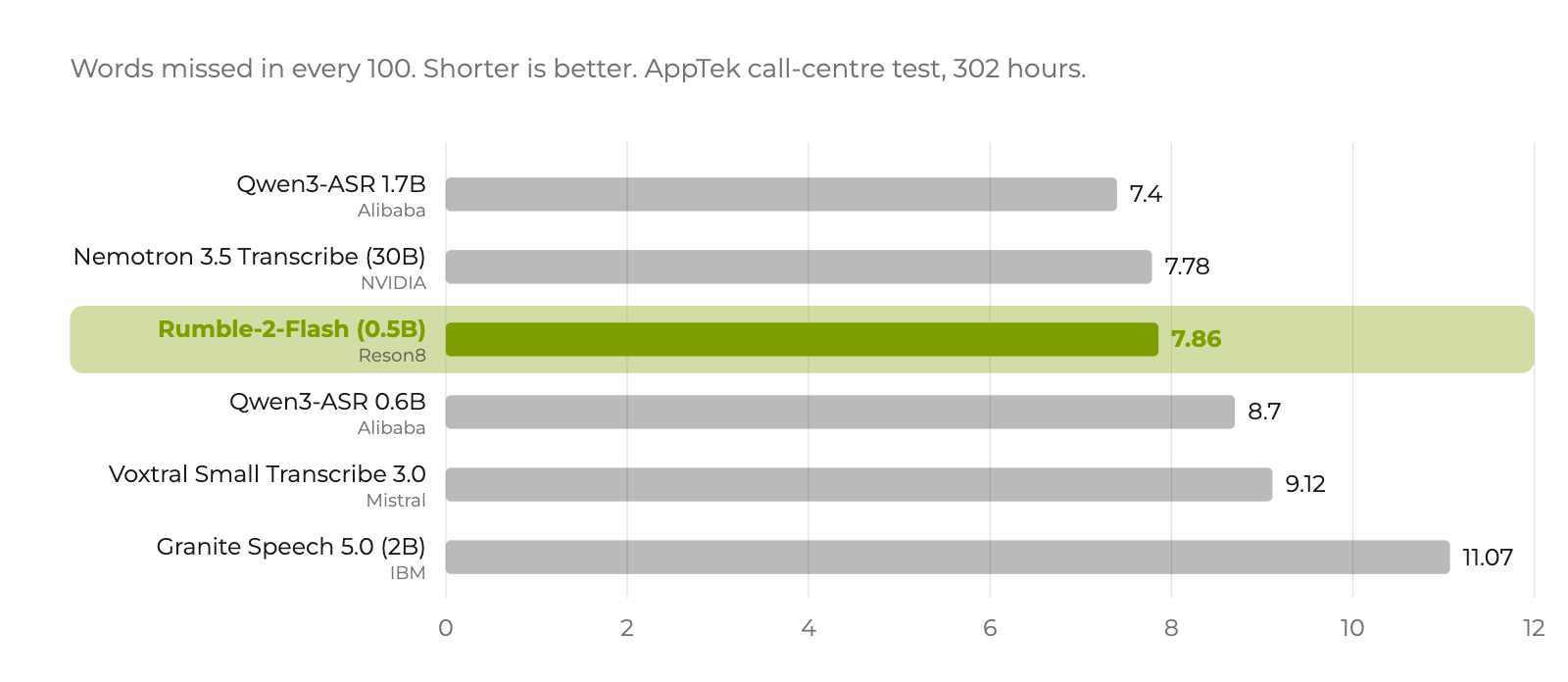
Real calls: 7.86% WER on the AppTek call center benchmark
Clean audio is easy. Phone calls have compression, noise, and varied accents. That is why Reson8 tested the model on the AppTek call center benchmark, with 302 hours of support calls and 14 English accents.
The reported numbers:
- Rumble-2-Flash: 7.86% WER
- Nemotron 3.5 Transcribe (30B), from NVIDIA: 7.78%
- Qwen3-ASR 0.6B: 8.7%
- Qwen3-ASR 1.7B: 7.4%, the only one in the comparison that did better
The result ties a 30B model and comes close to Qwen3-ASR 1.7B. Worth noting that the scoring uses AppTek's own script and covers only English, so validate with your own audio before deciding.
Speed: one hour of audio in about half a second
Throughput depends on how full the batches are. On the larger Open ASR Leaderboard sets, where batches stay full, the model exceeds 7,000 RTFx. RTFx is how many times faster processing is than real-time audio, and 7,000 equals one hour of audio in about half a second.
That is the best-case scenario. In interactive use, with few concurrent requests, speed will be lower, and the company has not disclosed that number.
If you work with voice, it is worth comparing with the Zyphra ZONOS3-Mini test, which does the reverse, text-to-speech. Another small open model is in the QVAC BotPsy test.
How to test Rumble-2-Flash today with Transformers
The weights are on Hugging Face at Reson8/Rumble-2-Flash. There is also a Reson8 API, whose pricing was not checked for this article.
First, install the dependencies:
Terminal
uv pip install torch transformers accelerateThen transcribe an audio file:
Python
from transformers import AutoProcessor, AutoModelForMultimodalLM

model_id = "Reson8/Rumble-2-Flash"
processor = AutoProcessor.from_pretrained(model_id)
model = AutoModelForMultimodalLM.from_pretrained(model_id, device_map="auto")

inputs = processor.apply_transcription_request(
    audio="caminho/ou/url/do/audio.mp3",
    language="Portuguese",  # omita para detectar automaticamente
).to(model.device, dtype=model.dtype)

output = model.generate(**inputs, max_new_tokens=512)
generated = output[:, inputs["input_ids"].shape[-1]:]
print(processor.decode(generated, return_format="transcription_only")[0])
The audio parameter accepts a local path, URL, NumPy array, or a list of them. The official example uses English; switching to Portuguese in the language field follows the same pattern, but confirm the language name in the model card.
Frequently asked questions about Reson8's Rumble-2-Flash
What is Rumble-2-Flash?
It is an open speech recognition model from Reson8, with 0.5B parameters, Apache 2.0 license, and over 40 languages with automatic detection. It uses the Qwen3-ASR architecture.
Does Rumble-2-Flash work in Portuguese?
Yes, on the multilingual Open ASR Leaderboard, which includes Portuguese. The average is 6.96% word error rate, according to Reson8, but there is no Portuguese-specific number in the release.
Is Rumble-2-Flash suitable for phone calls?
According to Reson8, it achieves 7.86% WER on the AppTek call center benchmark, with 302 hours and 14 English accents, virtually tied with the 30B Nemotron 3.5 Transcribe at 7.78%.
How fast is Rumble-2-Flash?
On the large Open ASR Leaderboard sets, with full batches, it exceeds 7,000 RTFx, equivalent to one hour of audio in about half a second. With few concurrent requests, speed tends to be lower.
How to test Rumble-2-Flash?
Download Reson8/Rumble-2-Flash on Hugging Face and load it with Transformers or vLLM, no custom code required. There is also a Reson8 API, with pricing not disclosed in the release.
What Rumble-2-Flash changes for those using speech in products
A 0.5B model with performance close to much larger models lowers the barrier to running transcription locally or on modest GPUs. Apache 2.0 allows commercial use, and native vLLM support makes serving at scale easier.
The limits are clear: the call tests cover English, the numbers come from the manufacturer, and the best rate in the comparison still belongs to a larger model from the same family. Measure on your own audio before replacing what already works.
Your idea could be running with an AI squad. Want to see how?
Source: Reson8
Tags:#Rumble-2-Flash#Reson8#reconhecimento de fala#modelos abertos#benchmark

Developer and creator of bridgecode, an agentic development environment for orchestrating squads of AI agents. Helps people going from vibe coding to professional development move from idea to shipped product.
Related articles
Benchmarks
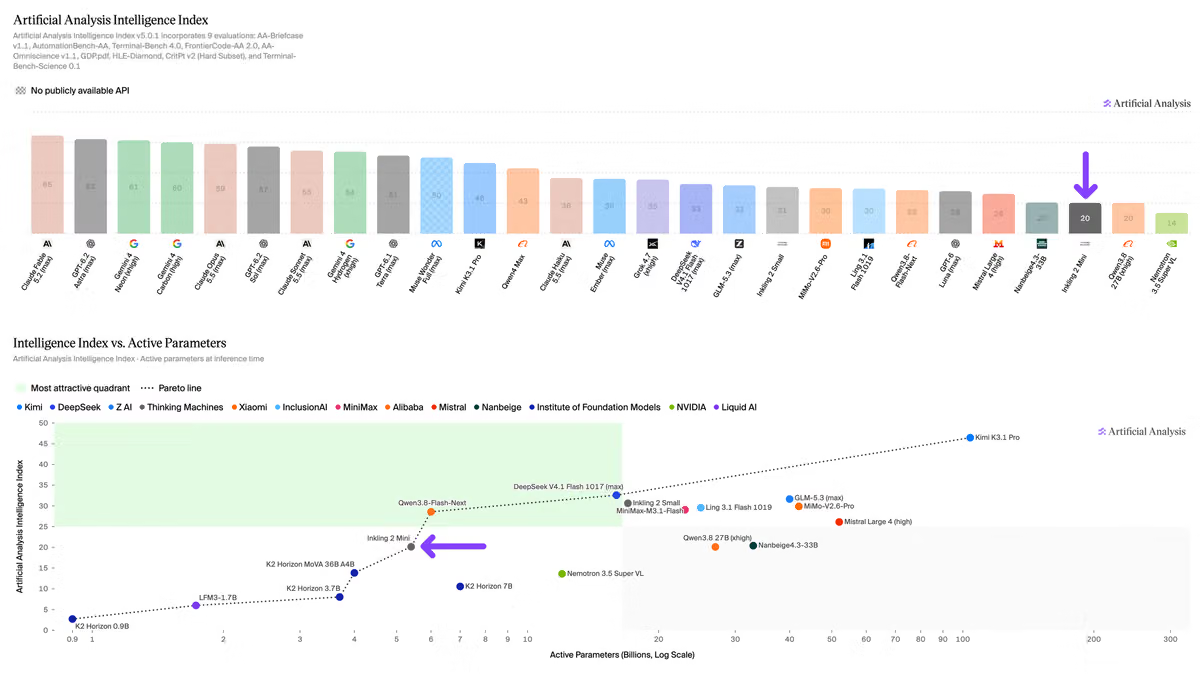
Inkling 2 Mini scores 20 on Intelligence Index with 5.4B active parameters
Artificial Analysis measured the Inkling 2 Mini, an open model from Thinking Machines: 20 on the Intelligence Index, 5.4B active parameters, and a per-task cost six times lower than Qwen3.8 27B.
5 min

Benchmarks
K2-Horizon: 6 open models from 0.9B to 375B-A23B
K2-Horizon: six fully open models, from 0.9B to 375B-A23B, with MoVA and Uno (up to 2.2x faster) and released data and code, according to the paper.
5 min

Benchmarks
DaisyRose-27B: Terminal-Bench 4.1 rises from 5.6% to 12.0%
RadixArk has released DaisyRose-27B, trained with RL on top of Qwen3.8-27B. The pass@1 on Terminal-Bench 4.1 went from 5.6% to 12.0%, according to the company.
5 min