
The Institute of Foundation Models published the K2-Horizon paper on arXiv on November 16, 2026: a family of six fully open language models, ranging from a 0.9B dense model to a 375B MoE with 23B active parameters. The team claims the models lead or compete with open models of comparable size on agent and code benchmarks.

Benchmarks5 min
K2-Horizon: 6 open models from 0.9B to 375B-A23B
K2-Horizon: six fully open models, from 0.9B to 375B-A23B, with MoVA and Uno (up to 2.2x faster) and released data and code, according to the paper.
The biggest AI newsletter in the World
Get AI articles in your inbox
Technical curation on models, agents and coding tools. No spam, unsubscribe anytime.
What makes the release different is transparency. Beyond the final weights, the group releases pre-training data, checkpoints from each stage, logs, and training and evaluation code.
In this article you will see:
- What K2-Horizon is and the six models in the family
- What MoVA attention and Uno adapters are
- What it means to be open source by the LLM360 definition
- How to start testing without a massive GPU
What is K2-Horizon, the open family from the Institute of Foundation Models
K2-Horizon is a fleet of six models designed for general reasoning and agent work: math and science, software engineering, deep research, and office automation. The smallest has 0.9B parameters and is dense. The largest is a 375B MoE with 23B active parameters.
MoE, short for Mixture of Experts, is an architecture where only a portion of the parameters processes each token. That is why a 375B model can have the inference cost of a 23B active model, although it still needs to fit entirely in memory.
Four of the models share the same pre-training corpus, with 22 trillion tokens, and the same recipe. According to the paper, this reveals consistent scaling behavior and enables controlled studies on size and sparsity.
MoVA and softplus gating: K2-Horizon's architectural innovations
To strengthen reasoning, the paper introduces Mixture-of-Value (MoVA) attention, which applies MoE to the value projections of attention. It also brings softplus attention gating, a more flexible gate with theoretical motivation.
The standout result is the 36B model with 4B active parameters, which uses both techniques. According to the authors, it nearly matches a 32B dense model trained on the same data, with one-seventh of the active parameters.
These numbers come from the authors themselves and have not yet been reproduced by third parties. The paper is an arXiv publication, not yet peer-reviewed.
Uno: up to 2.2x faster decoding without a draft model
Another item in the paper is Uno, a set of lossless diffusion adapters that accelerate decoding by up to 2.2x. The difference from traditional speculative decoding is that it does not require a separate draft model.
For those serving models in production, this means fewer components to maintain. "Lossless" indicates the output follows the same distribution as the original model, according to the paper. The gain is up to 2.2x, so actual results depend on the model and workload.
If you follow ways to accelerate inference, it is worth comparing with DaisyRose-27B, which recommends DSpark speculative decoding.
True open source: what the LLM360 definition demands
The release follows the LLM360 definition of open source. In practice, the group releases the full development history:
- Checkpoints: final and intermediate weights from each training stage
- Data: pre-training corpus and the pipelines that generated it
- Logs and code: training, evaluation, and infrastructure, including the xLLM framework for dense and MoE training and the RL360 RL stack
The paper notes that the pipelines produced roughly 10 trillion synthetic pre-training tokens, showing that synthetic data can be a key ingredient at scale. According to the previous round's post, the license is Apache 2.0, except for the TxT360-v2 dataset, which is CC BY 4.0. Check the license for each artifact on the official page before using in production.
For those who want to study how a model is made, not just use it, this is one of the most complete open packages published to date. Compare with other open recipes, such as ByteDance's Axion 1.0.
How to test K2-Horizon today
All artifacts are gathered on the project page and the full paper is on arXiv. The arXiv abstract page does not include a benchmark table, so read the PDF for per-task numbers.
The suggested path is to start with the smaller models, designed for consumer hardware, and only then scale up. The 375B model requires data center infrastructure, and the paper does not disclose API pricing.
A good test roadmap:
- Pick a small model and run it on your own task set
- Compare with the open model you already use, in the same environment
- Only then evaluate the jump to the 36B MoE with 4B active parameters
To measure whether an endpoint preserves the accuracy of an open model, also see the Endpoint Accuracy Index v1.1.
Frequently asked questions about K2-Horizon
What is K2-Horizon?
It is a family of six fully open language models from the Institute of Foundation Models, ranging from a 0.9B dense model to a 375B MoE with 23B active parameters, built for reasoning and agent work.
Is K2-Horizon truly open source?
Yes, according to the paper. The release follows the LLM360 definition and provides final weights, checkpoints from each stage, pre-training data, logs, and training, evaluation, and infrastructure code.
What are the Uno adapters?
They are lossless diffusion adapters that speed up decoding by up to 2.2x without needing a separate draft model, according to the paper.
What is MoVA attention?
It is a technique that applies Mixture of Experts to attention value projections. The 36B model with 4B active parameters that uses it nearly matches a 32B dense model on the same data, according to the authors.
How to try K2-Horizon?
Start with the smaller models, designed for consumer hardware, and download the artifacts from the project page at ifm.ai/k2. The 375B model requires data center infrastructure.
What K2-Horizon changes for those who train and use open models
K2-Horizon expands the supply of end-to-end open models. Consumers gain six sizes to choose from. Researchers gain data, logs, and code to reproduce and question the recipe.
The limits are clear: benchmark numbers come from the authors, the paper has not yet been peer-reviewed, and the giant model does not run on a common machine. Test on your use case before replacing what already works.
What would a team of AI agents do for your business this week? Find out at bridgecode.
Tags:#K2-Horizon#Institute of Foundation Models#modelos abertos#MoE#benchmark

Developer and creator of bridgecode, an agentic development environment for orchestrating squads of AI agents. Helps people going from vibe coding to professional development move from idea to shipped product.
Related articles
Benchmarks
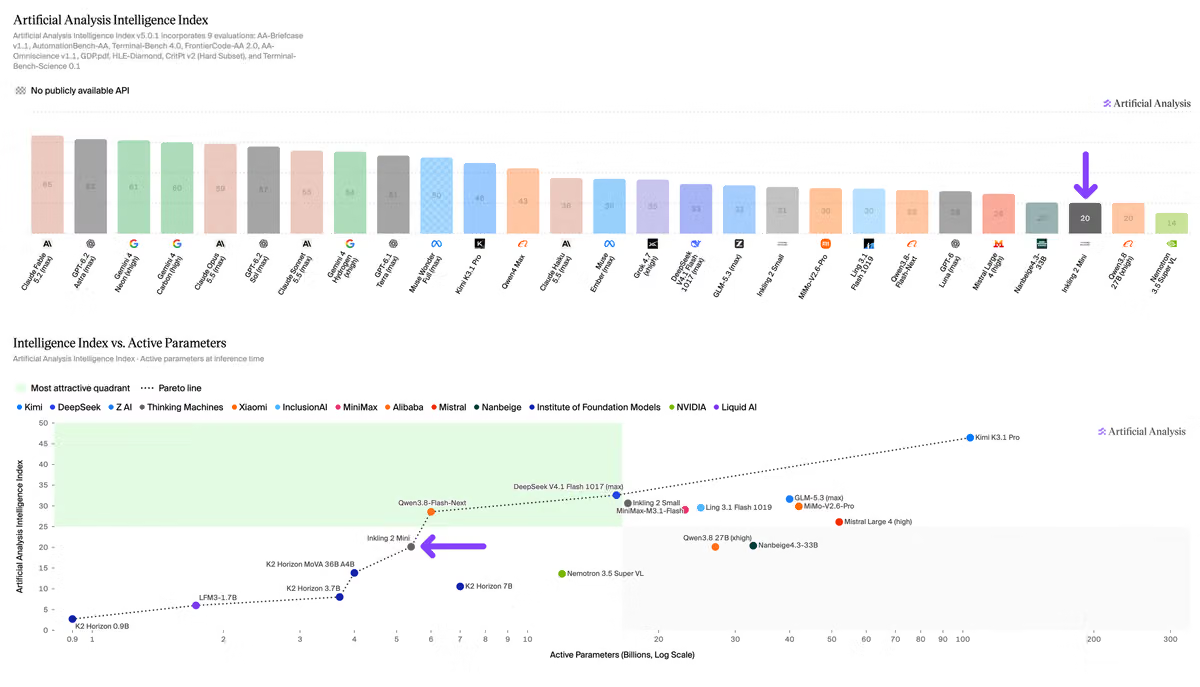
Inkling 2 Mini scores 20 on Intelligence Index with 5.4B active parameters
Artificial Analysis measured the Inkling 2 Mini, an open model from Thinking Machines: 20 on the Intelligence Index, 5.4B active parameters, and a per-task cost six times lower than Qwen3.8 27B.
5 min

Benchmarks
Rumble-2-Flash: 0.5B open speech model with 6.96% WER
Reson8 has open-sourced Rumble-2-Flash, a 0.5B speech model under Apache 2.0 with 40+ languages. See WER on the Open ASR Leaderboard and in real calls.
5 min

Benchmarks
DaisyRose-27B: Terminal-Bench 4.1 rises from 5.6% to 12.0%
RadixArk has released DaisyRose-27B, trained with RL on top of Qwen3.8-27B. The pass@1 on Terminal-Bench 4.1 went from 5.6% to 12.0%, according to the company.
5 min