
RadixArk released DaisyRose-27B on November 18, 2026, its first model, and reported that pass@1 on Terminal-Bench 4.1 rose from 5.6% to 12.0% compared to Qwen3.8-27B. It is an open-weight model designed for code and terminal agents.

Benchmarks5 min
DaisyRose-27B: Terminal-Bench 4.1 rises from 5.6% to 12.0%
RadixArk has released DaisyRose-27B, trained with RL on top of Qwen3.8-27B. The pass@1 on Terminal-Bench 4.1 went from 5.6% to 12.0%, according to the company.
The biggest AI newsletter in the World
Get AI articles in your inbox
Technical curation on models, agents and coding tools. No spam, unsubscribe anytime.
The result comes from post-training, not a new model from scratch. That matters for anyone building agents, because it shows how much a good task set and an efficient RL cycle can change an average model.
In this article you will see:
- What DaisyRose-27B is and what RadixArk did not announce
- The numbers across the seven disclosed benchmarks
- How training worked with Miles, 144 H200 GPUs, and 1,200 tasks
- How to run the model today with SGLang
What DaisyRose-27B is, RadixArk's first model
DaisyRose-27B is a 27-billion-parameter language model built on top of Qwen3.8-27B. RadixArk, the company known for the SGLang inference ecosystem, used reinforcement learning (RL), a technique where the model learns from rewards for solving tasks, not just from text examples.
Training used long-horizon agent tasks, with sessions up to 1 million tokens. According to the company, it took only 1,200 curated tasks, 18 days, and 144 H200 GPUs.
What the announcement does not include: it is not a new architecture, there is no new version of Qwen, and there is no independent reproduction of the numbers. Everything below comes from RadixArk itself.
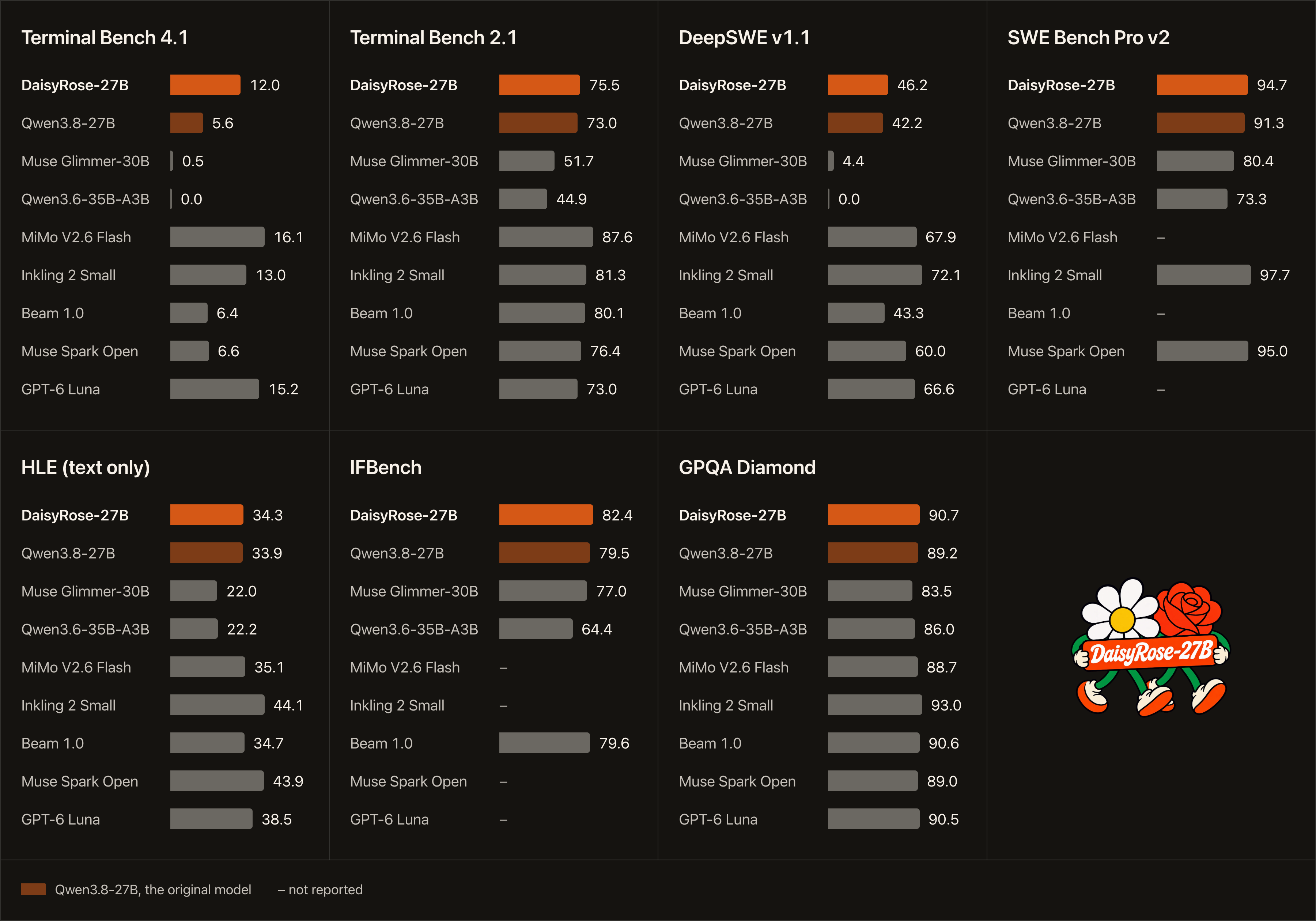
DaisyRose-27B on benchmarks: gains across all seven tests
RadixArk compares DaisyRose-27B with the original Qwen3.8-27B. The table below reproduces the values disclosed in the official publication.
| Benchmark | Qwen3.8-27B | DaisyRose-27B |
|---|---|---|
| Terminal Bench 4.1 | 5.6 | 12.0 |
| Terminal Bench 2.1 | 73.0 | 75.5 |
| DeepSWE v1.1 | 42.2 | 46.2 |
| SWE Bench Pro v2 | 91.3 | 94.7 |
| HLE (text only) | 33.9 | 34.3 |
| IFBench | 79.5 | 82.4 |
| GPQA Diamond | 89.2 | 90.7 |
The biggest jump is in Terminal-Bench 4.1, which measures whether the agent completes real tasks in a terminal. In the other tests the gain is smaller, from 0.4 points on HLE to 4.0 points on DeepSWE.
The company states that for each benchmark it uses the best of the BF16 and FP8 runs, and that the two differ by less than one point where both were evaluated. The model card provides the comparison sources and evaluation settings.
How RadixArk trained DaisyRose-27B with the Miles framework
Training used Miles, an open-source RL framework for large-scale post-training, in fully asynchronous mode: the agent keeps working while the model learns. According to RadixArk, 128 H200 GPUs run task inference and 16 run the trainer.
Data quality was the other pillar. Tasks were created in partnership with Eigent AI, starting from thousands of candidates, and about 1,200 made it into the final set.
The company listed three selection criteria:
- Target a real error: each task was redesigned around failures that Qwen3.8-27B made.
- Multiple dependent steps: each attempt runs up to 1.5 hours in a sandbox, with more than 100 tool calls and more than 256k output tokens.
- Reward for solving: tasks that could pass without actually solving the problem were fixed or removed.
For agent developers, the lesson is practical: a few well-designed tasks can yield more than many generic examples. Other recent releases follow the same open-recipe approach, such as ByteDance's Axion 1.0.
Spec sheet: license, formats, and 256K context
The checkpoints are available in three formats, all under Apache 2.0:
The model retains the architecture, tokenizer, chat template, image understanding, and the 256K token window from Qwen3.8-27B. FP8 and NVFP4 formats use less memory, which helps those with smaller GPUs.
Open weights don't mean zero cost: you pay for the hardware. RadixArk hasn't disclosed API pricing for the model.
How to test DaisyRose-27B today with SGLang
The official recommendation is to serve with SGLang and DSpark speculative decoding, a technique that uses a fast draft to accelerate generation. The SGLang cookbook provides per-GPU and per-format configurations.
With the server running, port 30000, and the name DaisyRose-27B, any OpenAI API-compatible client works:
Python
from openai import OpenAI

client = OpenAI(base_url="http://localhost:30000/v1", api_key="none")

response = client.chat.completions.create(
    model="DaisyRose-27B",
    messages=[{"role": "user", "content": "How many positive divisors does 360 have?"}],
    temperature=1.0,
    top_p=0.95,
    extra_body={"top_k": 20, "min_p": 0.0},
)

print(response.choices[0].message.reasoning_content)
print(response.choices[0].message.content)
The model reasons before responding by default. The reasoning appears in reasoning_content and the final answer in content, following the model card quickstart.
If you're already comparing small models for tool tasks, it's also worth reading the Tether QVAC BotPsy test and then running both in your own scenario.
Frequently asked questions about RadixArk's DaisyRose-27B
What is DaisyRose-27B?
It is RadixArk's first model, built on Qwen3.8-27B and post-trained with reinforcement learning via the Miles framework. It was trained on long-horizon agent tasks, with sessions of up to 1 million tokens.
What was the gain on Terminal-Bench 4.1?
The pass@1 rose from 5.6% to 12.0%, according to RadixArk. This is a company-reported figure, with no independent reproduction so far.
Does DaisyRose-27B have an open license?
Yes. The BF16, FP8, and NVFP4 checkpoints are released under Apache 2.0, which permits commercial use. The hardware to run it is up to the user.
How to run DaisyRose-27B?
RadixArk recommends serving it with SGLang and DSpark speculative decoding. The SGLang cookbook provides configurations for each GPU and checkpoint format, and the API remains compatible with the OpenAI client.
Does the model retain Qwen3.8-27B's context window?
Yes. It preserves the architecture, tokenizer, chat template, image understanding, and the 256k-token context window. Longer sessions use summarization in the harness to cover multiple trajectories.
What DaisyRose-27B changes for those building code agents
A 12.0% Terminal-Bench is still a low number in absolute terms. The relative gain is large, but the 4.1 test is hard and the model is far from solving most tasks.
The value lies in the recipe: Apache 2.0 weights, quantized formats, and a documented training method. Researchers of agent post-training get a concrete starting point, and those who only consume models get another open 27B option to test.
Since all numbers come from the manufacturer, test on your code before adopting.
Instead of just following news like DaisyRose-27B, put AI to work for you on bridgecode.
Source: RadixArk
Tags:#DaisyRose-27B#RadixArk#modelos abertos#Terminal-Bench#benchmark

Developer and creator of bridgecode, an agentic development environment for orchestrating squads of AI agents. Helps people going from vibe coding to professional development move from idea to shipped product.
Related articles
Benchmarks
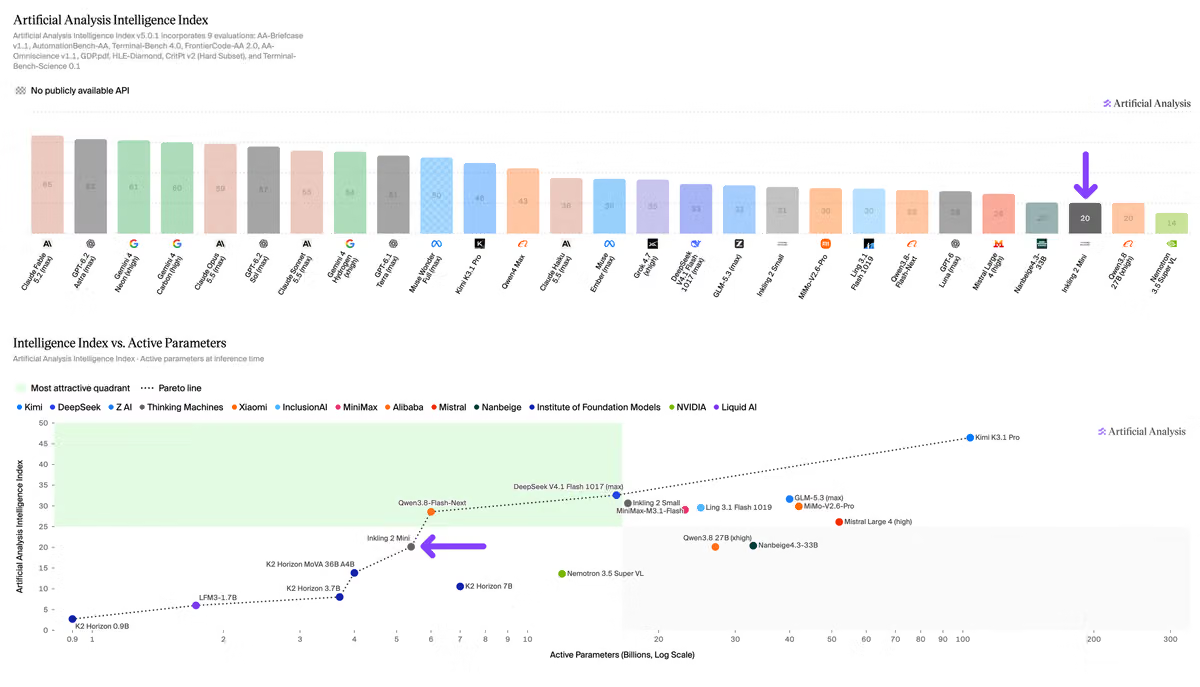
Inkling 2 Mini scores 20 on Intelligence Index with 5.4B active parameters
Artificial Analysis measured the Inkling 2 Mini, an open model from Thinking Machines: 20 on the Intelligence Index, 5.4B active parameters, and a per-task cost six times lower than Qwen3.8 27B.
5 min

Benchmarks
K2-Horizon: 6 open models from 0.9B to 375B-A23B
K2-Horizon: six fully open models, from 0.9B to 375B-A23B, with MoVA and Uno (up to 2.2x faster) and released data and code, according to the paper.
5 min

Benchmarks
Rumble-2-Flash: 0.5B open speech model with 6.96% WER
Reson8 has open-sourced Rumble-2-Flash, a 0.5B speech model under Apache 2.0 with 40+ languages. See WER on the Open ASR Leaderboard and in real calls.
5 min