
Thinking Machines released Inkling 2 Mini, an open-weight model that Artificial Analysis scored at 20 points on the Intelligence Index. The analysis was published on November 20, 2026.
Benchmarks5 min
Inkling 2 Mini scores 20 on Intelligence Index with 5.4B active parameters
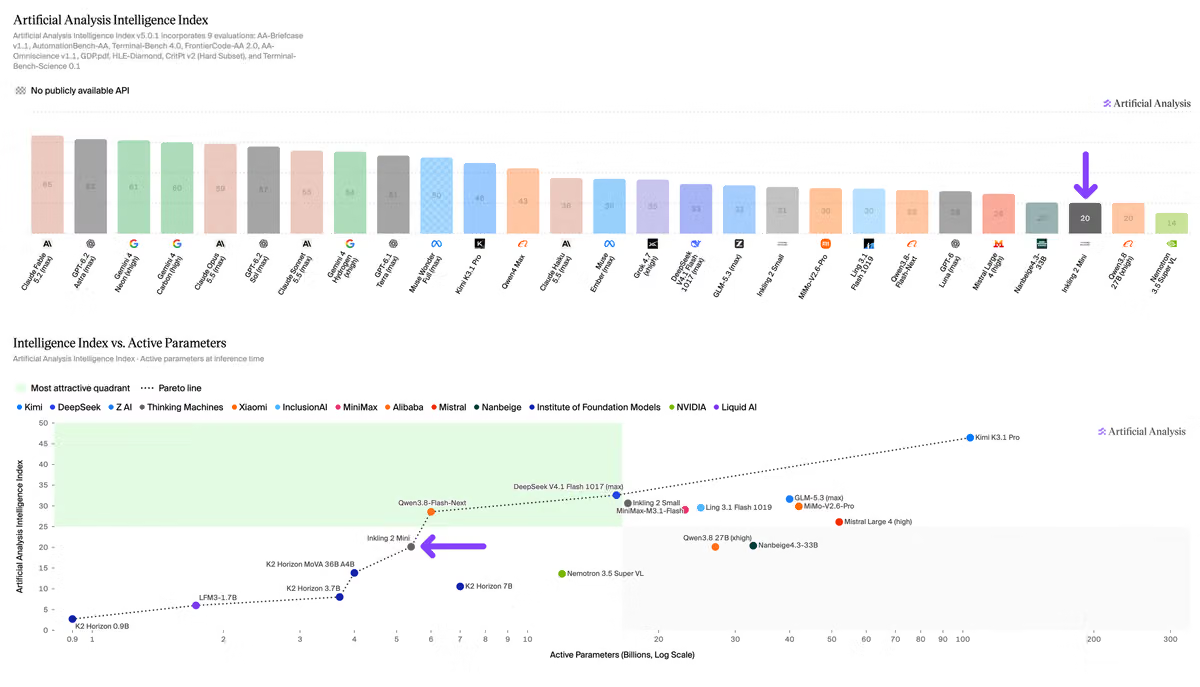
Artificial Analysis measured the Inkling 2 Mini, an open model from Thinking Machines: 20 on the Intelligence Index, 5.4B active parameters, and a per-task cost six times lower than Qwen3.8 27B.
The biggest AI newsletter in the World
Get AI articles in your inbox
Technical curation on models, agents and coding tools. No spam, unsubscribe anytime.
The highlight is efficiency: 5.4B active parameters for a score that much larger models need more compute to match.
In this article you will see:
- What Inkling 2 Mini is and how the looped transformer works
- How it compares to Qwen3.8 27B and Nanbeige4.3 33B
- Cost and time per task measured by Artificial Analysis
- Limits of the result and how to test
This post covers the Artificial Analysis measurement, not a bridgecode test. There was no new release of Inkling 2 Small, which was already covered here.
What is Inkling 2 Mini, Thinking Machines' open model
Inkling 2 Mini is a mixture of experts model, an architecture where only a portion of experts is activated per token. It has 26B total parameters and 5.4B active.
The license is Apache 2.0, the context window is 1 million tokens, and it accepts text and image input. Open weights mean you can download the model and run it on your own infrastructure.
According to Artificial Analysis, it is small enough to run on a MacBook or a DGX Spark. The source does not report speed or configuration on those devices.
Thinking Machines had already appeared on the blog with the larger sibling, covered in the post Inkling 2 Small: benchmark shows strength in enterprise tasks. The Mini targets the opposite extreme: running cheap and close to the user.
How the Inkling 2 Mini looped transformer works
A looped transformer repeats some layers more than once per token. Instead of stacking new layers, the model reuses the same weights and gains reasoning depth.
In Inkling 2 Mini, 12 of the 24 layers run three times per token. That is why the 5.4B active parameters already count the three passes through the looped layers.
The number of unique weights per text token is smaller: 3.1B. In other words, the model stores little, but uses that little more than once.
The effect is trading memory for compute. The repetition adds calculation without adding output tokens, which explains part of the cost numbers below.
Inkling 2 Mini vs Qwen3.8 27B and Nanbeige4.3 33B on the Intelligence Index
Artificial Analysis says Inkling 2 Mini ties at 20 points with Qwen3.8 27B (xhigh) and Nanbeige4.3 33B. The two rivals have roughly 5x and 6x more active parameters, respectively.
The model sits on the Pareto frontier of intelligence versus size, both in total and active parameters. Pareto frontier means no measured model delivers a higher score at the same size.
The Intelligence Index is Artificial Analysis' composite index, combining multiple evaluations of knowledge, code, and science. The score of 20 is modest compared to top models, so the gain here is efficiency, not maximum capability.
For top-tier context, Gemini 4 Neon scored 61 points on the same index. The Mini plays in a different league: models that fit on small hardware.
Cost, time, and tokens: where Inkling 2 Mini wins and where it loses
Artificial Analysis measured cost and time per task on the index. Inkling 2 Mini costs $0.59 and takes 9.0 minutes, versus $3.53 and 38.2 minutes for Qwen3.8 27B.
That works out to roughly 6x lower cost and 4x faster speed. The cost uses Thinking Machines' own pricing: $0.15 per million input tokens, $0.50 for output, and $0.015 for cache hits.
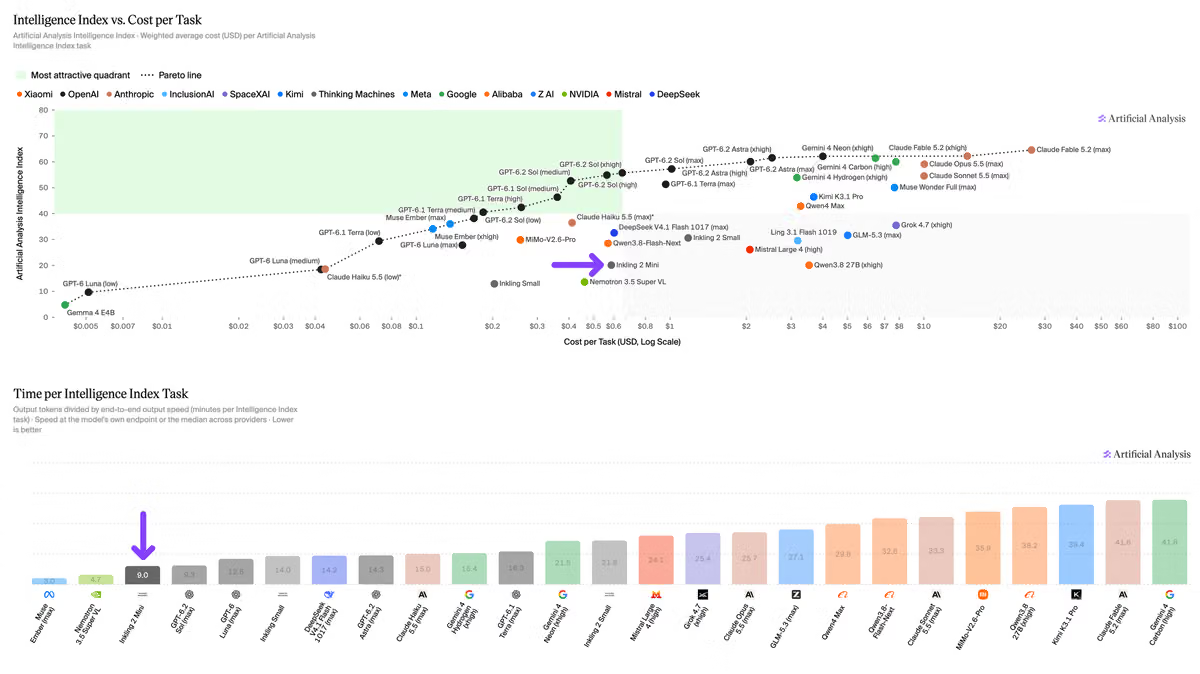
There's a hidden cost in tokens. Inkling 2 Mini generates an average of about 152k output tokens per task, versus about 110k for Qwen3.8 27B and 158k for Nanbeige4.3 33B.
That's roughly 38% more tokens than Qwen3.8 27B for the same score. Even so, on the source's compute proxy (active parameters times tokens), it uses about 2.8x less compute than Qwen3.8 27B and 5x less than Nanbeige4.3 33B.
A cost comparison point: GPT-6 Luna (max) scores 28 points at $0.15 per task, according to the same analysis. In other words, if you want a higher score at lower cost, there's still a cheaper closed option.
Limits of the Inkling 2 Mini result
The result comes from a single independent source, Artificial Analysis, and uses Thinking Machines' first-party pricing. Prices from other providers may change the cost per task.
The score of 20 summarizes the entire index. It doesn't tell you how the model will perform on your code, in your language, or in your agent tool.
The source also doesn't detail latency on local hardware. Before betting on a MacBook, measure with your workload.
The model spends more output tokens than Qwen3.8 27B. If your workflow charges per token on another provider, the math may differ from what's published.
How to test Inkling 2 Mini today
The most direct path is the model page on Artificial Analysis, which collects the numbers and comparisons. The weights are open and the license is Apache 2.0.
A simple test: run your 20 real tasks with Inkling 2 Mini and with Qwen3.8 27B. Compare accuracy, tokens, and time, not just the index score.
If you already use small models in agents, it's also worth checking out Meta's Muse Ember, another lightweight model designed for repetitive tasks.
Frequently asked questions about Thinking Machines' Inkling 2 Mini
What is the Inkling 2 Mini?
It is an open model from Thinking Machines with 26B total parameters and 5.4B active parameters, in a mixture-of-experts format. It uses looped layers and understands both text and images.
What is the Inkling 2 Mini's score on the Intelligence Index?
20 points, according to Artificial Analysis. That ties with Qwen3.8 27B (xhigh) and Nanbeige4.3 33B, with far fewer active parameters.
What is the license and context window of the Inkling 2 Mini?
The license is Apache 2.0 and the context window is 1 million tokens, with text and image input.
Can the Inkling 2 Mini run on a notebook?
Artificial Analysis says it is small enough to run on a MacBook or a DGX Spark. The analysis does not detail local configuration or speed.
Is the Inkling 2 Mini cheaper than Qwen3.8 27B?
Yes, per task. It costs $0.59 and takes 9 minutes, versus $3.53 and 38.2 minutes for Qwen3.8 27B, using Thinking Machines' own pricing.
What Inkling 2 Mini changes for those using AI in agents
Open models with few active parameters lower the cost floor for support tasks like triage, extraction, and code subtasks. The Mini shows it's possible to match 27B to 33B models with far less compute.
The caution is to measure the full cost, including output tokens, before switching models.
Selling a digital product or service? Build an agent squad on bridgecode that works with you every day.
Source: Artificial Analysis
Tags:#Inkling 2 Mini#Thinking Machines#Artificial Analysis#modelos abertos#benchmark

Developer and creator of bridgecode, an agentic development environment for orchestrating squads of AI agents. Helps people going from vibe coding to professional development move from idea to shipped product.
Related articles

Benchmarks
K2-Horizon: 6 open models from 0.9B to 375B-A23B
K2-Horizon: six fully open models, from 0.9B to 375B-A23B, with MoVA and Uno (up to 2.2x faster) and released data and code, according to the paper.
5 min

Benchmarks
Rumble-2-Flash: 0.5B open speech model with 6.96% WER
Reson8 has open-sourced Rumble-2-Flash, a 0.5B speech model under Apache 2.0 with 40+ languages. See WER on the Open ASR Leaderboard and in real calls.
5 min

Benchmarks
DaisyRose-27B: Terminal-Bench 4.1 rises from 5.6% to 12.0%
RadixArk has released DaisyRose-27B, trained with RL on top of Qwen3.8-27B. The pass@1 on Terminal-Bench 4.1 went from 5.6% to 12.0%, according to the company.
5 min