
NVIDIA published the Nemotron 3.5 Bolt E4B 4GB paper on November 16, 2026, a small open model for fast conversational agents. According to the company, across 21 benchmarks it achieves the highest average accuracy and generates fewer tokens than Gemma-4-E4B-it and Qwen3.5-4B, in both reasoning and non-reasoning modes.
Benchmarks5 min
Nemotron 3.5 Bolt: 21 benchmarks and 2.74x faster
Nemotron 3.5 Bolt E4B 4GB from NVIDIA: a 4 GB model with the highest average across 21 benchmarks and 2.74x faster decoding speed with DFlash.
The biggest AI newsletter in the World
Get AI articles in your inbox
Technical curation on models, agents and coding tools. No spam, unsubscribe anytime.
The target is voice assistants, interactive characters, and robot and IoT device interfaces. In these cases, what matters is fitting in memory (about 4 GB) and responding quickly.
In this article you will see:
- What Nemotron 3.5 Bolt E4B 4GB is and where it comes from
- Results on the 21 benchmarks and the accuracy versus latency chart
- The 2.74x speedup with the DFlash drafter
- How to test with the free endpoint or download the checkpoints
What is Nemotron 3.5 Bolt E4B 4GB, NVIDIA's small model
Bolt is a post-trained language model derived from Gemma-4-E4B-it and optimized for speed and intelligence per GB of memory. It retains Gemma's strong conversational ability and improves multi-turn tool use, instruction following, and correct use of provided context.
The model has a reasoning mode and a non-reasoning mode. There is also a conversational mode, activated by the conversational_mode flag, which generates short responses without excessive formatting, better suited for speech.
Training used RLVR (reinforcement learning with verifiable rewards) and RLHF (with human feedback), with NeMo-RL and NeMo-Gym. Covered areas were conversational tool use, call schemas, instructions, instruction hierarchy, and output format.
What the paper does not provide: pricing and an independent audit. All results are from NVIDIA.
Nemotron 3.5 Bolt on benchmarks: 21 tests and the highest average
NVIDIA evaluated the model on 21 benchmarks of conversational proficiency, multi-turn tool use, instruction control, context robustness, and state and action grounding. Among them are BFCL-v3, ToolSandbox, Tau2-Bench, IHEval, and LongBench v2.
The reported result: highest average accuracy and fewer output tokens than Gemma-4-E4B-it and Qwen3.5-4B, both with and without reasoning. Fewer tokens mean faster and cheaper responses to generate.
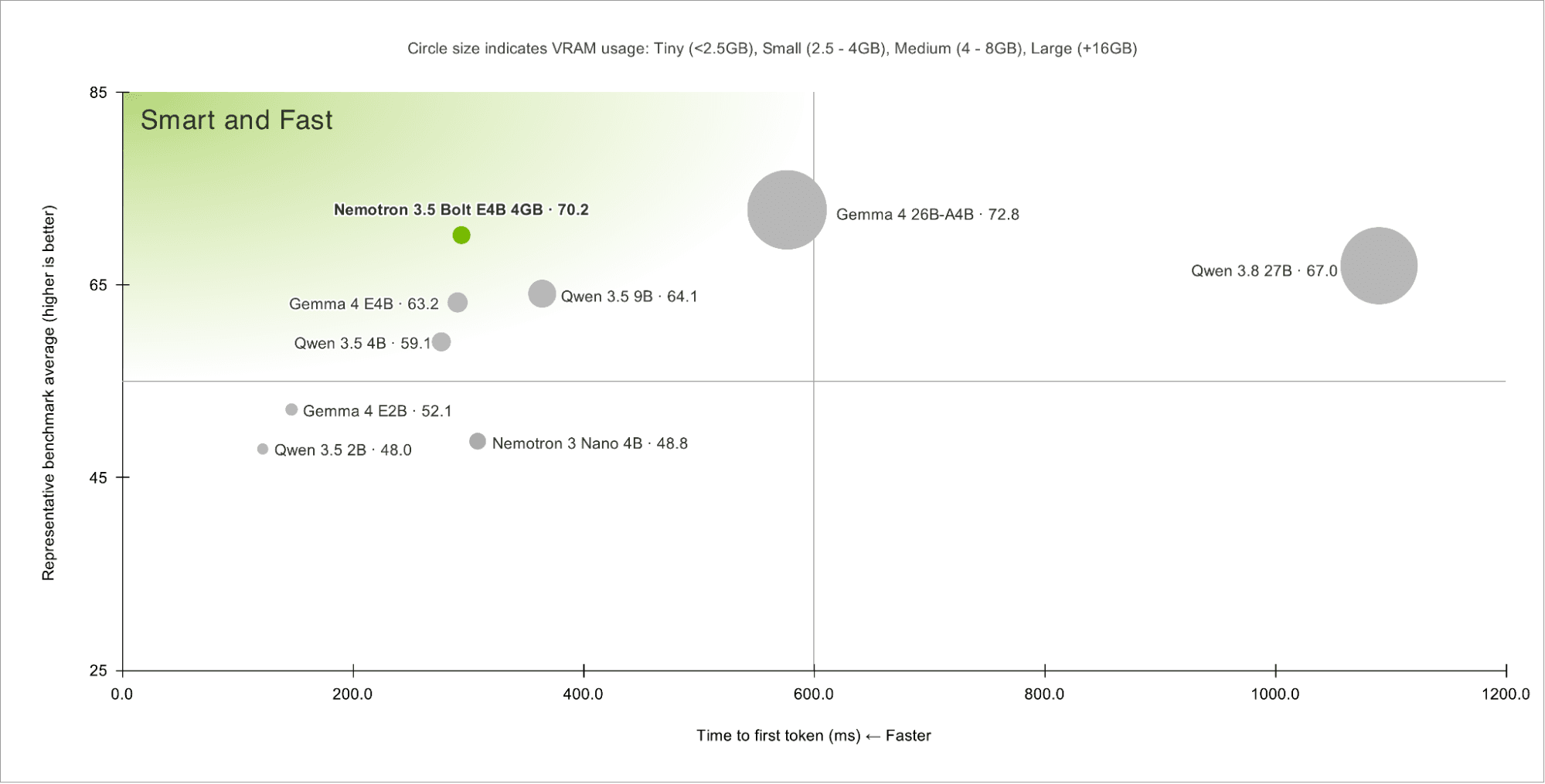
The chart above shows average score against time to first token (TTFT). The average uses MultiChallenge, RoleMRC, BFCL-v3, IHEval, SysBench, and RelyToolBench. Local models use Q4_K_M quantization and were measured on an RTX 5090, with inputs of about 3,000 tokens and outputs of about 50.
As a cloud reference, NVIDIA cites Gemini 3.8 Flash (77.1 points; 2,449.5 ms) and Claude Sonnet 5.5 (76.2; 3,002.2 ms). The point is latency: Bolt running locally responds much earlier, although score comparison requires looking at the full chart and the hardware used.
DFlash: 2.74x faster decode throughput per user
The model ships with a DFlash drafter, a parallel drafter used in speculative decoding, a technique where a lightweight model proposes multiple tokens and the main model verifies. According to NVIDIA, with DFlash the Bolt E4B reaches 2.74x the decode throughput per user, at concurrency 1, compared to running without speculative decoding.
The company also reports 1.21x the generation throughput of Gemma-4-E4B-it with MTP, at batch size 1. For voice assistants, where there is one user at a time, this is the scenario that matters most.
For the quantized version, NVIDIA converted the BF16 checkpoint to Q4_K_M with importance matrix calibration, using about 1 million tokens from RL rollouts. The calibration helps preserve accuracy when reducing the model to four bits.
Checkpoints, license, and where Bolt runs
The paper lists four checkpoints on Hugging Face:
- NVIDIA-Nemotron-3.5-Bolt-E4B-4GB: GGUF quantized to Q4_K_M
- NVIDIA-Nemotron-3.5-Bolt-E4B-BF16: Hugging Face format in BF16
- Drafter DFlash for GGUF
- Drafter DFlash NVFP4 for BF16
NVIDIA lists GeForce RTX, Jetson, and RTX/DGX Spark as targets. In live tests, the model powered a Reachy Mini robot running on an 8 GB Jetson Orin Nano. The paper also releases the Nemotron-System-User-Instruction-Hierarchy-v1 dataset. Check the license terms on each checkpoint page before using in production.
One caveat: post-training was done only in English. The paper tests whether the model retains the original Gemma's multilingual capability across 36 languages on WMT24++ and 12 on MMLU-ProX, so review those results before using it in Portuguese.
How to test Nemotron 3.5 Bolt today
The quickest way is the free API endpoint at build.nvidia.com, which lets you validate your use case before downloading anything. Limits and terms should be confirmed on that page.
To run locally, there's the NVIDIA NIM container in the NGC catalog or the Q4_K_M GGUF, which fits in about 4 GB. A simple roadmap:
- Test on the free endpoint with your system prompt
- Enable
conversational_modeif the output is spoken - Download the GGUF and the DFlash drafter to measure latency on your hardware
If your use case is tool use with a tiny model, compare with Tether's 0.8B QVAC BotPsy. For the other side of voice, see Rumble-2-Flash, Reson8's speech model.
Frequently asked questions about NVIDIA's Nemotron 3.5 Bolt
What is Nemotron 3.5 Bolt E4B 4GB?
It is a small, open model from NVIDIA, post-trained from Gemma-4-E4B-it, optimized for fast conversational agents with about 4 GB of memory, for voice assistants and local devices.
Is it better than Gemma-4-E4B-it and Qwen3.5-4B?
According to NVIDIA, across 21 benchmarks it achieves the highest average accuracy and generates fewer tokens than Gemma-4-E4B-it and Qwen3.5-4B, in both reasoning and non-reasoning modes. The results come from NVIDIA itself.
Does Nemotron 3.5 Bolt have a free API?
Yes. NVIDIA points to a free API endpoint at build.nvidia.com. Limits and terms should be confirmed on the page.
What is DFlash and how much does it speed things up?
DFlash is a parallel drafter for speculative decoding. According to NVIDIA, it reaches up to 2.74 times the per-user decoding speed at concurrency 1, compared to running without it.
Does Nemotron 3.5 Bolt work for Portuguese?
There is a GGUF in Q4_K_M and a BF16 version, but post-training was only in English. The paper evaluates 36 languages on WMT24++ and 12 on MMLU-ProX, so check those results before using it for Portuguese.
What Nemotron 3.5 Bolt changes for voice assistants and local agents
Bolt shows that a 4 GB model, well post-trained, can be the fast component of a local assistant. Fewer tokens per response and speculative decoding reduce latency, which is what the user feels in a spoken conversation.
The limits: the numbers come from NVIDIA, post-training was in English, and a 4B model's score doesn't replace a cloud model's on complex tasks. Test on your use case before adopting.
Stop switching between ten AI tools. Coordinate your agents in a single flow on bridgecode.
Source: NVIDIA
Tags:#Nemotron 3.5 Bolt#NVIDIA#modelos pequenos#DFlash#benchmark

Developer and creator of bridgecode, an agentic development environment for orchestrating squads of AI agents. Helps people going from vibe coding to professional development move from idea to shipped product.
Related articles
Benchmarks
RoboTrack-Bench: point trackers fall short in real-world robotics
Ai2 released RoboTrack-Bench and RoboTracker. Leading trackers lose 3.0 to 6.6 AJ on real robotic manipulation videos. See the method and limitations.
5 min
Benchmarks
Ling-3.2-air scores 23 on Intelligence Index with 5.5B active
inclusionAI released Ling-3.2-air: 124B total, 5.5B active, 1M context, MIT license, and 23 on the Intelligence Index. See the numbers and the limits.
5 min
Benchmarks
Inkling 2 Mini scores 20 on Intelligence Index with 5.4B active parameters
Artificial Analysis measured the Inkling 2 Mini, an open model from Thinking Machines: 20 on the Intelligence Index, 5.4B active parameters, and a per-task cost six times lower than Qwen3.8 27B.
5 min