
Gemini 4 Hydrogen, launched by Google on November 12, 2026, is the fastest model in the Gemini 4 lineup and arrives with a series of benchmark, speed, and pricing numbers. The company positions it as the fast execution layer for agents, designed for daily coding and automation work, not for deep long-horizon reasoning, which remains with Gemini 4 Carbon and Gemini 4 Argon. In this article we gather the published numbers, explain how to read them carefully, and show how to turn all of this into a simple test in your workflow. An important disclaimer applies to the entire text: all results below are self-reported by Google and have not been independently verified. When there is interpretation or practical suggestion, it will be marked as our recommendation.
Gemini 4 Hydrogen: benchmarks and what changes in your workflow
Gemini 4 Hydrogen outperforms Argon on the Artificial Analysis Intelligence Index and delivers speed for agents. See the numbers and how to use it.
Get AI articles in your inbox
Technical curation on models, agents and coding tools. No spam, unsubscribe anytime.
What is Gemini 4 Hydrogen and where to find it
Gemini 4 Hydrogen is a model in the Gemini 4 line, adapted from Gemini 4 Carbon. According to Google, it was built to execute code, run tests, verify changes, and handle repetitive tasks in agents, with a 1 million token context window. It is not the recommended choice for deep planning, which the company reserves for the frontier models in the same line.
Availability is broad. The announcement cites all tiers of Google AI Studio and the Gemini API, Gemini for business, the Gemini app, and Google Search, plus Antigravity for paid Google AI Pro and Ultra subscribers. In practice, any team with access to the Gemini API can already compare the model with what they use today, without waiting for special access. To contextualize the launch, it is worth reading our coverage of the larger sibling, in Gemini 4 Carbon hits the top in MKA and sets pricing, and the piece on the Gemini Decisions API, another new addition from the same family.
Benchmarks published by Google
The table below collects the numbers published in the announcement. Repeating the disclaimer: they are self-reported and have not been independently verified by us or by third parties, as far as we can confirm.
| Metric | Gemini 4 Hydrogen | Comparison |
|---|---|---|
| Artificial Analysis Intelligence Index | 51 (54 in xhigh) | 50 from Argon |
| Terminal-Bench 4.1 | 57% | 18.2% from Gemini 3.8 Flash |
| Agent Arena | #5 | no comparison published |
| HLE-Diamond | 58.8% | no comparison published |
| Vals Tax Agent Bench | 52.3% | no comparison published |
| Vals Legal Research Bench | 55.8% | no comparison published |
| AutomationBench-AA | best in group | no number published |
| Multimodal Knowledge Agent | 53.4% | no comparison published |
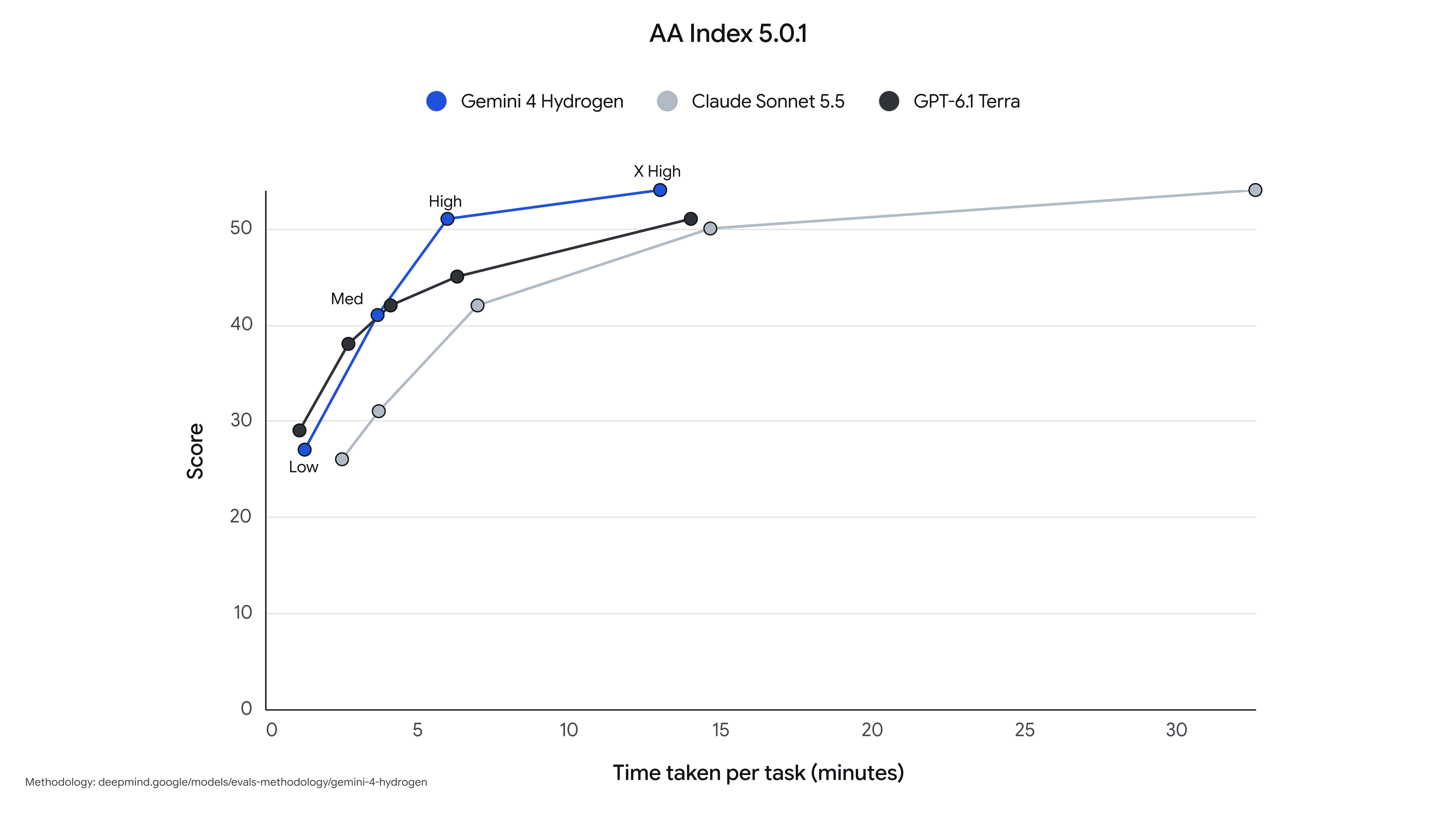
The most cited highlight is the Artificial Analysis index, where Hydrogen surpasses Argon at the standard reasoning level, with 51 versus 50, reaching 54 at the highest level. The chart accompanying the announcement shows Hydrogen relative to Argon, Carbon, and reference models. Google also cites 71.6% on Agents' Last Exam v1.1, a test of end-to-end professional workflows.
How to read these numbers carefully
Benchmarks help compare models, but they have limits, and that goes double when the test author is the same company selling the model. Our recommendation is to separate the numbers into three groups. The first is naturally independent indices, like the one from Artificial Analysis, which still appears here in the form Google reports it. The second is specific agent tests, like Terminal-Bench and Agent Arena, which come closer to real usage but depend on configuration. The third is domain benchmarks, like those from Vals for tax and legal research, useful if your work is similar.
Another caution is the chosen comparison. The gap between 57% and 18.2% on Terminal-Bench 4.1 is large, but the opponent is Gemini 3.8 Flash, a previous-generation model, not a current competitor in the same class. In several table items the announcement provides no comparison at all. For that reason, treat each line as a signal, not proof. What really decides adoption is the result on your tasks, with your code and your quality rules.
Speed and cost
According to the Google announcement, Hydrogen finishes tasks 2.5 times faster in the default high mode, with 24% lower quota consumption in an agent pipeline with the Orchestrator, an Antigravity feature that switches between Carbon and Hydrogen in the same session. Google also reports that in early tests partners saw the model run 2x to 2.8x faster and use 12% to 23% fewer tokens than 3.8 Flash. These are self-reported numbers, in scenarios chosen by the company and its partners.
Pricing is flat across the entire 1 million token window: $1.50 per million input tokens and $7.50 per million output tokens. That means there is no higher tier for long contexts. To review the concepts, see the glossary entries for context window and input and output tokens. Our recommendation is to calculate cost per completed task, not just price per million tokens, because a cheaper model that makes mistakes and needs a retry can end up more expensive in the end.
Reasoning levels and the role of each model
Hydrogen has four reasoning levels: low, medium, high, which is the default, and xhigh, a new level. According to Google, the progression is smooth and predictable, so you wait and pay only for the depth the task requires. The Artificial Analysis index, for example, rises from 51 to 54 when moving from default to xhigh, according to the announcement.
To understand the logic behind these options, it helps to know the concept of reasoning model. In the role division proposed by Google, Hydrogen is the fast execution layer, while Carbon and Argon handle deep reasoning, with the ability to run in parallel and alternate in the same session. According to the documentation cited in our coverage, the model does not have structured output or Live API. Our recommendation is to check this limitation before planning any integration, because it can make certain workflows unviable.
How to test in your workflow
Instead of relying on the table, build a short, repeatable comparison. Here's the playbook we recommend.
- Pick three to five real, repetitive tasks from your repository, such as fixing a bug, running the test suite, and updating a legacy code section.
- Define the success criteria for each task upfront: tests passing, no unnecessary file changes, and review without rework.
- Run each task on Hydrogen at the default level and on the model you use today, with the same prompt and the same repository state.
- Record the time, input and output tokens, and the number of manual fixes.
- Repeat the round at a lower reasoning level and at a higher one, to see where the quality gain stops justifying the time and cost.
With that spreadsheet in hand, you have your own benchmark, which is more valuable for your decision than any number published in an ad.
When to keep Carbon or Argon
Hydrogen shouldn't become a hammer for every problem. For deep reasoning, architecture design, subtle bugs that require many steps, and long-horizon planning, Google itself recommends Carbon and Argon. The suggested combination is to use Hydrogen for execution and let the larger model decide the direction.
Our recommendation is to keep that separation in your test as well: if a task fails repeatedly on Hydrogen, even at the highest level, don't force it. Note the case, hand the task to a stronger model, and use the log to refine the rule for when each model comes into play. Those migrating from Gemini 3.8 Flash tend to have the best comparison point, since it's the model used as a reference in some of the published numbers, but the final decision should always come from your data.
Frequently asked questions about Gemini 4 Hydrogen
What is Gemini 4 Hydrogen?
Google positions it as the fast execution layer of the Gemini 4 line, adapted from Gemini 4 Carbon and designed to run code, execute tests, and handle repetitive tasks in agents. It has a 1-million-token context window.
Does Hydrogen outperform Argon in benchmarks?
According to Google, at the standard tier it scores 51 versus Argon's 50 on the Artificial Analysis Intelligence Index, and 54 on xhigh. These are self-reported numbers without independent verification.
How much does it cost to use Gemini 4 Hydrogen?
Pricing is flat across the 1-million-token window: $1.50 per million input tokens and $7.50 per million output tokens, per the announcement.
Does Hydrogen replace Carbon or Argon?
No. Hydrogen is the fast execution layer; for deep, long-horizon reasoning, Google recommends Carbon and Argon. They can work together in multi-model workflows.
Does the model have structured output or Live API?
According to the documentation cited in our coverage, the model does not have structured outputs or Live API. If your workflow depends on those, check before migrating.
Conclusion
Gemini 4 Hydrogen expands the Gemini 4 lineup with a fast, flat-priced tier, backed by strong numbers on agent benchmarks. But all those numbers come from Google, are self-reported and lack independent verification, and several comparisons use models from previous generations as references. The safest path is to test on a repetitive task, compare speed, cost, and quality against your current model, and reserve Carbon or Argon for heavy reasoning. Want to run agents with different models side by side, each in its own isolated space? Check out bridgecode.
Source: Google Announcement

Developer and creator of bridgecode, an agentic development environment for orchestrating squads of AI agents. Helps people going from vibe coding to professional development move from idea to shipped product.
Related articles

ByteDance Axion 1.0: 59.0 on HLE with open agent recipe
ByteDance released Axion 1.0, an open agent model recipe with two SFT stages and RL. See the reported results, what the repository includes, and the limitations.
Tether QVAC BotPsy: 0.8B Nearly Doubles Base Model's Tool Use
Tether has released QVAC BotPsy-0.8B, an open model for tool use that, according to the company, nearly doubles the base model's scores across four benchmarks. See the numbers and the limitations.
RoboTrack-Bench: point trackers fall short in real-world robotics
Ai2 released RoboTrack-Bench and RoboTracker. Leading trackers lose 3.0 to 6.6 AJ on real robotic manipulation videos. See the method and limitations.