
OpenAI released GPT-6.2 Sol on November 17, 2026 as the model for everyday code and agent workflows. Artificial Analysis measured 57 points on the Intelligence Index and kept pricing at $2 per million input tokens and $10 per million output tokens.

Newsletter5 min
GPT-6.2 Sol: 57 points on the Intelligence Index for $2/$10 per million tokens
OpenAI's GPT-6.2 Sol (Nov 17, 2026) scores 57 on Artificial Analysis's Intelligence Index while maintaining $2 input and $10 output per million tokens.
The biggest AI newsletter in the World
Get AI articles in your inbox
Technical curation on models, agents and coding tools. No spam, unsubscribe anytime.
In this article you will see:
- What GPT-6.2 Sol is and what it's for
- GPT-6.2 Sol score and cost on the Intelligence Index
- Where GPT-6.2 Sol got worse at agentic coding
- How to try GPT-6.2 Sol today
What GPT-6.2 Sol is and what it's for
According to the OpenAI API changelog, GPT-6.2 Sol is the option for everyday code and agent workflows. GPT-6.2 Astra, released the same day, is aimed at demanding reasoning and coding tasks.
Both models accept the Responses API and Chat Completions. OpenAI states that tool calling requires the Responses API, so agents that depend on tools need to be on it to use Sol.
The Intelligence Index is Artificial Analysis's composite index, a single score that combines evaluations of reasoning, knowledge, and agent tasks. The data in this article comes from the launch analysis.
The larger model in the family has its own article: GPT-6.2 Astra is 2nd on the Intelligence Index and costs $8/40.
GPT-6.2 Sol score and cost on the Intelligence Index
Sol gained 2 points and reached 57 on the Intelligence Index. According to Artificial Analysis, this puts it on par with GPT-6 Astra, but at roughly 15% of the cost per task. That is the model's core argument.
Pricing did not change from GPT-6.1 Sol: $2 per million input tokens and $10 per million output tokens. Artificial Analysis also says that several Sol effort tiers sit on the cost-per-task Pareto frontier.
| Item | GPT-6.2 Sol |
|---|---|
| Intelligence Index score | 57 (up 2 points) |
| Input per million tokens | $2 (same as GPT-6.1 Sol) |
| Output per million tokens | $10 (same as GPT-6.1 Sol) |
| Cost per task vs. GPT-6 Astra | roughly 15% |
The Pareto frontier is the set of models that have no competitor that is both better and cheaper at the same time. Being on it means that, for that cost, there is no option with a higher score.
Where GPT-6.2 Sol got worse at agentic coding
The less encouraging data point is precisely coding. On the Coding Agent Index, measured with the Codex harness at max effort, Sol lost 3 points versus GPT-6.1 Sol. For a model sold for everyday code, that is a warning.
The drop comes from 14 fewer points on SWE-Atlas-QnA-AA. According to Artificial Analysis, the model is more likely to omit important facts in its answers than its predecessor. In code questions, this can hide details that change the decision.
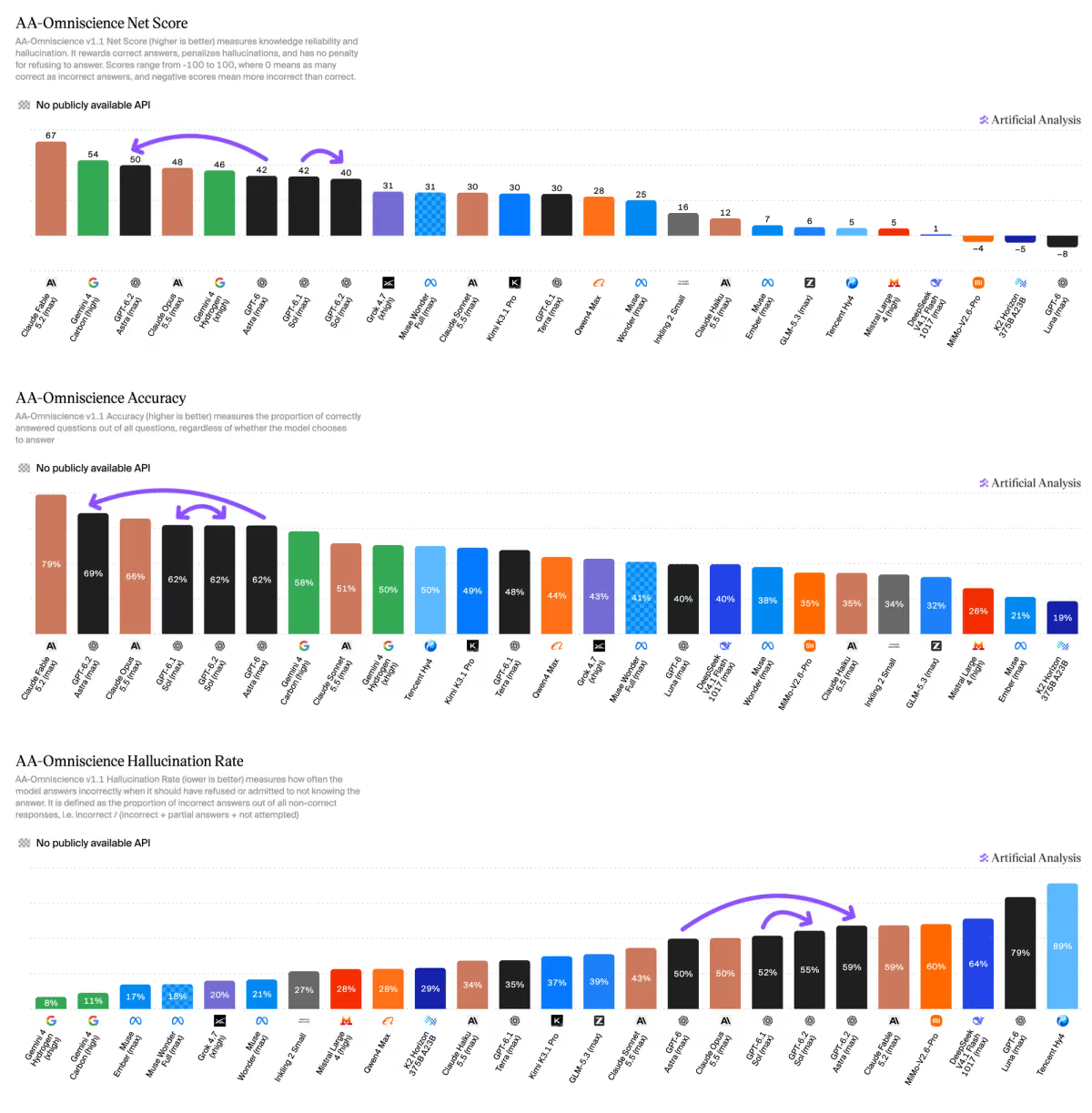
On AA-Omniscience, Sol's hallucination rate is 55% at max effort, versus 59% for Astra. The metric measures the tendency to guess when the model does not know the answer to broad factual questions.
Sol also appears in non-code tests. On AA-3D, which measures creation of interactive 3D experiences, it scored 1259, behind Astra at 1318 and Claude Fable 5.2 at 1271. On AA-Robotics v0.1, it scored 78, above Claude Fable 5.2's 75.
How to test GPT-6.2 Sol today
The model is available in the API with the identifier gpt-6.2-sol, in the Responses API and in Chat Completions. Before switching the model in production, read the GPT-6.2 migration guide in the OpenAI documentation.
According to the company, GPT-6.2 changes how the Responses API preserves reasoning when you edit the conversation prefix and how it handles the top-level instructions field. Integrations that edit history deserve testing.
A good approach is to take 20 real tasks from your repository, run them on Sol and on the current model, and compare accuracy and cost. Sol is an evolution of the line shown in GPT-6.1 Terra arrives at the API and Codex.
If you use the Codex CLI, the 5 tips for using the Codex CLI in your workflow help organize this test.
Frequently asked questions about GPT-6.2 Sol
What is GPT-6.2 Sol's score on the Intelligence Index?
GPT-6.2 Sol scored 57 points, 2 more than GPT-6.1 Sol, according to Artificial Analysis. That puts it on par with GPT-6 Astra at roughly 15% of the cost per task.
How much does GPT-6.2 Sol cost?
The price is $2 per million input tokens and $10 per million output tokens, unchanged from GPT-6.1 Sol, according to Artificial Analysis.
Is GPT-6.2 Sol better than GPT-6.1 Sol for coding?
Not on the agentic coding index. On the Coding Agent Index, Sol lost 3 points versus GPT-6.1 Sol due to a 14-point drop on SWE-Atlas-QnA-AA.
When should you use GPT-6.2 Sol versus Astra?
OpenAI recommends Sol for everyday coding and agent workflows, and Astra for demanding reasoning and coding tasks. Astra costs $8 input and $40 output, according to Artificial Analysis.
Does GPT-6.2 Sol hallucinate a lot?
Sol's hallucination rate on AA-Omniscience is 55% at maximum effort, versus 59% for Astra. The metric measures the tendency to guess when the model doesn't know the answer.
What changes for those choosing a model for agents
Sol is worth analyzing when cost per task matters more than the last tenth of a point. It delivers the GPT-6 Astra score at a fraction of the cost, but agent code data calls for testing on your own code before switching.
The 14-point drop on SWE-Atlas-QnA-AA suggests caution on code question-answering tasks. For generation and editing, it's worth measuring on your repository, since the index is an average.
Testing a new model alongside the current one becomes simple when each agent has its own space. Instead of just following news like Sol, build a squad on bridgecode and run the models in parallel, each in its own isolated space.
Source: OpenAI
Tags:#OpenAI#GPT-6.2 Sol#Artificial Analysis#benchmark

Developer and creator of bridgecode, an agentic development environment for orchestrating squads of AI agents. Helps people going from vibe coding to professional development move from idea to shipped product.
Related articles

Newsletter
GPT-6.2 Astra ranks 2nd on the Intelligence Index and costs US$ 8/40
OpenAI released GPT-6.2 Astra on November 17, 2026. It placed second on Artificial Analysis's Intelligence Index and costs US$ 8 for input and US$ 40 for output.
5 min

Newsletter
Z.ai's GLM-5.4 Uses Loop Transformer, Targets General-Purpose Code
Z.ai announced GLM-5.4, its first flagship with a 750B Loop Transformer, up to 200 tokens/s, and a focus on general-purpose code. API and weights not yet released.
5 min
Newsletter
GitHub Copilot uses browser in preview with Chrome extension
GitHub Copilot now has browser use in public preview as of 17/11/2026, with a Chrome extension, in the CLI, app, VS Code and JetBrains.
5 min