
OpenAI released GPT-6.2 Astra on November 17, 2026, and Artificial Analysis placed the model in second place on its Intelligence Index. According to the analysis, OpenAI now trails only Anthropic's Claude Fable 5.2.

Newsletter5 min
GPT-6.2 Astra ranks 2nd on the Intelligence Index and costs US$ 8/40
OpenAI released GPT-6.2 Astra on November 17, 2026. It placed second on Artificial Analysis's Intelligence Index and costs US$ 8 for input and US$ 40 for output.
The biggest AI newsletter in the World
Get AI articles in your inbox
Technical curation on models, agents and coding tools. No spam, unsubscribe anytime.
In this article you will see:
- What GPT-6.2 Astra is and where it runs
- GPT-6.2 Astra price per million tokens
- Where GPT-6.2 Astra leads and where it didn't improve
- How to migrate and test GPT-6.2 Astra today
What GPT-6.2 Astra is and where it runs
GPT-6.2 Astra is OpenAI's model for demanding reasoning and coding tasks. The information comes from the OpenAI API changelog, published on the same day, November 17, alongside GPT-6.2 Sol.
Astra works on the Responses API and Chat Completions. According to the company, tool calling requires the Responses API. Anyone still using Chat Completions for agents needs to consider this switch before testing the model.
The Intelligence Index is Artificial Analysis's composite index, which brings together various evaluations of reasoning, knowledge, and agent tasks into a single score. It serves as a public benchmark for comparing models from different labs.
Sol, Astra's sibling, gets its own article on bridgecode. See its data in GPT-6.2 Sol: 57 points on the Intelligence Index for $2/10.
GPT-6.2 Astra price per million tokens
Pricing information comes from Artificial Analysis, which tracks provider tables. Astra costs $8 per million input tokens and $40 per million output tokens. That is 20% below GPT-6 Astra.
The discount also appears in caching. Cached input dropped to $0.40 per million tokens, down from $1.00 on the previous model. For agents that resend the same context at every step, this is the number that weighs most on the bill.
| Item | GPT-6.2 Astra |
|---|---|
| Input per million tokens | $8 |
| Output per million tokens | $40 |
| Cached input per million | $0.40 (was $1.00) |
| Change vs. GPT-6 Astra | 20% cheaper |
Where GPT-6.2 Astra leads and where it didn't improve
According to Artificial Analysis, Astra rose 5 points over GPT-6 Astra. With that, it passed Gemini 4 Carbon, which scores 60, and Claude Opus 5.5, with 59, in their respective maximum efforts. For context on Carbon, read Gemini 4 Carbon beats top of MKA.
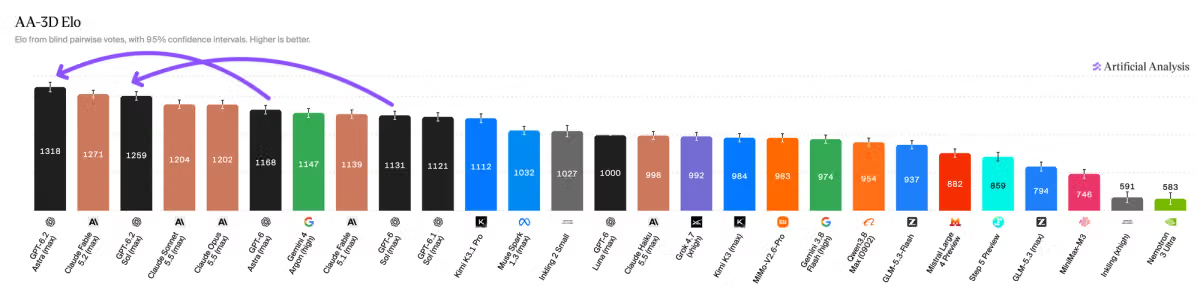
The model leads AA-3D, which measures the ability to create interactive 3D experiences evaluated by people. Astra scored 1318, against 1271 for Claude Fable 5.2 and 1259 for GPT-6.2 Sol.
In AA-Robotics v0.1, a research preview measuring how models understand, plan, and act in the real world, Astra scored 79 points and Sol 78. Claude Fable 5.2 came in at 75. Artificial Analysis itself warns that it is adding harder tasks to the test.
In science and knowledge, the analysis says OpenAI leads Terminal-Bench-Science 0.1 and places second in CritPt v2, the hard subset. Astra only loses to Claude Fable 5.2 in factual knowledge on AA-Omniscience and HLE-Diamond.
There is an important limit for programmers. On the Coding Agent Index, measured with the Codex harness at maximum effort, Astra remained stable relative to GPT-6 Astra. In other words, the overall index jump did not repeat in code with agents.
Astra's hallucination rate on AA-Omniscience is 59% at maximum effort, according to Artificial Analysis. The metric measures the tendency to guess an answer when the model does not know the correct one. Worth checking the result for critical facts.
How to migrate and test GPT-6.2 Astra today
OpenAI warns that GPT-6.2 changes two Responses API behaviors: how reasoning is preserved when editing a conversation prefix, and how the top-level instructions field is handled. A migration guide for GPT-6.2 is available in the documentation.
The practical approach is to run the same task set on GPT-6.2 Astra and the model you already use, measure cost and accuracy, and only then switch. To compare code with agents, it's also worth checking out SWE bench Pro.
If your workflow uses Codex, the article on the shared quota between ChatGPT and Codex helps plan usage.
Frequently asked questions about GPT-6.2 Astra
How much does GPT-6.2 Astra cost on the API?
GPT-6.2 Astra costs US$ 8 per million input tokens and US$ 40 per million output tokens, according to Artificial Analysis. That is 20% below GPT-6 Astra, and cached input dropped to US$ 0.40 from US$ 1.00 previously.
What is GPT-6.2 Astra's position on the Intelligence Index?
GPT-6.2 Astra placed second. Artificial Analysis says OpenAI now trails only Anthropic's Claude Fable 5.2, and that Astra gained 5 points over GPT-6 Astra.
Did GPT-6.2 Astra improve on agentic coding?
No. On the Coding Agent Index, using the Codex harness at maximum effort, Artificial Analysis measured Astra as flat relative to GPT-6 Astra, with no point gain.
What is the difference between GPT-6.2 Astra and GPT-6.2 Sol?
OpenAI recommends Astra for demanding reasoning and coding, and Sol for everyday coding and agent workflows. Both work on the Responses API and Chat Completions.
Do I need to change my integration to use GPT-6.2?
You might need to. OpenAI states that GPT-6.2 changes how the Responses API preserves reasoning when editing the conversation prefix and how it handles the instructions field, and has published a migration guide.
What changes for those building agents with GPT-6.2 Astra
Astra is a strong candidate for hard reasoning tasks, where overall score and lower price carry weight. For agent-based coding, Artificial Analysis data shows no gain over GPT-6 Astra, so testing in your own repository matters more than the ranking.
Cheaper caching favors long-running flows where the same context returns at each step. The Responses API migration requires attention to the instructions field before swapping the model in production.
You define the goal, and the agents split the tasks: the new model runs alongside the ones you already use, each agent in its own isolated space, without stepping on each other's code. See how parallel orchestration works in bridgecode.
Source: Artificial Analysis and OpenAI
Tags:#OpenAI#GPT-6.2 Astra#Artificial Analysis#benchmark

Developer and creator of bridgecode, an agentic development environment for orchestrating squads of AI agents. Helps people going from vibe coding to professional development move from idea to shipped product.
Related articles

Newsletter
GPT-6.2 Sol: 57 points on the Intelligence Index for $2/$10 per million tokens
OpenAI's GPT-6.2 Sol (Nov 17, 2026) scores 57 on Artificial Analysis's Intelligence Index while maintaining $2 input and $10 output per million tokens.
5 min

Newsletter
Z.ai's GLM-5.4 Uses Loop Transformer, Targets General-Purpose Code
Z.ai announced GLM-5.4, its first flagship with a 750B Loop Transformer, up to 200 tokens/s, and a focus on general-purpose code. API and weights not yet released.
5 min
Newsletter
GitHub Copilot uses browser in preview with Chrome extension
GitHub Copilot now has browser use in public preview as of 17/11/2026, with a Chrome extension, in the CLI, app, VS Code and JetBrains.
5 min