
Edge0 announced on November 12, 2026 the release of the Edge0-145B and Edge0-120B weights, along with the inference framework and deployment tools. The company claims that Edge0-145B is the first open 145-billion-parameter model designed to run on your own computer.

Newsletter5 min
Edge0-145B: 145B open model to run on your PC
Edge0 has released the weights for Edge0-145B and Edge0-120B. The model has 145 billion parameters, activates only 10 billion per step, and targets laptops and GPUs.
The biggest AI newsletter in the World
Get AI articles in your inbox
Technical curation on models, agents and coding tools. No spam, unsubscribe anytime.
The news matters because it shifts to the local machine a type of task that usually goes to the cloud: coding, debugging, and iterating with agents. But almost all the numbers come from Edge0 itself, and that calls for careful reading.
In this article you will see:
- What Edge0-145B is and what Edge0 actually released
- How a model of this size fits in a laptop
- The benchmark results, with the limits of each comparison
- What to test before putting the model into an agent workflow
What is Edge0-145B, Edge0's open model
Edge0-145B is a language model with 145 billion total parameters, of which only about 10 billion enter the computation at each inference step. This is typical of a sparse expert architecture, known as Mixture of Experts: the model stores many specialized blocks and activates only a few per token.
Open weights mean anyone can download the parameters, evaluate, fine-tune, and integrate the model into a product. Edge0 says it released the complete package so developers can reproduce the results, with Edge0-120B alongside it and the unified inference framework.
This is a new model launch, not a version update. It is also not a cloud product announcement: the proposal is precisely to take inference off the server and put it on the hardware of the person using it.
Edge0 had already launched Edge0-35B in September, aimed at phones. According to the company, the 145B has roughly four times more parameters and targets laptops, while the smaller models continue for phones.
How Edge0-145B fits in a laptop
The challenge of any large model is memory. The weights need to be read at every token generated, and this competes for space and bandwidth with the operating system and other applications. That is why, until this launch, most local models stayed below 10 billion parameters.
Edge0 describes four design layers to work around this limit:
- Architecture: each group of 64 experts shares two large matrices, and each expert stores only a small private set of parameters
- Training: the model is trained already in the local architecture, without post-compression from a cloud model
- Loading: the most-used experts stay in GPU memory, a library of about 40 GB stays in RAM, and vocabulary data of about 48 GB stays on the SSD
- Scheduling: CPU and GPU work together, with speculative decoding to verify multiple tokens at once
The reported result is a peak memory of about 29 GB and decoding above 80 tokens per second on a compatible laptop, with typical power of about 120 W. The company compares with Qwen3.8-Flash-Next, which would have an estimated 70 GB in 4-bit quantization, leaving Edge0-145B with about 40% of the memory.
It is worth noting Edge0's own caveat: the comparison models' memory estimates have not yet been measured. Edge0's values are peaks measured in internal tests.
Edge0-145B benchmarks: what the numbers say
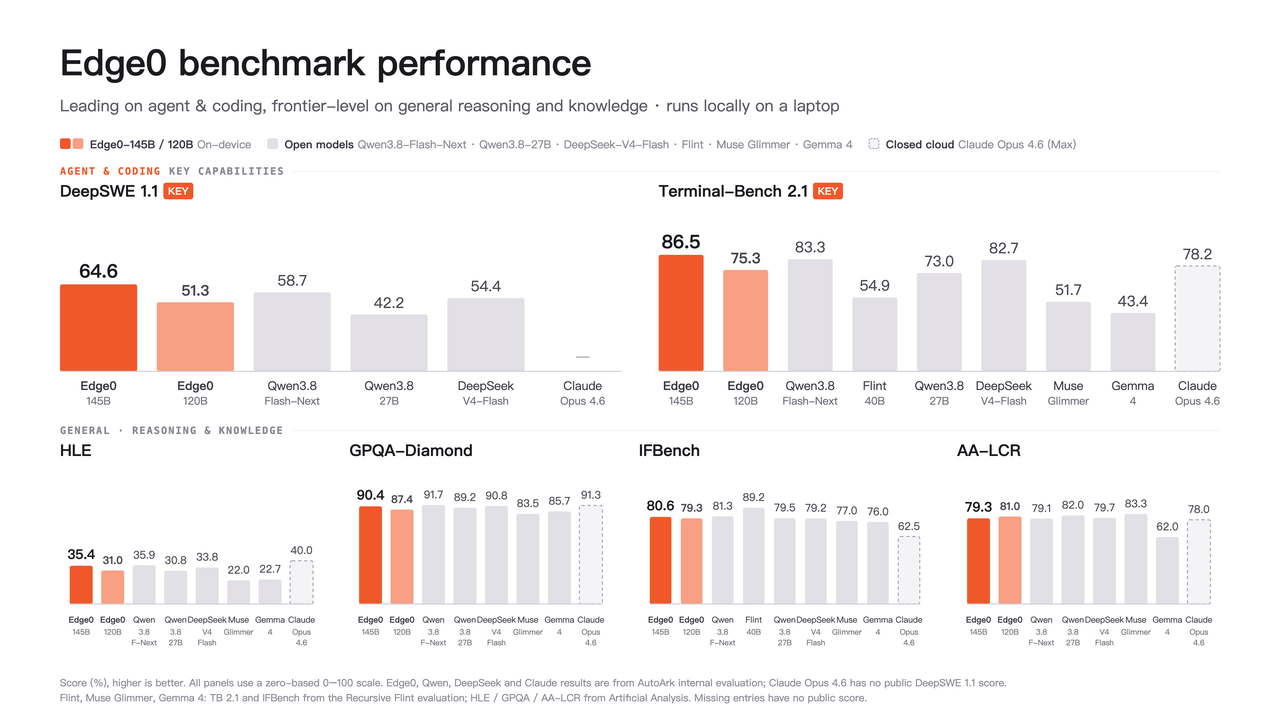
In the published comparison, Edge0-145B scores 64.6 on DeepSWE 1.1, versus 58.7 for Qwen3.8-Flash-Next and 54.4 for DeepSeek-V4-Flash-0731. On Terminal-Bench 2.1, which measures terminal agent work, it reaches 86.52 against 83.3, 82.7, and 78.2 for Claude Opus 4.6.
On knowledge and reasoning the picture is more balanced. The model hits 90.4 on GPQA-Diamond, close to DeepSeek's 90.8 and Claude Opus 4.6's 91.3. On IFBench, which measures instruction following, it scores 80.6 versus 62.5 for Claude.
On HLE, the official chart shows 35.4 for Edge0-145B, below the 40.0 for Claude Opus 4.6. The average across six benchmarks is 72.8, against 71.7 for Qwen3.8-Flash-Next.
The caveat lies in the data source. Edge0 states that results for Edge0, Qwen, DeepSeek, and Claude come from internal evaluation, and that the full test environment and reproduction instructions will ship with the technical report, still forthcoming. For HLE, GPQA, and AA-LCR, some of the other models' numbers come from Artificial Analysis.
Another detail: Claude Opus 4.6 has no public score on DeepSWE 1.1, so that specific comparison does not include the Anthropic model. The numbers apply to the models and tests cited, not to the entire market.
Local agent demos
Edge0 shows the model in long flows, with planning, code execution, debugging, and visual verification. Examples include a 3D Manhattan scene in Blender, a game, a program to control a real drone, and a circuit board project in KiCad.
These are company demos, without independent evaluation. Even so, they illustrate the core argument: tasks with dozens of planning and revision rounds incur no cloud token charges when inference runs locally.
The company acknowledges the counterpoint: hardware and electricity still cost money, and searches that depend on current information still need a connection.
How to try Edge0-145B today
Weights are on Hugging Face, and the inference framework and deploy tools are on Edge0's GitHub. The company claims launch support for macOS, Windows, and Linux, including Apple M chips and NVIDIA GPUs such as RTX 4090 and RTX 5090.
There is an important alert. An independent report from enjoy.dev says the published engine runs on Linux or Windows with an NVIDIA GPU, 16 GiB VRAM, 20 GiB RAM, and CUDA 13, and that Mac support was not yet available. Check the requirements in the repository before planning an install.
For anyone building agent workflows, the practical path is to measure on your own repository. Compare time, memory consumption, and code quality against the model you use today, repeating the same task more than once.
If the goal is to keep the environment isolated on the machine, it is also worth reading about OpenBot, a local workspace for AI agents and about the AWS Emulator, which brings AWS APIs to the laptop.
The base model also has history on the blog. Nous Research has already fine-tuned another model from Qwen3.8, as shown in the post about Arete-27B, which re-educates Qwen, and shows how the Qwen line became the base for much open work.
Frequently asked questions about Edge0-145B
What is Edge0-145B?
It is an open model from Edge0 with 145 billion parameters, designed to run locally. Only about 10 billion participate in computation at each step, and the company also released Edge0-120B and the inference framework.
How much memory does Edge0-145B need?
Edge0 reports a peak memory of around 29 GB on the test laptop and says this enables use on a 48 GB notebook. The numbers come from the company's internal tests.
Does Edge0-145B beat Claude in benchmarks?
Partially. In Edge0's table it comes ahead of Claude Opus 4.6 on Terminal-Bench 2.1 and IFBench, but falls short on GPQA-Diamond and HLE. The results are from internal evaluation and the full technical report has not been released yet.
Where to download Edge0-145B?
The weights for Edge0-145B and Edge0-120B are on Hugging Face, according to Edge0, and the inference framework and deployment tools are on the project's GitHub.
Does it run on any computer?
No. Edge0 itself says low-capability devices cannot run a model of this size and that hardware still determines which model fits. Check the requirements in the repository before installing.
What changes for AI agent users
Edge0-145B reinforces a trend: capable open models for code start to fit on machines a team already has. That opens room for flows where part of the work runs locally and part uses cloud models, depending on cost, privacy, and latency.
The decision to adopt depends on independent reproduction. Until the technical report and third-party tests arrive, treat the benchmarks as indication and validate on your case.
Stop switching between ten AI tools. Coordinate your agents in a single flow on bridgecode.
Source: Edge0
Tags:#Edge0#modelos abertos#IA local#Edge0-145B

Developer and creator of bridgecode, an agentic development environment for orchestrating squads of AI agents. Helps people going from vibe coding to professional development move from idea to shipped product.
Related articles

Newsletter
Z.ai's GLM-5.4 Uses Loop Transformer, Targets General-Purpose Code
Z.ai announced GLM-5.4, its first flagship with a 750B Loop Transformer, up to 200 tokens/s, and a focus on general-purpose code. API and weights not yet released.
5 min
Newsletter
GitHub Copilot uses browser in preview with Chrome extension
GitHub Copilot now has browser use in public preview as of 17/11/2026, with a Chrome extension, in the CLI, app, VS Code and JetBrains.
5 min

Newsletter
GPT-6.2 Sol: 57 points on the Intelligence Index for $2/$10 per million tokens
OpenAI's GPT-6.2 Sol (Nov 17, 2026) scores 57 on Artificial Analysis's Intelligence Index while maintaining $2 input and $10 output per million tokens.
5 min