
NVIDIA published a guide on Nemotron 3.5 Parse on November 26, 2026, with synthetic datasets, a fine-tuning recipe, and a DFlash2 speculator to accelerate document reading. The number that stands out: 20.44 pages per second on an H200, 6.86x Parse 2.0.
Benchmarks5 min
Nemotron 3.5 Parse: DFlash2 reaches 6.86x Parse 2.0
NVIDIA released datasets and a DFlash2 speculator for Nemotron 3.5 Parse: 20.44 pages per second on H200, 6.86x Parse 2.0. See method and limits.
The biggest AI newsletter in the World
Get AI articles in your inbox
Technical curation on models, agents and coding tools. No spam, unsubscribe anytime.
All numbers below come from NVIDIA itself. They are not independent results or bridgecode tests.
In this article you will see:
- What Nemotron 3.5 Parse produces and what it is for
- How NVIDIA measured throughput and what DFlash2 changes
- Quality gains with SFT and GRPO
- Comparison limits and how to test
What is Nemotron 3.5 Parse and what it delivers
The Nemotron 3.5 Parse is a compact model that reads page images and returns structured data. It extracts content in reading order, classifies each segment (title, paragraph, table, chart), and provides bounding boxes for each region.
Tables and charts become structured records, ready to feed RAG (retrieval-augmented generation) systems and agents. A NVIDIA example: in a bar chart without printed values, the model estimates 18, 27, 39, and 54 from bar heights and axes.
This version is not a brand-new launch from scratch. The NVIDIA text starts from an already-published model and adds what was missing to use and adapt it.
Three open datasets for training document readers
NVIDIA released three sets used in Parse 3.5 training, each with images, annotations, generation documentation, and training format:
- Synthetic Charts V1: 9.98 million chart examples with categories, series, and values
- Synthetic Tables V1: 1 million rendered HTML tables, with rows, columns, and headers preserved
- OCR Synthetic Multilingual v2: 7.9 million synthetic multilingual pages
The idea is to render chart and table variations with known answers and train the model to do the inverse path. This serves as a base for anyone who wants to adapt a reader to a specific document type or language.
How two-phase training improves extraction
Training had two phases. First, supervised fine-tuning (SFT) taught the model to read text, layout, tables, charts, and multilingual documents. Then came reinforcement learning with verifiable rewards (RLVR), using GRPO.
Rewards check the quality of each extraction: correct series and values, usable structure, and output that finishes without repeating content. This gives the model freedom, since a difficult page can have multiple valid representations.
In NVIDIA's controlled comparison, pages with looped output drop from 126 to 29, about 77% fewer. Outputs hitting the 9,000 token limit drop from 185 to 35. The overall score rises from 66.24 to 71.38, with +5.18 points on tables and +4.15 on charts.
Note: these are development checkpoints, separate from the final published model.
Parse 3.5 Throughput: H200 Numbers with DFlash2
A parser generates a lot of text per page, so decode speed matters. NVIDIA changed the architecture: dynamic rectangular inputs (NaViT) instead of a fixed 2048 x 1664 canvas, compressed visual tokens as a causal prefix, and grouped-query attention with 8 key and value heads (GQA-8).
The model already includes a multi-token prediction head (MTP) with one lookahead token. The DFlash2 speculator goes further: a small draft model proposes up to 32 tokens ahead and Parse verifies them all together. At the 32-token setting, the average is about 14 accepted tokens per step.
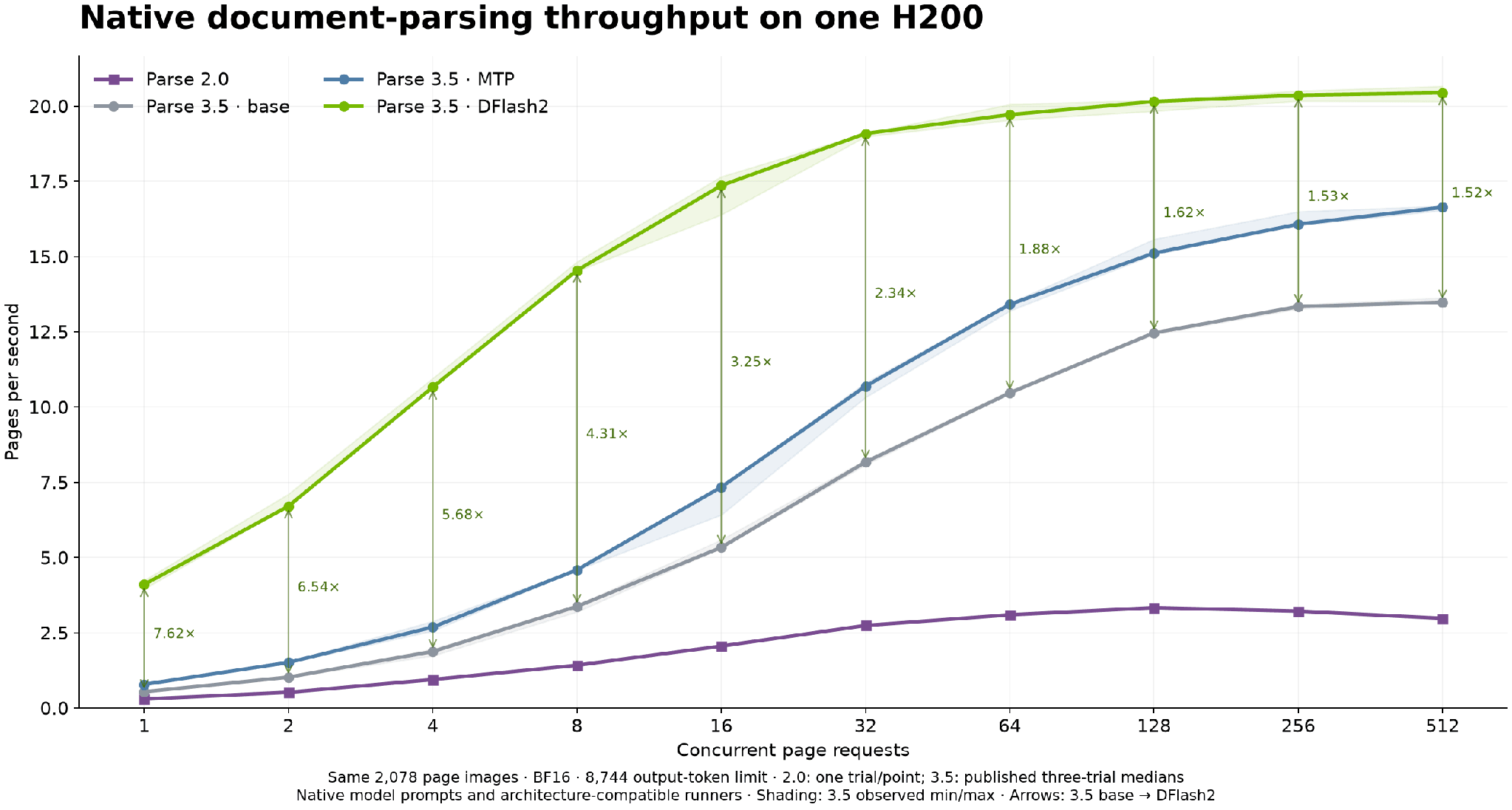
The test was a single pass on an H200 in BF16, with the same 2,078 pages. NVIDIA's results:
- DFlash2 speeds things up 7.62x at concurrency 1 and 1.52x at concurrency 512, versus Parse 3.5 without speculation
- At concurrency 512, Parse 3.5 does 13.48 pages per second without speculation and 20.44 with DFlash2
- Parse 2.0 does 2.98 pages per second at the same point
- That equals 4.53x and 6.86x the throughput of Parse 2.0
DFlash2's gain is larger with few concurrent requests and shrinks under high load, which makes sense for a system that is already saturated.
One, Two, or Three Passes: Quality vs. Throughput
The speed headroom lets you reprocess difficult regions. NVIDIA describes three modes:
- Single pass: reads the entire page once
- Dual pass: crops detected tables and charts and reprocesses them in more detail
- Triple pass: uses the model in detection mode to check whether any boxes or text were missed and re-extracts whatever it finds
In the published benchmark evaluation, dual and triple pass add 2.18 and 2.46 points on ParseBench over single pass. Each crop can become an extra request, so the quality gain costs throughput.
Comparison Limits
The numbers are NVIDIA measurements. Parse 2.0 used one attempt per point, while Parse 3.5 reports the median of three attempts. This favors Parse 3.5's reading, and the methodological difference is worth noting.
The test uses a single GPU and a single page set. On different hardware, with different documents, and a different inference server, results change. To decide, run your own PDFs.
For those building agents with document reading, the practical shift is this: you can trade throughput for quality depending on page type. It's the same logic of gaining speed without changing output that we saw in the Inkling 2 Mini with DSpark benchmark and the Nemotron 3.5 Bolt with DFlash. For the agent-side content search angle, also see the Box partnership with Nemotron.
Frequently asked questions about NVIDIA's Nemotron 3.5 Parse
What is Nemotron 3.5 Parse?
It is a compact NVIDIA model that turns page images into structured data. It returns text in reading order, content classes, bounding boxes, and table and chart records for RAG and agents.
How much does DFlash2 speed up Parse 3.5?
On H200 in BF16, 7.62x at concurrency 1 and 1.52x at concurrency 512, versus Parse 3.5 without speculation. At 512, it goes from 13.48 to 20.44 pages per second, according to NVIDIA.
What did NVIDIA release alongside the model?
Three synthetic datasets: Synthetic Charts V1 with 9.98 million examples, Synthetic Tables V1 with 1 million, and OCR Synthetic Multilingual v2 with 7.9 million. There is also a fine-tuning recipe and the DFlash2 speculator.
Does running two or three passes improve extraction?
Yes, at a throughput cost. In the benchmark evaluation, double and triple passes add 2.18 and 2.46 points on ParseBench over a single pass, according to NVIDIA.
Are the numbers independent?
No. They are NVIDIA's own measurements, on an H200, with 2,078 pages. Parse 2.0 used one attempt per point and Parse 3.5 used the median of three. Test with your documents before deciding.
What Changes for Those Building Document Agents
Having the model, synthetic datasets, and speculator in the same package reduces the work of building your own document reader. Those processing many pages benefit from the throughput. Those dealing with dense tables can accept dual or triple pass.
The final result depends on your documents. Measure with a real sample before migrating.
Got a stalled idea? Put Nemotron 3.5 Parse to work on it and build your AI agent squad on bridgecode.
Source: NVIDIA
Tags:#Nemotron#NVIDIA#OCR#DFlash2#Benchmark

Developer and creator of bridgecode, an agentic development environment for orchestrating squads of AI agents. Helps people going from vibe coding to professional development move from idea to shipped product.
Related articles
Benchmarks
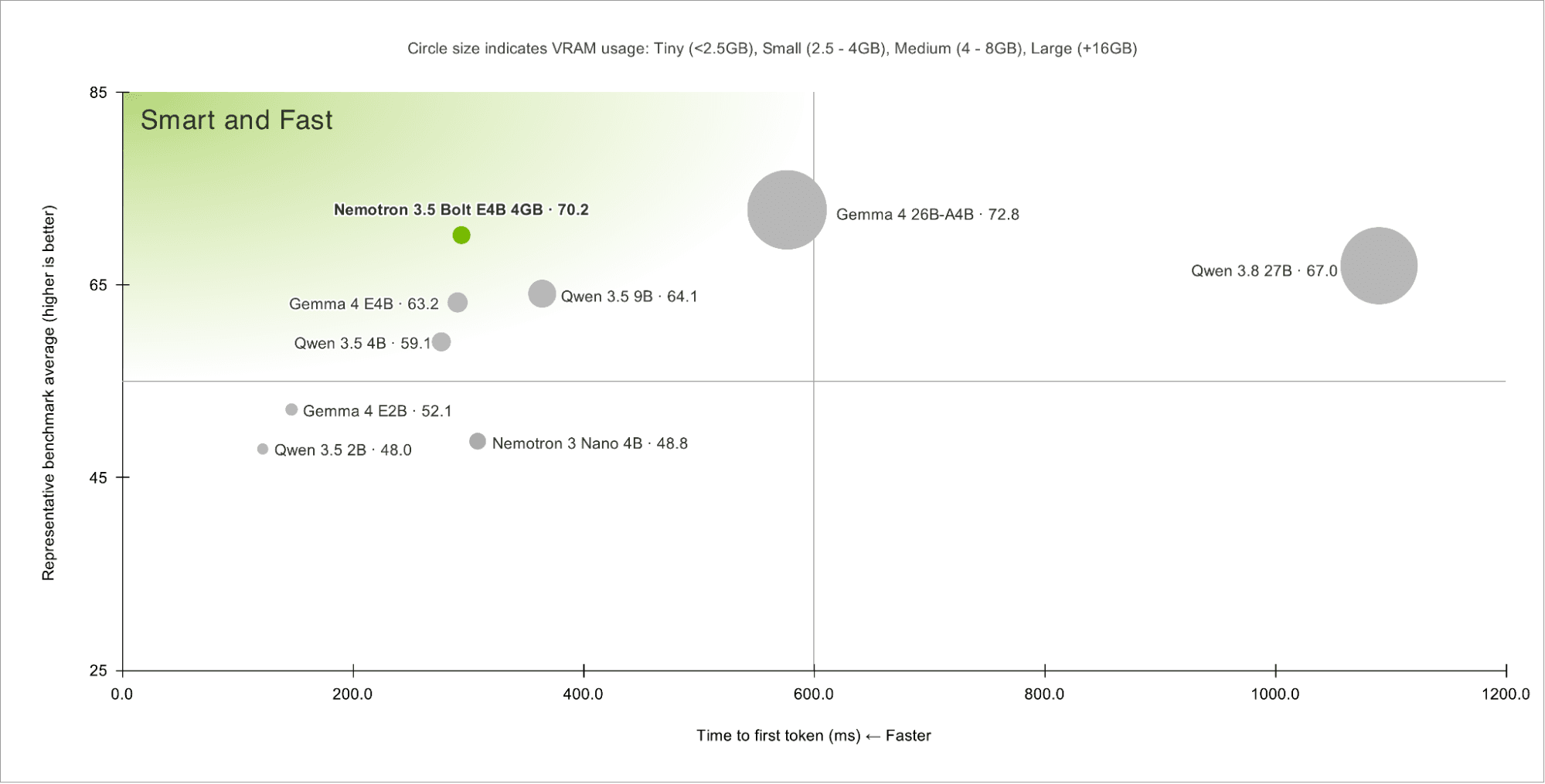
Nemotron 3.5 Bolt: 21 benchmarks and 2.74x faster
Nemotron 3.5 Bolt E4B 4GB from NVIDIA: a 4 GB model with the highest average across 21 benchmarks and 2.74x faster decoding speed with DFlash.
5 min
Benchmarks
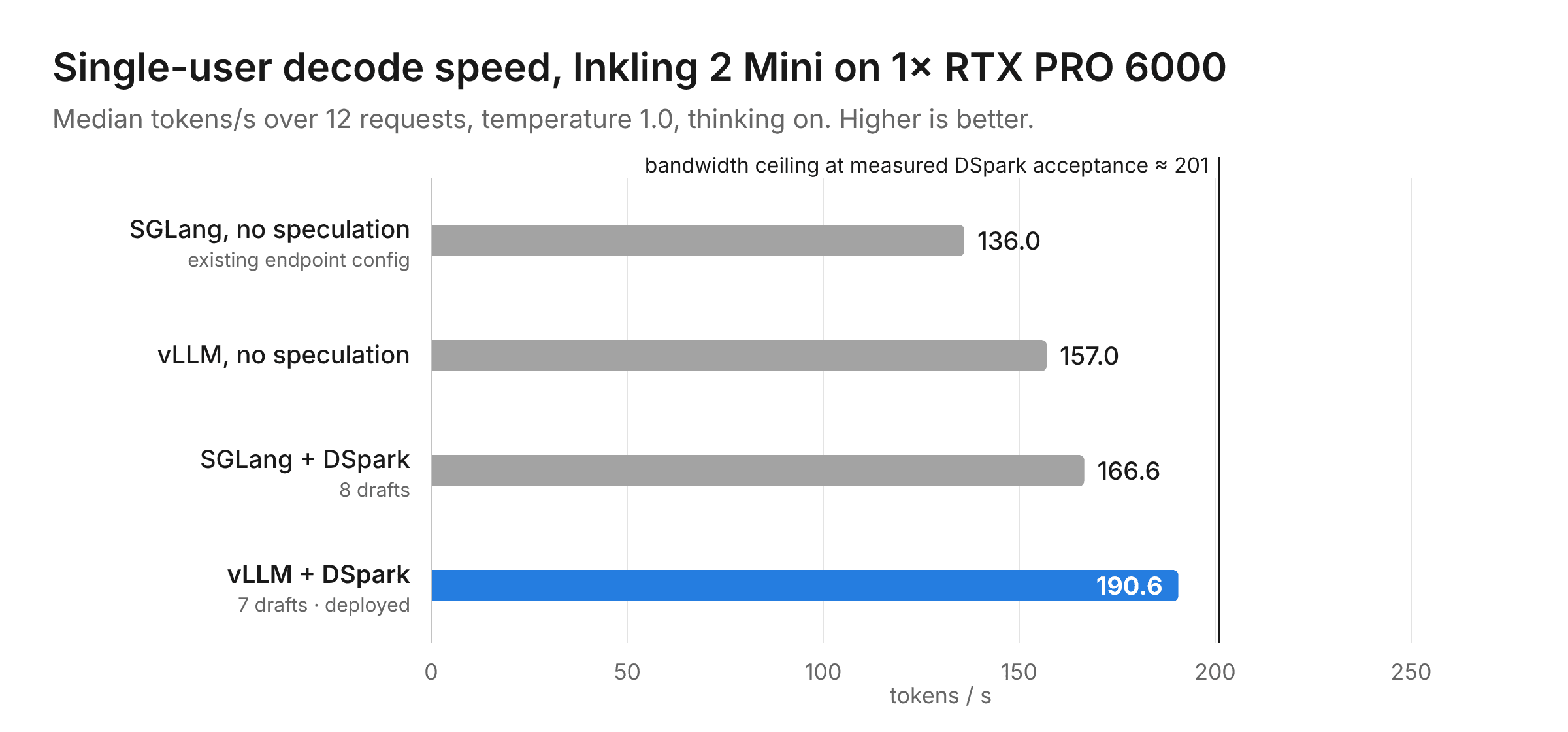
Inkling 2 Mini reaches 190 tok/s with vLLM and DSpark
Hugging Face tested Inkling 2 Mini on an RTX PRO 6000: from 136 to 190.6 tok/s with vLLM and DSpark. See the method, the numbers, and the limits.
6 min
Benchmarks
llama.cpp x AMD: public dashboard measures Ryzen and Radeon
ggml-org has opened a public dashboard that measures llama.cpp on AMD Ryzen and Radeon. See the method, the Qwen3.5-0.8B numbers, and the test limits.
6 min