
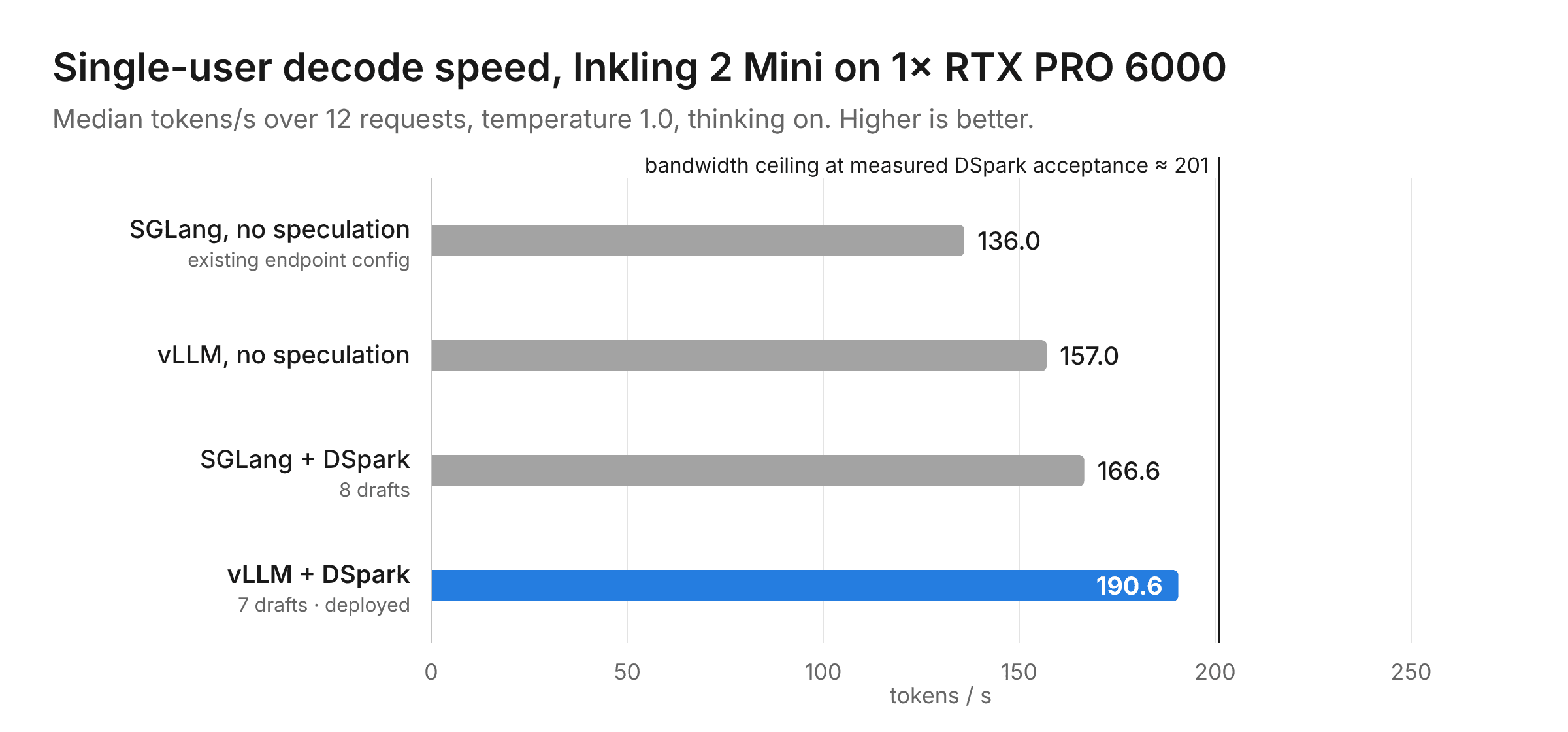
Hugging Face published an Inkling 2 Mini inference benchmark on November 25, 2026, running on a single NVIDIA RTX PRO 6000 GPU with 96 GB. The result: single-user decode speed rose from 136 to 190.6 tokens per second, a 40% gain.
Benchmarks6 min
Inkling 2 Mini reaches 190 tok/s with vLLM and DSpark
Hugging Face tested Inkling 2 Mini on an RTX PRO 6000: from 136 to 190.6 tok/s with vLLM and DSpark. See the method, the numbers, and the limits.
The biggest AI newsletter in the World
Get AI articles in your inbox
Technical curation on models, agents and coding tools. No spam, unsubscribe anytime.
The tuning was done by a code agent using a fixed experiment protocol. That makes the benchmark useful for anyone who wants to serve the model locally or on a dedicated endpoint.
In this article you will see:
- What was measured and on which hardware
- The numbers for each configuration
- The test limits and what was left out
- How to reproduce the winning command
What Hugging Face measured on Inkling 2 Mini
The Inkling 2 Mini is an open model with roughly 26B total parameters and 3B active per token. It accepts multimodal inputs and has a 1M token context window.
The architecture is unusual: a looping Mixture of Experts, meaning a model that activates only a few experts per token. There are 24 physical layers, and the middle 12 run three times, so each token passes through 48 layers.
The checkpoint comes in mixed NVFP4 and MXFP8, with an embedded DSpark drafter for speculative decoding. In this technique, a small model proposes several tokens and the main model verifies them all at once.
For the model's overall scoreboard, read our Inkling 2 Mini analysis on the Intelligence Index. This post covers only serving speed.
How the test was run: method and sample
The agent received the skill inference-optimisation, the CLI hf, and access to Hugging Face Jobs. The rule was to change one variable at a time and compare each candidate against two control runs.
There were 46 valid runs. All used six fixed prompts (code, explanation, story, comparison table, bash script, and historical summary), temperature 1.0, thinking enabled, and 512 output tokens.
With speculation active, each measurement used 12 repetitions. The script measures single-user decode, aggregate throughput with multiple users, prefill, and time to first token.
The Job GPU is the same as the Hugging Face nvidia-rtx-pro-6000 endpoint, so the lab numbers approximate production use.
Results: vLLM with DSpark leads decode
The official chart shows single-user speed across the four tested configurations.
The table summarizes the configurations measured on an RTX PRO 6000:
| Configuration | 1 user (tok/s) | 8 users (tok/s) |
|---|---|---|
| SGLang without speculation (base) | 134 to 139 | 543 to 598 |
| vLLM without speculation | 157.0 | 638 |
| SGLang with DSpark (8 drafts) | 166.6 | not measured |
| vLLM with DSpark (7 drafts) | 190.6 | 716 |
| Published endpoint, over internet | 194.9 | 673 |
Simply switching from SGLang to vLLM nightly gave about 15% gain. Enabling DSpark with 7 drafts and probabilistic sampling added another 21%.
Throughput with 8 users went from roughly 570 to 716 tok/s, a 26% increase. The community already had a result of 167.7 tok/s with SGLang and DSpark on LocalMaxxing for the same GPU, and the Hugging Face test surpassed it.
Why speed plateaus near 190 tok/s
The team measured the board: 1,469 GB/s copy bandwidth. Since each token traverses 48 layer visits, decode reads about 5.6 GB of weights per step, yielding a ceiling of roughly 256 tok/s without speculation.
With speculation, the MoE activates more experts when verifying several tokens together, and the ceiling drops to about 201 tok/s. At 190.6 tok/s, the configuration is already near 95% of that limit.
Measured acceptance was about 2.3 tokens per step at temperature 1.0. Pushing further would require a drafter with higher acceptance or a verification pass that touches fewer experts.
What didn't work and the test limits
Several flags failed. Short drafts (3 to 6) were rejected at startup because the checkpoint requires 7 tokens in vLLM. Greedy sampling from the drafter dropped speed by 11% in vLLM.
Some SGLang tweaks appeared to yield 4% gains, but they didn't replicate against fresh controls. SGLang variance reached ±4.5%, versus 0.4% for vLLM.
The limits matter for anyone deciding:
- The hardware is a single RTX PRO 6000. On other GPUs, results may differ.
- The official recipes target B200 and GB300, and the vLLM used is a nightly build.
- The benchmark measures speed, not response quality.
- There are six prompts and outputs are 512 tokens, so long tasks may behave differently.
How to reproduce the winning configuration
The command below comes from the Hugging Face report. It limits context to 262,144 tokens and memory to 85%, two flags required for DSpark to start on 96 GB.
Terminal
vllm serve thinkingmachines/Inkling-2-Mini \
--tool-call-parser inkling \
--enable-auto-tool-choice \
--reasoning-parser inkling \
--max-model-len 262144 \
--gpu-memory-utilization 0.85 \
--speculative-config '{"method":"dspark","num_speculative_tokens":7,"draft_sample_method":"probabilistic"}'The team validated the output before publishing the endpoint. At temperature 0, 6 of 6 prompts produced identical output with and without speculation, and needle-in-a-haystack retrieval passed 3 of 3 up to 250k tokens.
If you want to better understand local inference tools, also see our guide to the best GitHub repos for running LLMs locally and the llama.cpp benchmark dashboard on AMD.
Frequently asked questions about Inkling 2 Mini on the RTX PRO 6000
What was the speed of Inkling 2 Mini on the RTX PRO 6000?
The best configuration reached 190.6 tok/s for a single user, with vLLM nightly and DSpark with 7 drafts. The baseline with SGLang without speculation ranged from 134 to 139 tok/s, according to Hugging Face.
What is DSpark in Inkling 2 Mini?
It is a speculative decoding drafter included in the model checkpoint. It proposes multiple tokens per step and the main model verifies them all together, which speeds up generation without changing the output at temperature zero.
Does the extra speed change the model's responses?
Not in Hugging Face's tests. At temperature 0, outputs with and without speculation were byte-for-byte identical across 6 out of 6 prompts. The team also avoided rejection methods that alter the distribution.
Can the result be reproduced on another GPU?
There is no guarantee. The numbers apply to a 96 GB RTX PRO 6000, and the official serving recipes target B200 and GB300 GPUs. On other cards, flags and performance may vary.
What is the theoretical speed limit on this GPU?
Hugging Face estimated around 201 tok/s for speculative decoding at the measured acceptance level. At 190.6 tok/s, the configuration already uses about 95% of the card's memory bandwidth.
What changes for those serving open models
The case shows that the choice of inference engine and speculative decoding weighs as much as the model. A 40% gain came from configuration alone, without swapping hardware.
The practical advice is to measure on your own hardware, with repeated controls, before adopting any flag. Lab numbers, even good ones, don't replace your use case.
From draft to production-ready: split the work among specialist agents and track every step in bridgecode.
Source: Hugging Face
Tags:#Inkling 2 Mini#vLLM#DSpark#Hugging Face#inferência local#benchmark

Developer and creator of bridgecode, an agentic development environment for orchestrating squads of AI agents. Helps people going from vibe coding to professional development move from idea to shipped product.
Related articles
Benchmarks
llama.cpp x AMD: public dashboard measures Ryzen and Radeon
ggml-org has opened a public dashboard that measures llama.cpp on AMD Ryzen and Radeon. See the method, the Qwen3.5-0.8B numbers, and the test limits.
6 min
Benchmarks
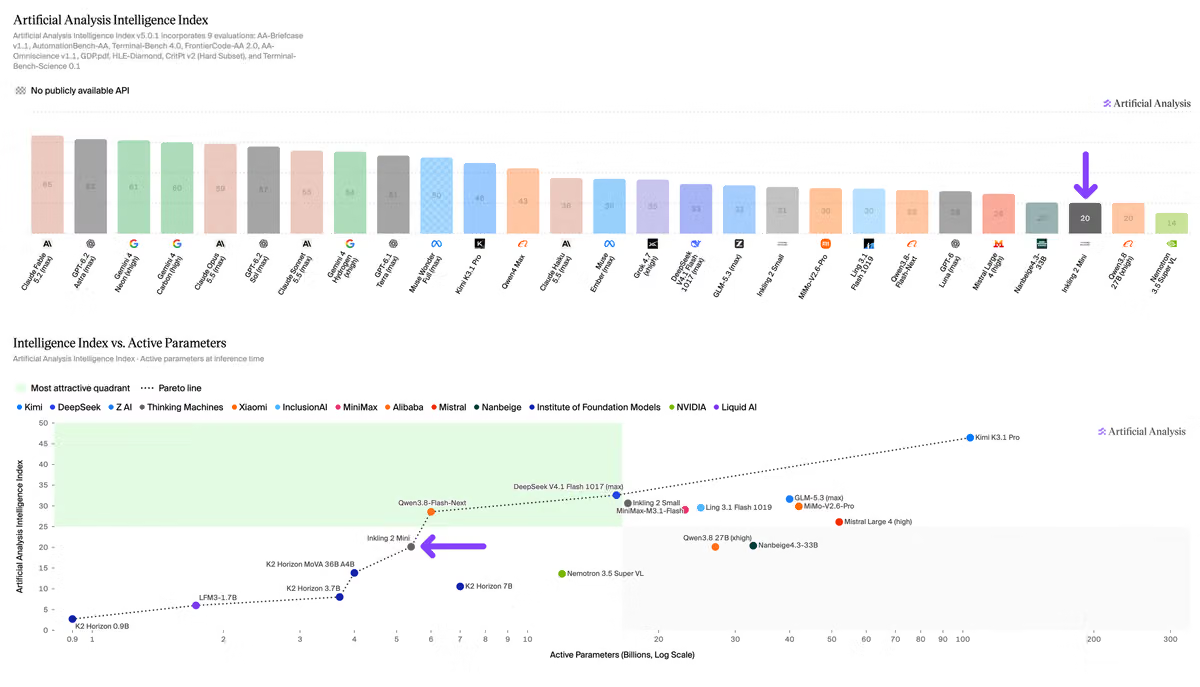
Inkling 2 Mini scores 20 on Intelligence Index with 5.4B active parameters
Artificial Analysis measured the Inkling 2 Mini, an open model from Thinking Machines: 20 on the Intelligence Index, 5.4B active parameters, and a per-task cost six times lower than Qwen3.8 27B.
5 min
Benchmarks
GigaChat 4 708B: SWE-bench 80.9 and 1M Context, MIT
ai-sage released GigaChat 4, a 708B MoE with 41B active parameters, 1M context, and an MIT license. See the SWE-bench, Terminal-Bench numbers and the limits of the comparison.
6 min