
On October 29, 2026, Doximity published a dosing benchmark. Nine language models got at least 2.3% of the evaluated responses wrong.

Doximity Benchmark: LLMs Get 2.3% of Doses Wrong
Doximity evaluated nine LLMs on 261,508 doses and found at least 2.3% errors, including serious or potentially lethal failures.

Marcelo Santiago
Criador do bridgecode
The biggest AI newsletter in the World
Get AI articles in your inbox
Technical curation on models, agents and coding tools. No spam, unsubscribe anytime.
The result measures a specific risk of clinical AI. It does not prove that all medical use of LLMs is unsafe.
In this article you will see:
- How Doximity set up the dosing test.
- Which errors appeared most frequently.
- What DoseCheck checks without another LLM.
- What the benchmark allows us to conclude, and what it does not allow.
What Doximity evaluated in the dose benchmark
The evaluation brought together nine LLMs released in 2026 and dosing questions inspired by physician consultations. The publication reports 8,530 questions answered per model, covering 2,204 medications.
In total, Doximity analyzed 261,508 dosages. The company says the error rate of at least 2.3% is a conservative lower bound, not a complete count of all possible failures.
The questions included factors that change a recommendation, such as age, weight, renal or hepatic function and drug interactions. The test checked whether the models considered this information when it was in the prompt.
This focus matters because a dose does not depend only on the drug name. Formulation, route of administration, frequency and the person's conditions can also change what would be appropriate.
The test evaluated responses without external tools and with reasoning budget at the lowest level, as described in the chart. Therefore, it measures a specific configuration, not all ways to use the same models.
What Doximity's numbers reveal about dose errors
Doximity reports that at least 2.3% of dosages were wrong. The rate is presented as conservative because some failures may not be identified by the classification method used in the study.
Almost 20 responses per thousand contained a serious error, according to the EQUIP scale cited by the company. In a sensitivity analysis with the NCC MERP scale, about 30.5 responses per thousand fell into categories E to H.
The publication classifies 43.8% of detected errors as serious and 3.4% as potentially lethal.
These percentages describe the errors identified in the study, not the proportion of all responses given in real world use.
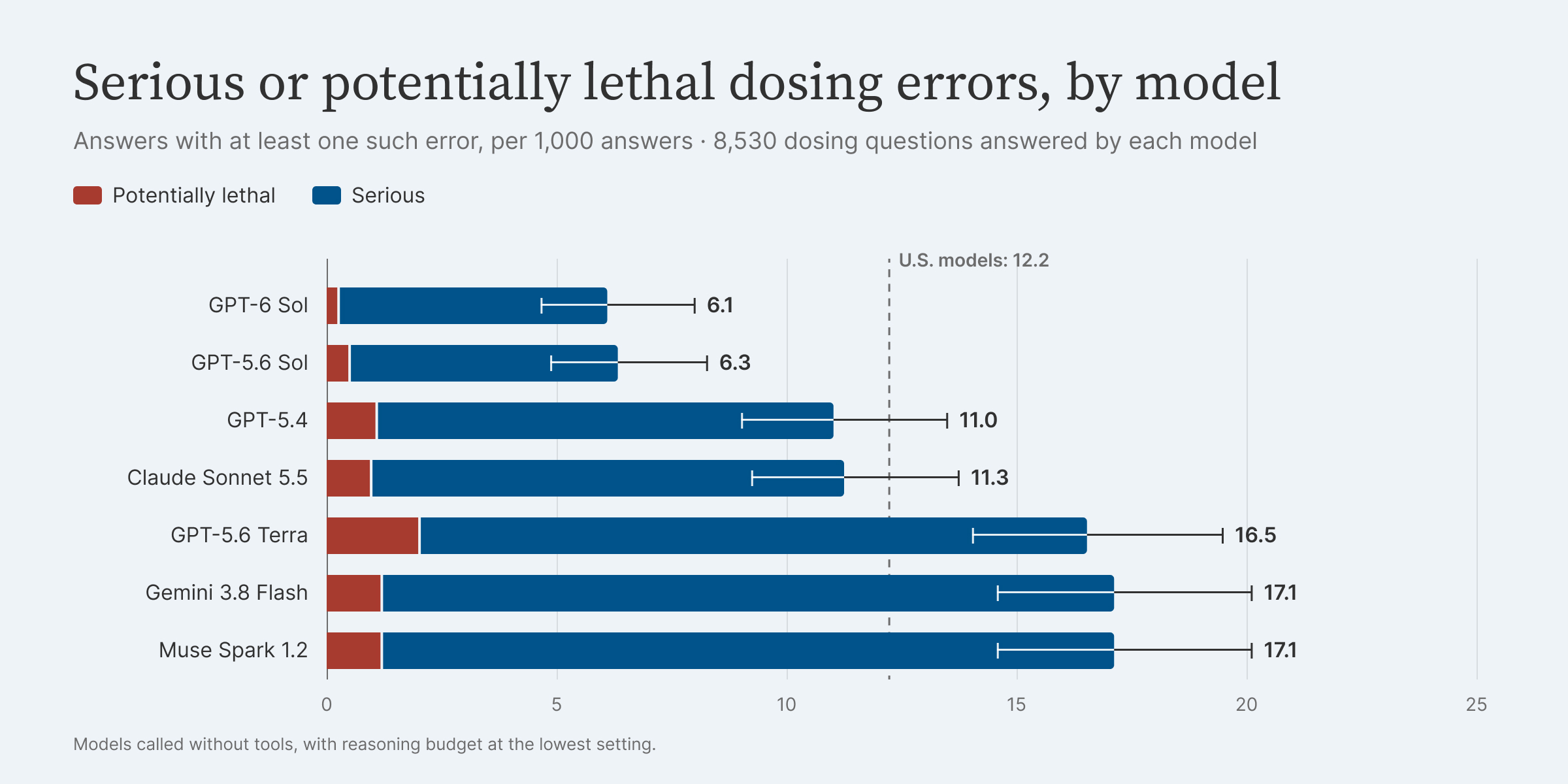
The most common pattern was failing to adjust the dose for patient characteristics, even when the question provided age, weight or clinical conditions. Doximity also observed higher risk with medications approved in 2024 or later.
In the analysis released, the most recent medications had 5.1 times the odds of error, after adjustments for model, question type and route of administration. The company reports a confidence interval of 3.9 to 6.5 for this estimate.
| Measure reported by Doximity | Result |
|---|---|
| Models evaluated | 9, all released in 2026 |
| Questions answered per model | 8,530 |
| Medications covered | 2,204 |
| Dosages evaluated | 261,508 |
| Incorrect dosages | At least 2.3% |
| Serious errors | Almost 20 per thousand responses |
How DoseCheck verifies a dose without consulting another LLM
Alongside the study, Doximity introduced DoseCheck, a dosage verification layer for Doximity Ask. Instead of asking another model to review the answer, the system compares claims against a structured drug database.
The company describes a flow that extracts the drug, dose, route, frequency and relevant indications. Then it compares those fields with structured references and flags when it finds a match.
According to Doximity, the RxIndex database combines FDA labeling, guidelines and primary literature. The company reports coverage of 1,900 monographs and more than 36,000 dosing regimens, broken down by indication, population and route.
When the dose matches the records, the clinician sees a green seal and can open the full reference.
The company says the check returns in under 100 milliseconds. That speed is vendor reported, not an independent audit.
The publication itself stresses that DoseCheck does not replace clinical judgment.
The study and the product are different things. The results describe model responses, while the tool applies a deterministic check after generation.
What Doximity's benchmark does not prove about clinical AI
The announcement is a publication from Doximity itself, which also develops DoseCheck.
That context does not invalidate the data. Still, it matters when interpreting a test published by a company that offers a related solution.
The sample does not represent all models, versions, medical questions or flows with search and tools.
The result does not predict the error rate of a specific product. For that, the evaluation would need to be repeated in that system's configuration and cases.
This caution applies to benchmarks in general. In the SnowPR test with real world coding tasks, the team defines what can be generalized.
To compare test types, see the analysis of the Artificial Analysis Index v5.
For those building applications, the lesson is to separate probabilistic tasks from exact checks.
A model can summarize evidence. Units, limits, conversions and dosing rules require reliable sources, explicit validation and review by qualified professionals.
The benchmark shows why fluency is not enough to decide if a system is safe.
In high risk areas, tests should cover edge cases, version changes, missing data and extraction failures. They also need to record the source of each rule.
Frequently asked questions about the Doximity dosing benchmark
What did Doximity evaluate in the dosing benchmark?
Doximity tested nine LLMs with dosing questions for 2,204 medications. The publication reports 8,530 questions answered per model.
How many incorrect doses did Doximity find?
The company reports at least 2.3% incorrect dosages in the analyzed set. It describes this rate as a conservative lower bound.
Does the benchmark prove that all LLMs are unsafe for medicine?
No. It covers nine models and a specific configuration of questions without external tools, so it does not represent all models or all clinical workflows.
What does DoseCheck do?
DoseCheck compares dose fields, such as medication, amount, route and frequency, with a structured database. Doximity says it does not replace clinical judgment.
Did Doximity publish a universal ranking of models?
No. The publication presents results from a delimited task and its own method, not a ranking that determines which model is best for any medical use.
Deterministic validation needs to accompany clinical AI
Doximity's study is not a universal model ranking. It is a quantified warning about a narrow and important task, with a test configuration described by the company itself.
For technical teams, the prudent path is to measure the system that will actually be used and add deterministic checks where there is a verifiable answer.
Clinical decision making remains with professionals, not with a benchmark percentage.
From draft to finished product, split the work among specialist agents and track each step on bridgecode.
Source: Doximity
Tags:#Doximity#LLM#benchmark#segurança clínica#DoseCheck#dosagem
Developer and creator of bridgecode, an agentic development environment for orchestrating squads of AI agents. Helps people going from vibe coding to professional development move from idea to shipped product.
Related articles
Benchmarks
CloudOpsBench: AI agents in cloud operations
CloudOpsBench measures how AI agents perform real cloud operations tasks. The best agent solves 60.6% of the 45 tasks on AWS. See the numbers.
7 min

Benchmarks
SuperCLUE November 2026: different leaders by category
SuperCLUE published in November 2026 a table with 19 models and different leaders in each category. The split ranking is more useful as a shortlist map than as a final verdict.
6 min

Benchmarks
BenchLeader November 7: Claude Opus 5.5 tops the aggregated benchmark index
BenchLeader updated its index on November 7, 2026. Claude Opus 5.5 leads with 69.3 points, closely followed by Gemini 4 Carbon and GPT-6 Astra.
5 min