
Alibaba unveiled Qwen4-Max, the new flagship model of the Qwen family, in an announcement on the official Qwen blog dated November 16, 2026. Reuters had already reported the launch on Sunday, the 15th. The model brings 2.4 trillion parameters, native vision and a 1 million token context.
Newsletter5 min
Qwen4-Max arrives with 2.4T parameters and 1M context
Alibaba launched Qwen4-Max, a closed model with 2.4T parameters, 1M token context and native vision, available on QwenCloud.
The biggest AI newsletter in the World
Get AI articles in your inbox
Technical curation on models, agents and coding tools. No spam, unsubscribe anytime.
This matters for people building with agents because Qwen4-Max targets long tasks, tool use and revisable results. At the same time, it is a closed model, with no weights to download.
In this article you will see:
- What Qwen4-Max is and what Alibaba claims about it
- The new architecture: sparse attention, gated residuals and N-gram
- The efficiency numbers, code safety and benchmarks
- How to test it today and what has not been confirmed yet
What is Qwen4-Max, Alibaba's new flagship model
Qwen4-Max is the first model in the Qwen4 family. Alibaba describes it as an "AI teammate" for work, creation and scientific discovery, able to run long duration tasks.
According to the official Qwen blog, it has 2.4T parameters in the backbone, 71B activated per token and an additional 328B of N-gram Embedding parameters. Active parameters are the part of the network used on each token, which defines the cost of running the model.
The announcement cites applications such as 3D modeling in Blender, game development in Unity, Unreal and Godot, production line planning and work in finance, law and health. These are demonstrations from the company itself, with no independent replication so far.
What the launch is not: it is not an open model and it does not bring the weights of the smaller models. Alibaba only says that smaller versions of the Qwen4 family will come as open source, with no date.
Qwen4-Max architecture: sparse attention, gated residuals and N-gram
Qwen4 uses a sparse Mixture of Experts, MoE, which splits the model into experts and activates only some per token. The novelty is in three blocks, all described in the announcement.
- GDN + Qwen Sparse Attention, QSA: three Gated DeltaNet layers compress history into fixed size states for each QSA layer, which selects relevant context in small blocks.
- Gated Residual: four parallel residual branches with read and write gates, to improve information flow and training stability.
- N-gram Embedding: context based queries that capture local token patterns with little extra cost.
Qwen says training at 2.4T scale occurred without loss spikes. In internal evaluations, Qwen4-Max-Base had 5% to 13% less bits per byte, BPB, than Qwen3.8-Max-Base, with 25% fewer active parameters. BPB measures how much the model errs when predicting text; lower is better.
Efficiency and code safety: what Alibaba measured
The most useful data for anyone paying per token is efficiency. In the Work360 evaluation, token usage drops about 24% on xhigh effort and 35% on high effort, compared with Qwen3.8-Max. On Terminal-Bench 4.0, the drop is about 48% and 49%.
In the same Work360 evaluation, average cost per task goes from US$ 4.43 to US$ 1.67, a 62% reduction, according to Alibaba. Work360 is a benchmark created by the company itself, with 26 top level domains and 721 specialized fields.
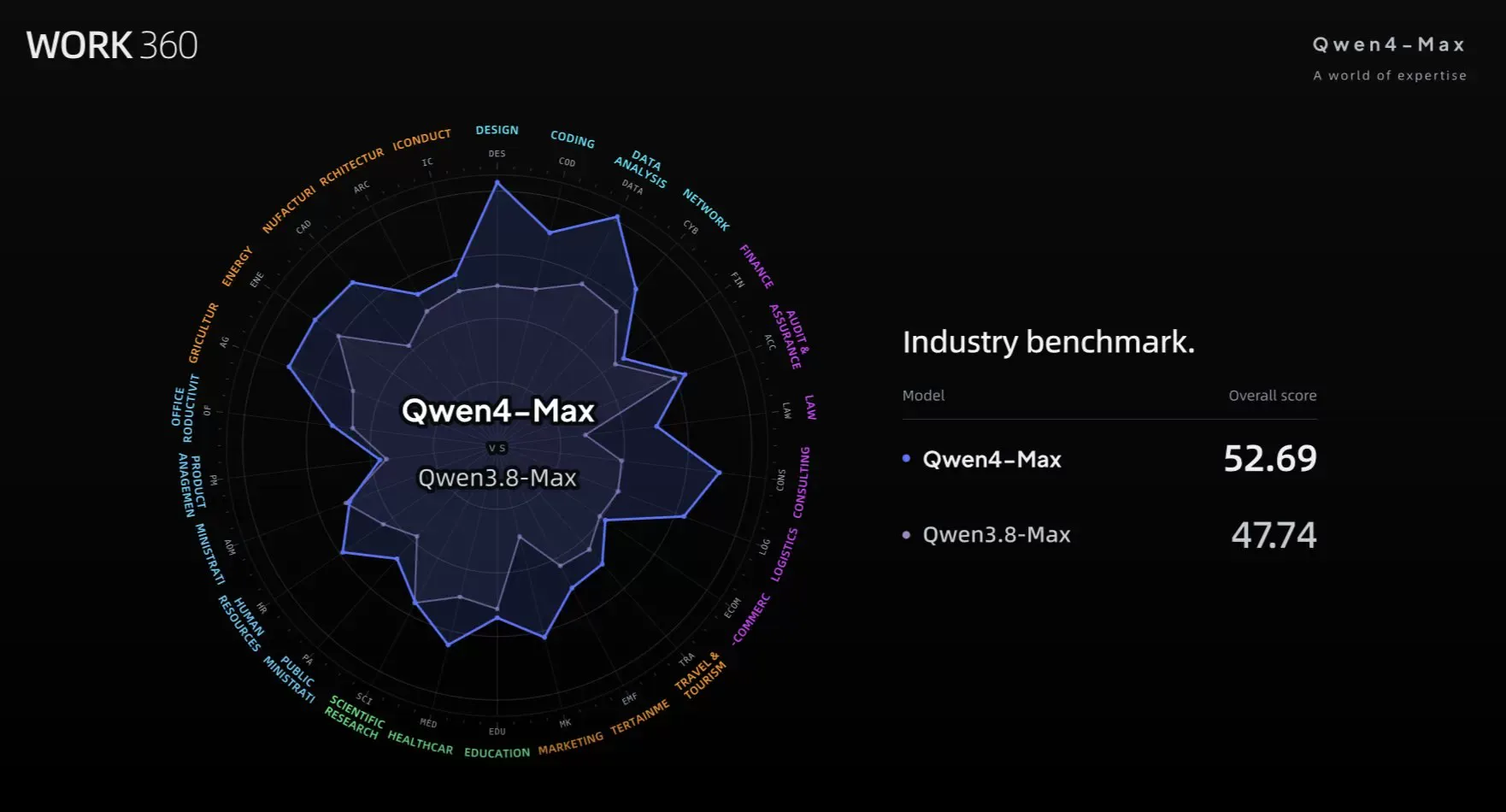
There is also a safety data point. On Last Secure Code Bench, the simultaneous hit rate for function and security rises from 22.0% to 31.8%. Secure code generation across the three levels, function, file and repository, goes from 8% to 14.7%.
Alibaba says internal reviews found no large scale cyber risk capabilities nor relevant gains in chemical, biological, radiological and nuclear risks. This is an internal assessment, not an external audit.
Qwen4-Max benchmarks: ahead on DeepSWE, behind on Terminal-Bench
The picture is mixed. According to coverage from The Next Web, Qwen4-Max scored 75.7 on DeepSWE v1.1, ahead of Claude Opus 5.5 at 74.2. On Terminal-Bench 4.0, however, it scored 48.5, behind Opus 5.5 (59.6) and Kimi K3.1 (67.2).
For coding agents that spend the day in shell, build and deploy, Terminal-Bench carries more weight than a single score. It is worth running both tests on your own repository before switching models.
Remember the charts are from Alibaba, and the competitor scores were also compiled by them. Some results come from public leaderboards like Arena and Artificial Analysis, cited in the footnotes of the announcement.
How to test Qwen4-Max today
The model is available on QwenCloud with ID qwen4-max, via API or Token Plan. Documentation is in the QwenCloud developer guide.
The announcement also mentions QwenWork, Qoder and QwenStudio as places to use the model. There are no weights to run locally.
If you already follow the Qwen line, it is worth reading how the community uses the previous generation, such as the fine tune Arete-27B from Nous Research on Qwen3.8-27B, and the Cohere report on Qwen3.8 in a security test.
To compare with the competition on the same theme of models that split work across agents, also check out the Orchestrator from Google Antigravity with Gemini 4 Carbon and Hydrogen.
Frequently asked questions about Alibaba's Qwen4-Max
What is Qwen4-Max?
It is the first model in the Qwen4 family, launched by Alibaba. It has 2.4 trillion parameters, native vision and a 1 million token window, according to the official Qwen blog.
Does Qwen4-Max have open weights?
No. Max is closed. Alibaba says smaller models in the Qwen4 family will be open soon, with no confirmed date in the announcement.
Where can you use Qwen4-Max today?
Via QwenCloud (ID qwen4-max), via API or Token Plan, and also in QwenWork, Qoder and QwenStudio, as per the announcement.
Is Qwen4-Max better than Claude Opus 5.5?
It depends on the test. In numbers published by Alibaba itself, it leads on DeepSWE v1.1 (75.7 versus 74.2), but trails on Terminal-Bench 4.0 (48.5 versus 59.6).
Are the benchmarks independent?
No. The charts are from Alibaba, including competitor scores. Some results cite public leaderboards such as Arena and Artificial Analysis.
What changes for people using AI agents with Qwen4-Max
For those building flows with multiple models, Qwen4-Max comes in as another heavyweight option, with long context and a claim of lower cost per task. The efficiency promise is strong, but it comes from internal testing.
The sensible path is to measure in your own case: same task, same repository, comparing tokens spent, tests passed and time. Only then is it worth changing the model for an agent in your flow.
Did Qwen4-Max catch your attention? Put this new model to work in an AI agent squad at bridgecode, each in its role.
Source: Qwen
Tags:#Qwen#Alibaba#modelos de IA#agentes de código

Developer and creator of bridgecode, an agentic development environment for orchestrating squads of AI agents. Helps people going from vibe coding to professional development move from idea to shipped product.
Related articles

Newsletter
Tencent launches Hy4 Flash with 1M context and low price
Tencent launched Hy4 Flash on November 17, 2026: 224B parameters, 12B active, 1M token context window and a focus on low cost per task.
5 min
Newsletter
AWS Emulator brings the AWS cloud to your laptop
AWS launched AWS Emulator, which runs AWS APIs on your laptop to test apps and code agents without a cloud account and without extra fees.
5 min
Newsletter
GitHub Copilot uses browser in preview with Chrome extension
GitHub Copilot now has browser use in public preview as of 17/11/2026, with a Chrome extension, in the CLI, app, VS Code and JetBrains.
5 min