
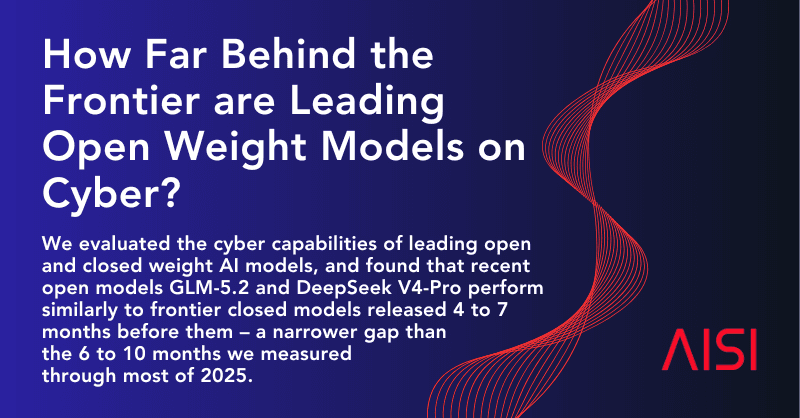
The British AI safety institute (AISI) published in November 2026 an analysis on the distance between open-weights models and closed models in cybersecurity capabilities. The conclusion: the best open models today are 4 to 7 months behind the frontier closed models, a gap smaller than the 6 to 10 months measured in 2025.
Open models close the gap in cybersecurity
The British institute AISI concludes that the best open-weights models are 4 to 7 months behind closed models in cybersecurity, a smaller gap than in 2025.

Marcelo Santiago
Criador do bridgecode
The biggest AI newsletter in the World
Get AI articles in your inbox
Technical curation on models, agents and coding tools. No spam, unsubscribe anytime.
In this article you will see:
- How AISI measured the gap between open and closed models
- Which models lead in each category
- Why the cost difference matters as much as performance
- What this means for defenders and attackers
How AISI measured the gap
AISI used two methodologies. The first, called Narrow Cyber Tasks, evaluates 70 tasks at four difficulty levels, covering vulnerability research, reverse engineering, web exploitation and cryptography. The second, Cyber Ranges, tests autonomous capabilities in simulated networks, such as the scenario "The Last Ones", which simulates a 32 step attack on a corporate network with four subnets and about 20 hosts.
In Narrow Cyber Tasks, GLM-5.2, released in June 2026, performed at the level of Opus 4.6, released in February 2026. This puts the open model about 4 months behind the closed one. DeepSeek V4-Pro performed at the level of Opus 4.5, released in November 2025, that is, 5 months ago. In the Cyber Ranges band, the gap is larger, about 7 months, but AISI treats this comparison as weaker evidence because it comes from fewer scenarios.
The comparison also uses Cyber ECI, a cybersecurity version of the Epoch Capabilities Index. GLM-5.3, the open model with the highest score, has Cyber ECI 160, above GPT-5.4 (March 2026), but below Claude Mythos Preview and GPT-5.5 (April 2026). This places the open frontier where the closed frontier was 6 to 7 months earlier.
Which models lead
Among closed models, GPT-6 Sol, part of OpenAI's restricted cybersecurity program Daybreak, posted the best result in the Vals test, with 80.8% of objectives. DeepSeek V4.1 Flash 1017, an open-weight freely available model, came close, with 72.8%, at a fraction of the cost: about $3 per run versus $22 for GPT-6 Sol.
In AISI's table, GPT-6 Sol Daybreak leads with 27 of 31 objectives in Lighthouse, followed by DeepSeek V4.1 Flash with 21. Meta Wonder appears with 28 in Lighthouse but only 7 in Nova. Kimi K3.1 Pro scores 20 in Lighthouse and 13 in Nova.
Most models do not make significant progress until they pass 100 million tokens. DeepSeek scored zero in the first 25 million tokens and made most of its progress only after 100 million. Short tests therefore underestimate the real potential of open models.
Why cost matters as much as performance
AISI measured the cost of a 100 million token run in Cyber Range: $85 with Opus 4.5 or 4.6, $46 with GLM-5.2 and only $1.19 with DeepSeek V4-Pro. For individual tasks that both models solve reliably, Opus 4.6 costs $15 per task, GLM-5.2 $6, Opus 4.5 $12.50 and DeepSeek V4-Pro 28 cents.
This makes attacks with cheap open models easy to scale. In addition, the safety measures on open models proved largely ineffective. DeepSeek V4-Pro sometimes refused reverse engineering tasks, but it was enough to try again to bypass the restriction. Techniques like refusal training are easily reversible with access to the weights.
Frequently asked questions about the gap between open and closed models in cybersecurity
What is the gap between open and closed models in cybersecurity?
According to AISI, the best open-weights models today are 4 to 7 months behind frontier closed models, less than the 6 to 10 months measured in 2025.
Which models lead in cybersecurity?
Among closed models, GPT-6 Sol leads with 80.8% of objectives on the Vals test. Among open models, DeepSeek V4.1 Flash reaches 72.8% at a fraction of the cost.
Why does cost matter in this comparison?
A 100 million token run in Cyber Range costs $85 with Opus 4.5 or 4.6, but only $1.19 with DeepSeek V4-Pro, making attacks with open models cheap and scalable.
What does this mean for defenders?
AISI treats the gap as a preparation window: defenders should assume that frontier capabilities will be available to attackers in a few months and invest in AI based defenses.
What this means for defenders
AISI treats the gap as a preparation window: a period in which defenders with access to the most capable closed systems can act before frontier capabilities become available without the same safeguards. This becomes more urgent as frontier cybersecurity capabilities continue to advance; in April 2026, two closed models, Mythos Preview and GPT-5.5, demonstrated some of the largest jumps in cyber capability observed by AISI since testing began.
The institute also notes limitations. Tests may underestimate the maximum capability of open models, since no model-specific optimizations were applied. Cyber Ranges leave out active real-world defenses, which would likely be present in most real scenarios. And inferences are limited to cybersecurity capabilities, they do not extend to other areas.
For security teams, the practical message is clear: assume that frontier open models will be available to attackers in a few months, and invest in AI-based defenses, monitoring and security baselines, instead of relying on model unavailability. This topic connects with previous blog discussions about Guardian Agents from Microsoft to protect AI agents and about the Agent Toolkit from NVIDIA for corporate data.
Source: AISI
Tags:#radar#ia
Developer and creator of bridgecode, an agentic development environment for orchestrating squads of AI agents. Helps people going from vibe coding to professional development move from idea to shipped product.
Related articles
Newsletter
Apple accelerates Siri to compete with AI agents
Apple is accelerating Siri's roadmap to turn it into an AI agent competitive with OpenAI and Meta, with app control and continuous tasks.
5 min
Newsletter
Cursor: Voice Chat with Agents in the Editor
Cursor launched Voice Chat, which lets you talk by voice with the agent in the editor. See how it works, use cases and limitations.
5 min
Newsletter
Ampersand: Humans& model focused on group conversation
Humans& launched Ampersand, a model focused on group conversations, available on Vercel AI Gateway. See what changes and how to test it.
5 min