
A study published on November 8, 2026 by Pew Research Center analyzed 480 occupations in the United States and found a striking difference: in professions with greater exposure to artificial intelligence, employment among men grew 6.3% for each additional point on the exposure scale, while for women the change was only 0.2%.

Men are advancing faster than women in jobs exposed to AI
A Pew Research Center study of 480 occupations shows that in professions with greater AI exposure, employment for men grew 6.3% per point on the scale, compared with 0.2% for women.

Marcelo Santiago
Criador do bridgecode
The biggest AI newsletter in the World
Get AI articles in your inbox
Technical curation on models, agents and coding tools. No spam, unsubscribe anytime.
In this article you will see:
- How the study measured AI exposure for each profession
- Employment growth numbers for men and women
- Which professions have the highest and lowest exposure to the technology
- What the research says about cause and effect
How the study measured exposure for 480 occupations
The Pew Research Center evaluated 480 occupations based on information from the Occupational Information Network (O*NET), a database from the United States Department of Labor. The classification considers the tasks performed in each profession, the possibility of them being carried out or assisted by generative AI, and the importance of these activities for the work.
The scale used ranges from zero to 3.5. The higher the score, the greater the proportion of important tasks in an occupation that can be performed or assisted by the technology.
The study analyzed the evolution of the number of workers between 2017 and 2019 and from January 2023 to June 2026. The years 2020 to 2022 were excluded from the comparison because of the changes caused by the Covid-19 pandemic in the labor market.
The numbers: 6.3% for men, 0.2% for women
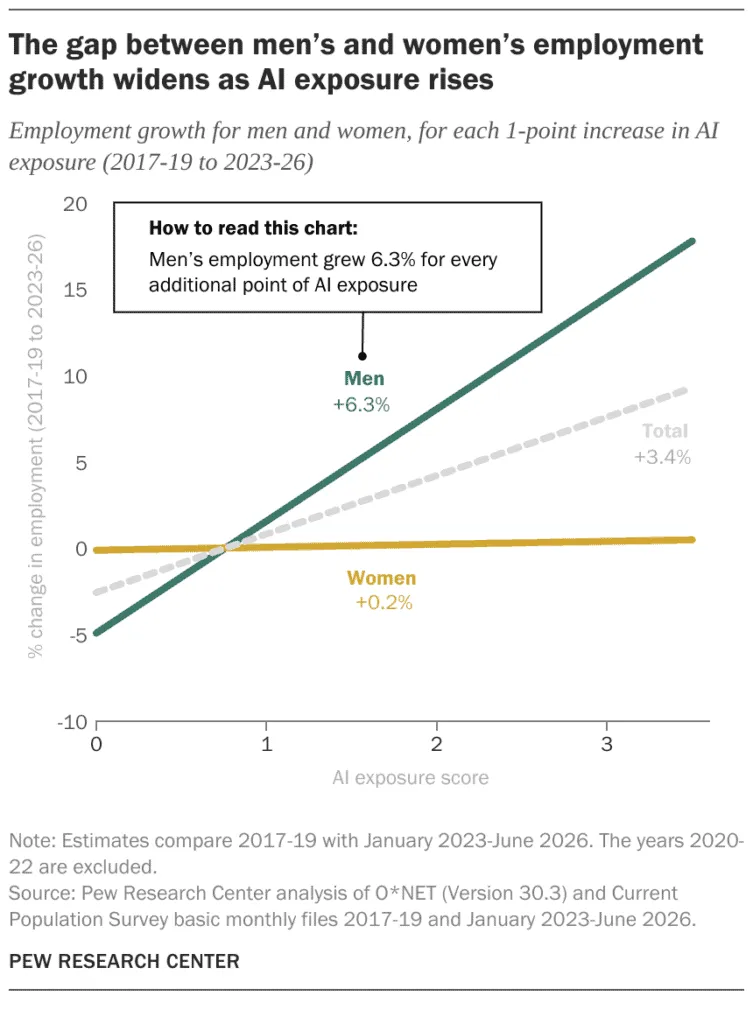
The results indicate that the greater the AI exposure of an occupation, the greater the growth in male employment. For each one point increase on the exposure scale, employment among men grew 6.3%. Among women, the variation was practically null, with an increase of only 0.2%.
The difference was even more evident in professions with the highest exposure to technology. Male employment grew about 24% more in occupations most exposed to AI than in those with the lowest exposure. Female employment growth remained practically the same across the scale.
In professions less exposed to artificial intelligence, the scenario was different: women had higher employment growth than men.
Which professions have the highest and lowest exposure
Among professions with very low exposure are truck drivers, construction workers and cleaning professionals. In the intermediate range are medical assistants, cashiers and audiologists.
Among occupations with very high exposure are accountants, software developers and financial managers. These activities involve tasks related to information processing, reading and writing, which can receive some kind of assistance from generative AI.
The research also identified that the difference in employment growth varies according to the workers' level of education.
Cause or coincidence: what the research says
The survey emphasizes that the relationship between AI exposure and hiring growth does not necessarily mean that the technology is the direct cause of the differences. Other transformations that occurred in the period may also have influenced the results.
The correlation between AI exposure and male employment growth is strong, but the study does not establish causality. It is possible that professions with greater AI exposure are also those that grew for other reasons, such as digital transformation or changes in demand.
Still, the pattern is consistent and deserves attention. Generative AI is changing the composition of the labor market unevenly, and understanding this dynamic is essential for anyone planning a career or hiring.
What this means for people working in technology
For developers or people working with AI, the data reinforces that technology is expanding opportunities in high information processing professions. Software developers are among the occupations with the greatest exposure, and employment in this area grew more among men.
The gender disparity in tech professions is not new, but AI may be amplifying the gap. Women in tech exposed professions did not see the same employment growth, even in areas where AI assists tasks.
For hiring teams, the data suggests AI adoption does not benefit all groups equally. Hiring and talent development strategies need to consider this dynamic to avoid widening existing inequalities.
Frequently asked questions about the Pew study on AI and employment by gender
What did the Pew Research study measure?
It analyzed 480 occupations in the United States and employment trends between 2017-2019 and 2023-2026, correlating them with each profession's exposure to generative AI.
How much did male employment grow in AI-exposed professions?
6.3% for each additional point on the AI exposure scale. In the most exposed professions, growth was about 24% higher than in the least exposed.
What about female employment?
The change was practically flat, with an increase of just 0.2% for each point on the exposure scale. In the least exposed professions, women saw higher growth than men.
Is AI the direct cause of this difference?
Not necessarily. The study does not establish causality. Other transformations during the period may also have influenced the results.
Which professions have the greatest exposure to AI?
Accountants, software developers and financial managers. The least exposed include truck drivers, construction workers and cleaning professionals.
Conclusion: AI is changing the labor market unevenly
The Pew Research Center study shows that AI exposure is associated with greater employment growth among men, but not among women. The difference is significant and consistent across 480 occupations analyzed.
It is still unclear whether AI is the direct cause or if other factors explain the pattern. But the correlation is strong enough to warrant attention from those planning careers, hiring, or defining employment policies.
To understand how AI affects developers' work, see Rich Sutton reinforces that compute alone does not create intelligence. If you want to see how AI agents are changing the way we code, check out Amp Spaces: an agent that coordinates other agents for you.
Source: Olhar Digital
Tags:#IA#mercado de trabalho#Pew Research#gênero#emprego
Developer and creator of bridgecode, an agentic development environment for orchestrating squads of AI agents. Helps people going from vibe coding to professional development move from idea to shipped product.
Related articles

Newsletter
Apple accelerates Siri to compete with AI agents
Apple is accelerating Siri's roadmap to turn it into an AI agent competitive with OpenAI and Meta, with app control and continuous tasks.
5 min
Newsletter
Rich Sutton reinforces that compute alone does not create intelligence
Turing Award winner Rich Sutton reinforces that raw compute is not enough for intelligence and calls for new methods, continuous learning and world models.
5 min
Newsletter
AI auditors detect misbehavior but generate false alarms
AI models catch a good portion of other agents' misbehavior, but they generate a lot of false alarms. See the numbers from Andy Hall's study.
6 min