
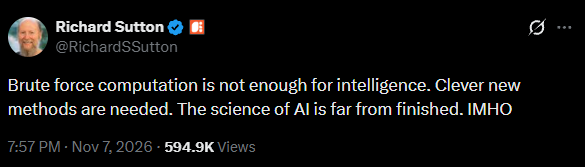
Rich Sutton, Turing Award winner and author of the influential 2019 essay "The Bitter Lesson", published on X on November 8, 2026 a new text that reopens the debate about what really generates artificial intelligence. The central thesis is direct: raw compute alone is not enough. AI science needs new methods and is "far from finished".
Rich Sutton reinforces that compute alone does not create intelligence
Turing Award winner Rich Sutton reinforces that raw compute is not enough for intelligence and calls for new methods, continuous learning and world models.

Marcelo Santiago
Criador do bridgecode
The biggest AI newsletter in the World
Get AI articles in your inbox
Technical curation on models, agents and coding tools. No spam, unsubscribe anytime.
The post resonated strongly in the AI community on X, a sign that Sutton touched a sensitive point. He had already criticized the limits of just scaling large language models, called synthetic data a "big mistake" and defended agents with world models that learn continuously from their own experience. The new text reinforces and organizes these ideas.
In this article you will see:
- What Sutton means by "compute alone is not enough"
- Why synthetic data is, in his view, a dead end
- What world models and continuous learning are
- How Jerry Tworek and Jayden Teoh reacted to the essay
- What this changes for those building with AI
What Sutton means by compute alone is not enough
In "The Bitter Lesson", Sutton argued that general methods that scale with compute end up beating sophisticated hand made approaches. The lesson was about the power of scaling. In the new text, he does not deny that, but corrects a common reading: scaling does not mean throwing more compute at the problem and waiting for intelligence to emerge.
The thesis now is that the real world is infinitely complex. Human expertise becomes a bottleneck and prevents true scaling. It is necessary to discover ideas that grow with compute, instead of relying on human assumptions. Without new methods, more compute only repeats what is already known.
Why synthetic data is a dead end
Sutton had already called synthetic data a "big mistake". The argument is simple: the real world is infinitely complex, and any simulation of it is only "microscopic". Models trained on synthetic data learn a simplified world, not the actual world.
This has a practical consequence. If the training base is an imperfect copy of reality, the model inherits the limitations of the copy. Sutton argues that AI needs to learn from the real world, continuously, and not from a static photograph of it.
World models and continuous learning
Sutton's proposal is to build agents with world models that learn continuously from their own experience. The world is much more complex than the text on the internet captures, and current language models do not keep learning after training.
What is missing is continuous learning without destroying old knowledge. Today, when a model learns something new, it tends to forget what it knew. Solving this is, for Sutton, the real next step for research.
See also how the METR evaluated the acceleration of AI development at Anthropic and how the OpenAI creates a standard for responsible AI infrastructure.
How the community reacted
Jerry Tworek, a researcher who left OpenAI to explore new AI approaches, contextualizes the essay. The bitter lesson still holds, but the more compute goes into training, the more the algorithm matters. Some algorithms scale, others hit dead ends, and many scaling dimensions remain unexplored. The temporary success of transformer scaling, combined with a misreading of the bitter lesson, "hacked the brain of an entire generation of scientists".
Jayden Teoh points to another angle. He has repeatedly seen the bitter lesson stall academic research, with promising ideas discarded for straying too far from the spirit of the essay. In his view, this is not Sutton's fault, but a misreading of the original message.
What changes for those who build with AI
For people who use AI day to day, the message is one of caution and method. Larger and larger models remain useful, but they are not the end of the story. The next generation of systems will depend on continuous learning methods, world models and agents that interact with the real world.
Until that arrives, the best approach is to treat the model as a powerful but limited tool. Break work into smaller tasks, validate results and do not assume the model "knows" what it is doing. Teams building products on AI should plan for transition, not stagnation.
The practical lesson for engineering teams is clear: keep using large models where they shine, but invest in evaluation, domain data and workflows that let you swap models without rewriting the product. The next competitive advantage may not be a bigger model, but the system that learns faster from real world feedback.
Frequently asked questions about Rich Sutton's essay on compute and intelligence
What is The Bitter Lesson?
It is Rich Sutton's 2019 essay arguing that general methods that scale with compute eventually outperform sophisticated handcrafted approaches.
Did Sutton change his mind about scaling?
No. He reinforces the bitter lesson, but corrects the reading that just throwing more compute is enough. New methods remain necessary.
Why are synthetic data a problem?
Sutton calls them a big mistake because the real world is infinitely complex and any simulation is only microscopic, inheriting limitations.
What are world models?
Models that represent the world and allow agents to learn continuously from their own experience without forgetting old knowledge.
Does this affect people who use AI day to day?
Yes. Larger models remain useful, but the next generation will depend on continuous learning and agents that interact with the real world.
Conclusion
Sutton's essay is not an obituary for scaling. It is a reminder that compute is necessary but not sufficient. Real intelligence requires methods that learn from the world, not just more parameters.
Anyone closely following AI knows the biggest changes come when someone questions the orthodoxy. Sutton did that before, in 2019, and he is doing it again now.
CTA
Source: Richard Sutton
Tags:#radar#ia
Developer and creator of bridgecode, an agentic development environment for orchestrating squads of AI agents. Helps people going from vibe coding to professional development move from idea to shipped product.
Related articles
Newsletter
AI auditors detect misbehavior but generate false alarms
AI models catch a good portion of other agents' misbehavior, but they generate a lot of false alarms. See the numbers from Andy Hall's study.
6 min

Newsletter
Palo Alto Networks in talks to acquire agent security startup
Palo Alto Networks is in talks to acquire Clutch Security, an AI agent credential security startup, for US$500 million.
5 min

Newsletter
Underdog launches 32 MB voice model in the browser
Startup Underdog launched Woof, a 32 MB voice model that runs in the browser without internet and is open for download.
5 min