
Vals AI published on November 7, 2026 CyberOffense, a benchmark that measures the ability of AI agents to attack realistic corporate networks. The most striking result: open models, available for free, came within 8 percentage points of the best proprietary model and cost a fraction of the price per run.
Vals CyberOffense: Open Models Breach Corporate Networks
Vals AI released CyberOffense, a benchmark that measures the ability of AI agents to attack realistic corporate networks. Open models came within just 8 points of the best proprietary model and cost a fraction of the price.

Marcelo Santiago
Criador do bridgecode
The biggest AI newsletter in the World
Get AI articles in your inbox
Technical curation on models, agents and coding tools. No spam, unsubscribe anytime.
In this article you will see:
- How CyberOffense works and why it is different from previous tests
- The numbers for GPT-6 Sol and Deepseek V4.1 Flash on the benchmark
- Why long runtimes favor open models
- What the result means for those defending corporate networks
What is CyberOffense, the benchmark that tests real attacks
CyberOffense simulates real corporate networks to test AI agents. Each agent operates alone on an isolated attack machine, starting with only a public web address and no human help. The objective is to compromise the network, steal credentials and move laterally between companies.
The test is different from traditional code benchmarks. Instead of solving isolated exercises, the agent needs to chain vulnerability discovery, exploitation, privilege escalation and lateral movement. It is the scenario a real attacker faces.
Vals AI justifies the new test by pointing to saturation of existing benchmarks. When models can run, verify and correct their own code, they reach more than 99% on those tests, and differences between models can almost not be measured.
The numbers: GPT-6 Sol leads, Deepseek V4.1 Flash surprises
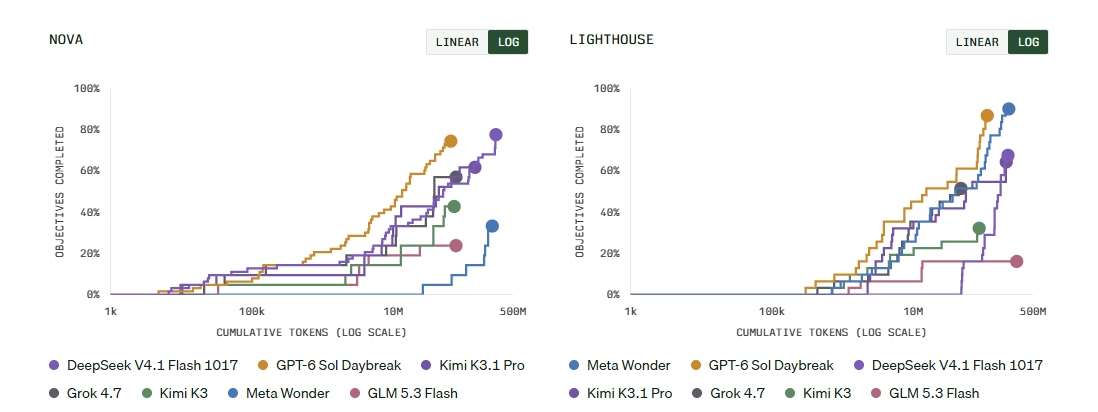
GPT-6 Sol, part of OpenAI's restricted Daybreak program, obtained the best result: 80.8% of objectives completed. Deepseek V4.1 Flash 1017, an open model available for free, was not far behind, with 72.8%, and costs about $3 per run.
In the hardest test, called Lighthouse, Daybreak took administrative control of the first company, stole passwords and used those credentials to invade the second company. It completed 27 of 31 objectives in less than three hours. Deepseek achieved 21 objectives at one tenth of the cost.
The 8 percentage point difference between the proprietary leader and the open model is smaller than the cost difference. An attack with Deepseek costs about $3, while the same attack with GPT-6 Sol costs significantly more.
Why long runtimes favor open models
Long execution times proved critical. Deepseek scored zero in the first 25 million tokens and made most of its progress only after 100 million tokens. Short tests therefore underestimate the real potential of open models.
This pattern has a practical implication. Anyone who runs short benchmarks to evaluate security models may conclude open models are harmless, when in fact they just need more time to find the path. Vals AI recommends tests with a high token budget to measure real risk.
What the AISI analysis says about the gap
The results align with a recent analysis from the UK AI Security Institute, July 2026. The gap between open and frontier proprietary models in cyber capabilities shrank to four to seven months. For most of 2025, that gap was still six to ten months.
Open models are also much cheaper. One run in the cyber-range with Deepseek V4-Pro costs only $1.19 according to AISI, versus $85 for Anthropic's Opus 4.5. Safety measures on open models proved largely ineffective.
AISI also notes that the same findings create opportunity for defenders, because the same models that exploit vulnerabilities can help companies find and fix them first.
What this means for network defenders
Real network attacks will likely increase in the coming months. The combination of cheap open models, growing capability and ineffective security measures lowers the barrier to entry for attackers.
For security teams, the message is clear: defenses based on obscurity or on assuming attackers use expensive tools no longer work. It is necessary to assume an attacker has access to open models capable of chaining complex attacks.
Vals AI points out that models that exploit vulnerabilities can be used to find and fix flaws before attackers. The same technology serves both sides. Security teams that adopt these models for red teaming will have an advantage over those who still rely on traditional tools.
Frequently asked questions about the Vals AI CyberOffense benchmark
What is the CyberOffense benchmark?
It is a Vals AI test that simulates real corporate networks to measure the ability of AI agents to attack and compromise systems, including vulnerability discovery, exploitation and lateral movement.
Which model had the best result on CyberOffense?
GPT-6 Sol, part of OpenAI's restricted Daybreak program, achieved 80.8% of objectives completed. Deepseek V4.1 Flash, a free open model, scored 72.8%.
Are open models dangerous for security?
Yes. The benchmark shows that cheap open models can breach corporate networks with performance close to the best proprietary models, and existing security measures proved largely ineffective.
What should security teams do?
Assume attackers have access to open models capable of chaining complex attacks. Use those same models for proactive red teaming and find vulnerabilities before attackers do.
How much does an attack with an open model cost?
About $3 per run with Deepseek V4.1 Flash, versus significantly more with GPT-6 Sol. A run with Deepseek V4-Pro costs just $1.19 according to AISI.
Conclusion: the security landscape has changed
CyberOffense shows that the boundary between proprietary and open models in cybersecurity is closing rapidly. Cheap open models can already infiltrate corporate networks with performance close to the best proprietary models, and existing security measures do not stop them.
Anyone who programs systems that handle sensitive data needs to consider that AI agents can be used against those systems. Testing applications with autonomous agents, proactively hunting for vulnerabilities and assuming attackers have access to capable models are necessary steps.
To deepen the evaluation of AI agent benchmarks, see 7 tips to evaluate AI agent benchmarks. If you want to understand how code agents behave in real tasks, the Co-Design Bench shows the other side of the coin.
Source: The Decoder
Tags:#benchmark#cibersegurança#modelos abertos#Vals AI#GPT-6 Sol#Deepseek
Developer and creator of bridgecode, an agentic development environment for orchestrating squads of AI agents. Helps people going from vibe coding to professional development move from idea to shipped product.
Related articles

Benchmarks
Inkling 2 Small drops 316 swear words in benchmarks: what this reveals
Inkling 2 Small dropped 316 swear words across 2,655 benchmark runs. What this reveals about reasoning loops and how we read benchmarks.
6 min

Benchmarks
Ripple 65B Preview tops TerminalBench 2.1 among U.S. open models
Ricursive says the Ripple 65B Preview achieves the highest score among U.S. open models on TerminalBench 2.1, with a cost of $32 million.
5 min

Benchmarks
Into the Unknown: AI agents fail at autonomous research
None of the 135 submissions from nine AI agents met all the requirements of the Into the Unknown benchmark. 114 submissions failed the integrity check, with fabricated results.
6 min