
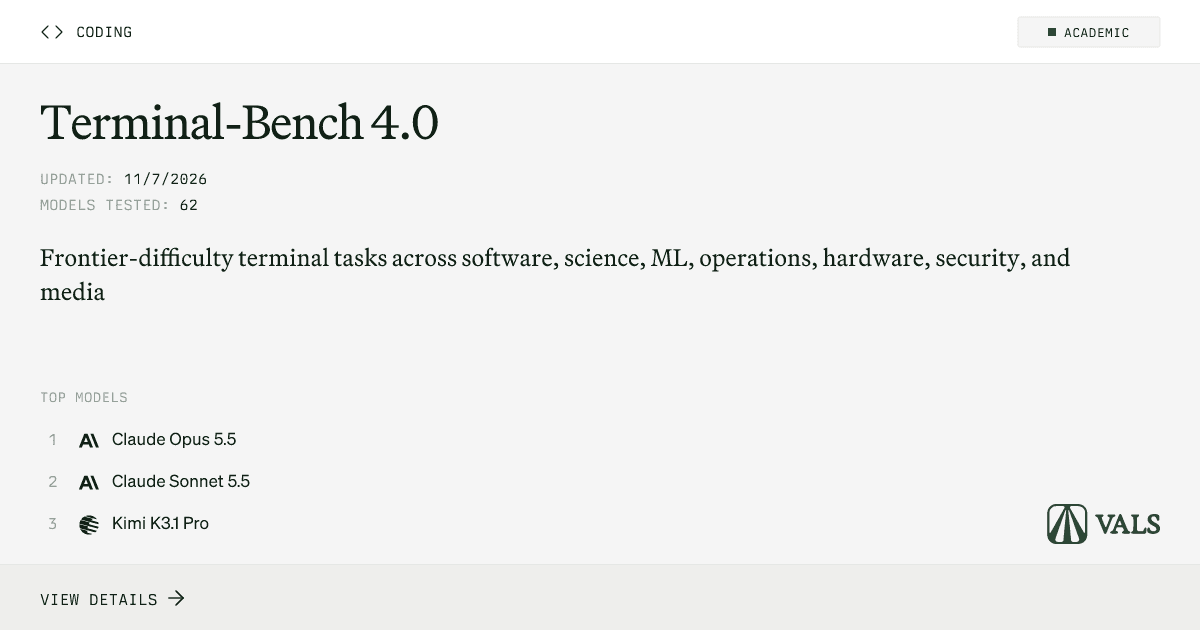
Vals AI published the updated results for Terminal-Bench 4.0, one of the most rigorous evaluations for autonomous agents that operate directly on the command line of Linux systems. The data shows that Claude Opus 5.5 and Claude Sonnet 5.5 took the top of the table, reaching 65.15% and 64.14% respectively in problem resolution rate for engineering and infrastructure.
HomeBlogBenchmarksTerminal-Bench 4.0: Claude Opus 5.5 and Sonnet 5.5 lead terminal operations with 65%
Benchmarks5 min
Terminal-Bench 4.0: Claude Opus 5.5 and Sonnet 5.5 lead terminal operations with 65%
Terminal-Bench 4.0 evaluates AI agents solving problems in a real Linux terminal. Claude Opus 5.5 leads with 65.15%, followed by Sonnet 5.5 with 64.14%.

Marcelo Santiago
Criador do bridgecode
The biggest AI newsletter in the World
Get AI articles in your inbox
Technical curation on models, agents and coding tools. No spam, unsubscribe anytime.
Unlike synthetic evaluations that only validate code responses in isolated boxes, Terminal-Bench puts models in front of environments with real file systems, command line tools (git, bash, compilers, debuggers) and practical execution constraints.
In this article you will see:
- What Terminal-Bench 4.0 requires from agents in Linux environments.
- The methodology with the Mini-SWE-agent harness and approval criteria.
- The official ranking with Claude, Kimi, Gemini and GPT.
- Cost per test metrics and average token consumption.
- How to run and orchestrate agents in terminals in your local workflow.
What Terminal-Bench 4.0 evaluates
The benchmark simulates real tasks faced by software engineers, system administrators and DevOps specialists in the day to day of servers and open source repositories:
- Failure investigation: diagnose why a service failed to start using systemd logs and network utilities.
- Compilation and build: configure toolchains, resolve missing dependencies and fix compilation errors in C, Rust and Python.
- Data and text manipulation: filter and transform large volumes of records using UNIX commands such as grep, sed, awk and jq.
- Repository automation: complex git operations, merge conflict resolution and patch application.
To compare with cybersecurity and reverse engineering tests in the same ecosystem, see also our analysis of the SRE Bench by Vals AI.
How the methodology works with Mini-SWE-agent
All tests are run through the Mini-SWE-agent harness, a controlled environment that grants the agent an interactive bash session with limited permissions inside ephemeral Docker containers.
On each conversation turn, the model:
- Issues a command in the terminal (e.g.:
cat /var/log/nginx/error.logorpytest -q). - Receives the stdout and stderr output from the shell.
- Analyzes the results and plans the next corrective action.
- Concludes with a finalization command when the task is completed.
The evaluation validates the final state of the operating system by running a deterministic suite of automated tests and assertions that the agent has no access to inspect.
The Terminal-Bench 4.0 Leaderboard
The consolidated results table from Vals AI shows a tight competitive landscape among top model families:
| Position | Model | Harness | Resolution Rate | Avg Cost / Test | Tokens / Test | Avg Duration |
|---|---|---|---|---|---|---|
| 1 | Claude Opus 5.5 | Mini-SWE-agent | 65.15% | $12.04 | 28.27m | 1h04m |
| 2 | Claude Sonnet 5.5 | Mini-SWE-agent | 64.14% | $10.75 | 58.53m | 1h22m |
| 3 | Kimi K3.1 Pro | Mini-SWE-agent | 63.64% | $4.57 | 16.57m | 49m21s |
| 4 | Gemini 4 Carbon | Mini-SWE-agent | 63.13% | $7.45 | 12.46m | 45m07s |
| 5 | GPT-6 Astra | Mini-SWE-agent | 59.60% | $9.58 | 3.01m | 35m42s |
| 6 | Claude Fable 5.1 | Mini-SWE-agent | 58.08% | $17.18 | 18.82m | 1h00m |
| 7 | Wonder Full | Mini-SWE-agent | 58.08% | $10.53 | 31.82m | 1h12m |
| 8 | Gemini 4 Argon | Mini-SWE-agent | 57.58% | $17.64 | 16.66m | 53m35s |
| 9 | GPT-6.1 Sol | Mini-SWE-agent | 55.05% | $1.72 | 2.86m | 45m12s |
The data shows that Claude Sonnet 5.5 delivers almost the same performance as Opus 5.5, 64.14% versus 65.15%, with a lower financial cost per run. Kimi K3.1 Pro also surprised by placing 3rd at just $4.57 per test, less than half the cost of Claude Opus. For a complementary analysis on benchmarks that test code in real repositories, check out the guide for SWE-bench Pro.
Token Efficiency and Resolution Time
Beyond raw accuracy, Terminal-Bench 4.0 measures the operational behavior of models:
- GPT-6 Astra is the fastest and most token efficient, consuming only 3.01 million tokens and completing the cycle in 35 minutes.
- Claude Sonnet 5.5 uses a longer iterative reasoning process, 58.53 million tokens, actively exploring diagnostic commands before making definitive decisions.
- GPT-6.1 Sol recorded the lowest absolute financial cost, $1.72 per test, although with a resolution rate about 10% lower than the leaders.
How to Run Agents in Parallel Terminals on bridgecode
The main challenge of operating agents in real terminals is preventing one session from locking your environment or creating conflicting changes in your working branch.
With bridgecode, you get dedicated terminals for each CLI, Claude Code, OpenCode, Codex and Antigravity, running in separate git worktrees. This lets you run an agent executing heavy commands in the background while you keep coding without interruptions. Explore the bridgecode ecosystem to put agent squads to work on your projects.
Frequently asked questions about Terminal-Bench 4.0
What is Vals AI's Terminal-Bench 4.0?
It is a rigorous benchmark that evaluates the ability of AI models and agents to operate directly in real Linux terminals to diagnose system failures, compile code and solve DevOps tasks.
Which models lead Terminal-Bench 4.0?
Claude Opus 5.5 leads with a 65.15% resolution rate, closely followed by Claude Sonnet 5.5 with 64.14% and Kimi K3.1 Pro with 63.64%.
Which model offered the best cost efficiency?
Kimi K3.1 Pro placed third overall with a 63.64% rate and an average cost of $4.57 per test, less than half the cost of Claude Opus ($12.04).
How are agents evaluated in Terminal-Bench?
Through the Mini-SWE-agent harness, where the agent issues bash commands in an ephemeral container and the final result is validated by deterministic test suites hidden from the model.
Conclusion: The Evolution of AI Command Line Usage
Terminal-Bench 4.0 demonstrates that AI models have moved past theory and now dominate Linux command line environments with stability above 65%. As models like Sonnet 5.5 and Kimi K3.1 Pro balance high assertiveness with affordable costs, automated operation of servers and repositories enters a new practical phase.
Source: Vals AI (Terminal-Bench 4.0)
Tags:#benchmark#claude#terminal#agentes-ia#linux
Developer and creator of bridgecode, an agentic development environment for orchestrating squads of AI agents. Helps people going from vibe coding to professional development move from idea to shipped product.
Related articles
Benchmarks
Fable 5.2 vs Opus 5.5: which model to choose for each task
Compare Claude Fable 5.2 and Opus 5.5: self reported benchmarks, price, speed and recommendations by use case for developers using AI.
5 min
Benchmarks
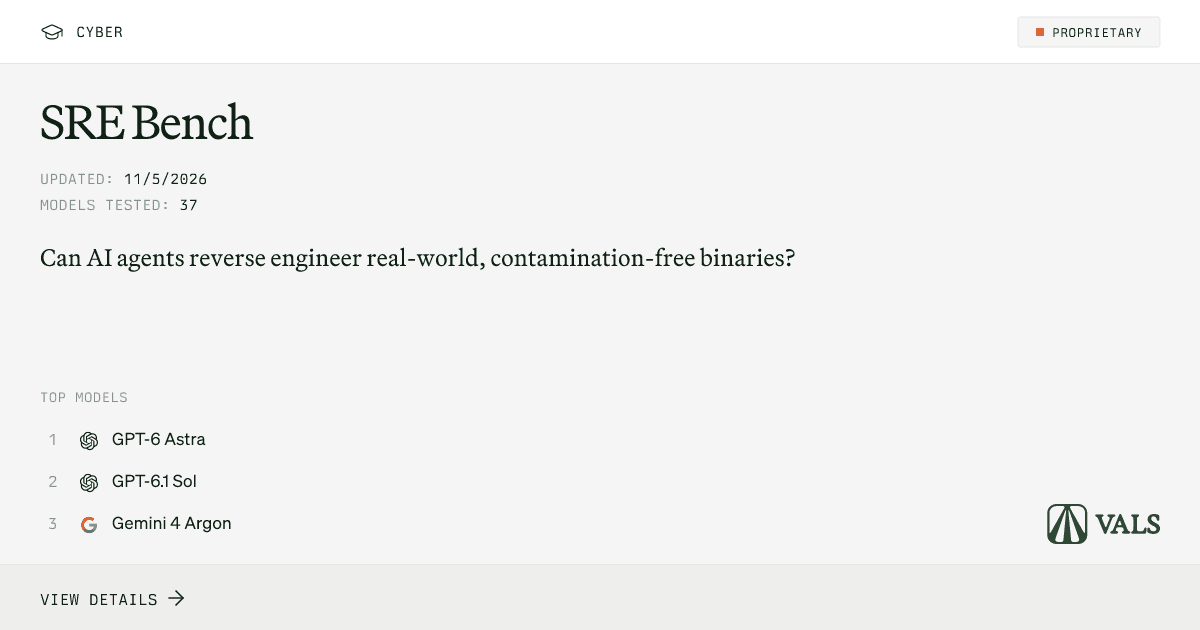
SRE Bench: Can AI Reverse Engineer Binaries?
SRE Bench tests whether AI agents can reverse engineer binaries without source code. GPT-6 Astra leads with 56.87%.
5 min
Benchmarks
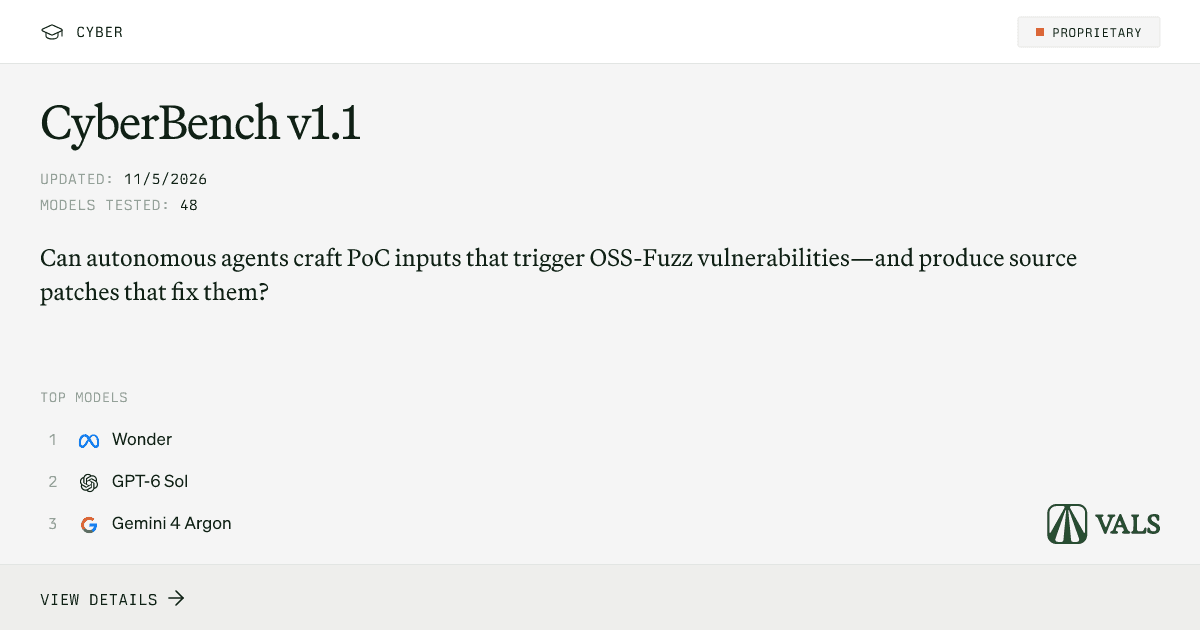
CyberBench: Can AI find security bugs?
CyberBench tests whether AI agents can find security flaws in code and produce patches. Wonder from Meta leads with 80.36%.
5 min