
SWE-bench Pro is the new code benchmark from Scale Labs that measures AI agents on real software engineering tasks. With 1,865 tasks across 41 repositories, it shows that even the best agents solve only a fraction of what SWE-bench Verified suggested. The official page was updated on November 9, 2026.
Benchmarks6 min
SWE-bench Pro: the code benchmark that humbles AI agents
SWE-bench Pro brings 1,865 real world tasks across 41 repositories and shows that code agents solve only a fraction of what older benchmarks suggested. See the official numbers.

Marcelo Santiago
Criador do bridgecode
The biggest AI newsletter in the World
Get AI articles in your inbox
Technical curation on models, agents and coding tools. No spam, unsubscribe anytime.
In this article you will see:
- What SWE-bench Pro is and why it is harder than Verified.
- The official numbers: 1,865 tasks, 41 repositories, three subsets.
- The current scoreboard: Muse Spark 1.1 leads with 61.5% on the public set.
- Why performance drops on tasks that require more lines and files.
- The benchmark limits and how to use it in practice.
What is SWE-bench Pro
SWE-bench Pro is a benchmark from Scale Labs, Scale AI, to evaluate AI agents on software engineering tasks. It was created to fix limitations of previous tests: data contamination, short tasks and public repositories already seen in training.
Each task asks the agent to solve a real problem in an existing repository. The agent needs to read code, edit files, run tests and deliver a fix that passes the hidden test suite. Evaluation is binary: the task is solved or not.
The benchmark has 1,865 tasks distributed across 41 professional repositories. The tasks range from bug fixes to feature requests, optimizations, security updates and UI changes.
Three subsets with different purposes
SWE-bench Pro is split into three sets.
The public set has 731 tasks from open source repositories with copyleft licenses, such as GPL. The license works as a legal barrier against contamination: it is unlikely that this code entered proprietary training corpora.
The private set has 276 tasks from 18 proprietary codebases from startups, obtained through partnership. It is the definitive test of generalization on industrial code the model has never seen.
The held out set has 858 tasks from another group of public repositories with copyleft licenses. It stays out of public leaderboards and serves for future analyses and internal evaluations.
Why it is harder than SWE-bench Verified
On SWE-bench Verified, the best models solve more than 70% of tasks. On SWE-bench Pro, the same models drop to the 20% range. GPT-5 and Claude Opus 4.1, for example, score 23.3% and 23.1% on the public set.
The difference comes from the design. Pro tasks require average changes of 107 lines in 4.1 files. Some reach more than 100 lines across several files. Older benchmarks had small, localized fixes.
The copyleft license also reduces contamination. If the code was not in training, the agent cannot rely on memorization.
Current public set scoreboard
The current public scoreboard has 25 models. The leader is Muse Spark 1.1 from Meta, with 61.5%. Next are GPT-5.4, xHigh, with 59.1%, Muse Spark with 55%, Claude Opus 4.6, thinking, with 51.9% and Gemini 3.1 Pro, thinking, with 46.1%.
Older models lag far behind. GPT-4o scores 1.51% and Qwen3 32B scores 3.4%. The gap between generations is large and consistent.
The private set is even tougher. Muse Spark 1.1 leads with 51.5%, followed by Claude Opus 4.6, thinking, with 47.1%. GPT-5 drops from 23.1% on public to 14.9% on private.
What brings models down
Three patterns show up in the official results.
First, performance drops as the solution requires more lines and files. Small changes are solved more often; large changes, almost never.
Second, language matters. Tasks in Go and Python have higher resolution rates, with some models above 30%. In JavaScript and TypeScript, rates vary from almost 0% to over 30%, depending on the model.
Third, the specific repository matters. Some repositories are consistently hard for all models, with rates below 10%. In others, certain models pass 50%. Factors like codebase complexity, problem type and documentation quality affect the outcome.
Top models are also more consistent. Claude Opus 4.1 and GPT-5 not only score higher, but maintain stable performance across languages and repositories. Smaller models have erratic performance.
How to test today
The public dataset and evaluation code are available on GitHub (scaleapi/SWE-bench_Pro-os). The public leaderboard is at labs.scale.com/leaderboard/swe_bench_pro. The private set has a separate leaderboard.
If you evaluate code agents, always compare the same harness (the program that reads, writes and executes code) across models. The benchmark measures the model plus environment pair, not the model in isolation.
For those building agent pipelines, SWE-bench Pro is a good maturity thermometer. An agent that solves less than a quarter of real tasks still needs human review for almost everything.
Benchmark limits
SWE-bench Pro has limits. It measures only whether the fix passes the hidden tests. It does not measure code quality, readability or maintainability.
Evaluation uses the SWE-Agent scaffold. Other harnesses can produce different results for the same model.
The private set is not reproducible outside Scale, because it depends on proprietary codebases. This makes the private leaderboard informative, but not verifiable by third parties.
Results reflect the state of models on the date of each measurement. New models enter the leaderboard over time.
Frequently asked questions about SWE-bench Pro
What is SWE-bench Pro?
It is a Scale Labs benchmark for evaluating AI agents on real software engineering tasks. It has 1,865 tasks across 41 repositories and measures whether the agent solves the problem by passing hidden tests.
Why is SWE-bench Pro harder than SWE-bench Verified?
Tasks require an average change of 107 lines across 4.1 files, and the code uses copyleft licenses, which reduces contamination. Models that score over 70% on Verified drop to around 20% on Pro.
Who leads the public leaderboard?
Muse Spark 1.1 from Meta with 61.5%. Next come GPT-5.4 (xHigh) with 59.1%, Muse Spark with 55%, Claude Opus 4.6 (thinking) with 51.9% and Gemini 3.1 Pro (thinking) with 46.1%.
What brings models down the most?
Tasks that require more lines and files, languages like JavaScript and TypeScript, and specific repositories with high complexity. Smaller models have erratic performance.
How to use the benchmark in practice?
Always compare the same harness across models, because the benchmark measures the model plus environment pair. Use the public dataset and evaluation code available on GitHub for your own tests.
Conclusion
SWE-bench Pro shows that code agents are still far from solving real software engineering tasks autonomously. The public leaderboard makes this clear: even the leader, Muse Spark 1.1, solves 61.5% of tasks, while previous generation models stay below 25%.
For those choosing or building code agents, the message is direct. Saturated benchmarks like SWE-bench Verified are no longer enough. Test on long tasks, across multiple files and in repositories the model has not seen. And compare model and environment together, because the harness matters as much as the model.
If you want to put code agents to work on real projects, start with small tasks and human review. As performance rises, expand the scope. SWE-bench Pro is a good starting point to calibrate expectations.
Did SWE-bench Pro catch your attention? Put this new development to work in an AI agent squad, each one in its role.
Co-Design Bench: code agents get 26% of real tasks right
7 tips to evaluate AI agent benchmarks
Source: Scale Labs
Tags:#radar#ia#benchmark
Developer and creator of bridgecode, an agentic development environment for orchestrating squads of AI agents. Helps people going from vibe coding to professional development move from idea to shipped product.
Related articles

Benchmarks
Co-Design Bench: code agents get 26% of real world tasks right
Researchers built a code agent benchmark based on real user requests. Even the best model fully completes only 26.4% of tasks. See the numbers.
7 min
Benchmarks
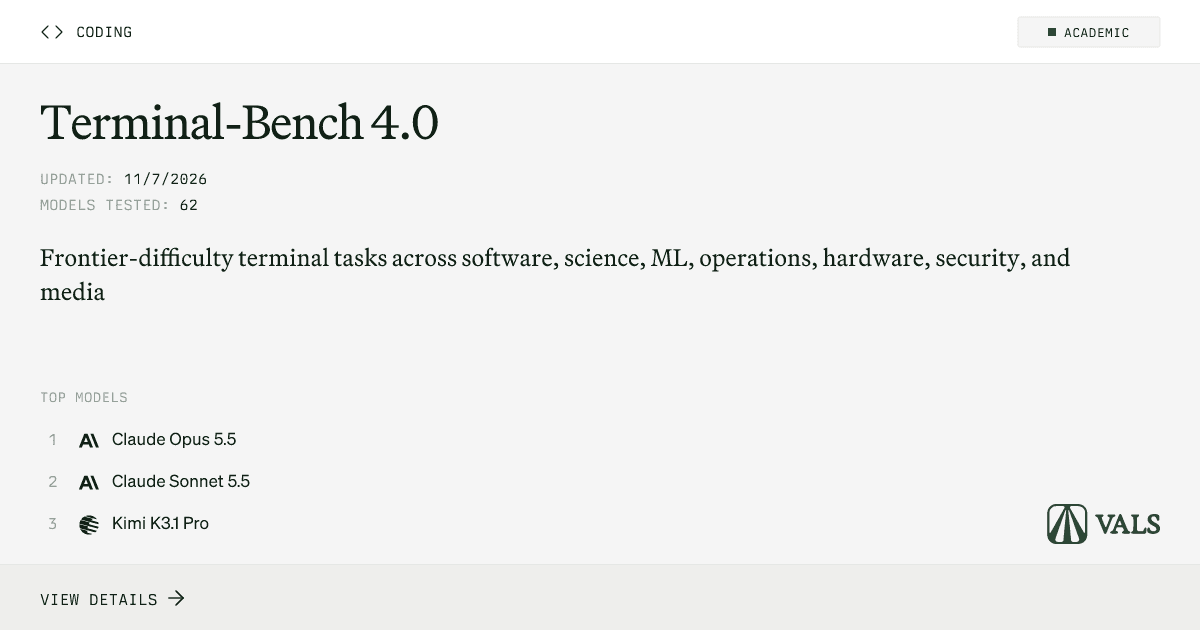
Terminal-Bench 4.0: Claude Opus 5.5 and Sonnet 5.5 lead terminal operations with 65%
Terminal-Bench 4.0 evaluates AI agents solving problems in a real Linux terminal. Claude Opus 5.5 leads with 65.15%, followed by Sonnet 5.5 with 64.14%.
5 min
Benchmarks
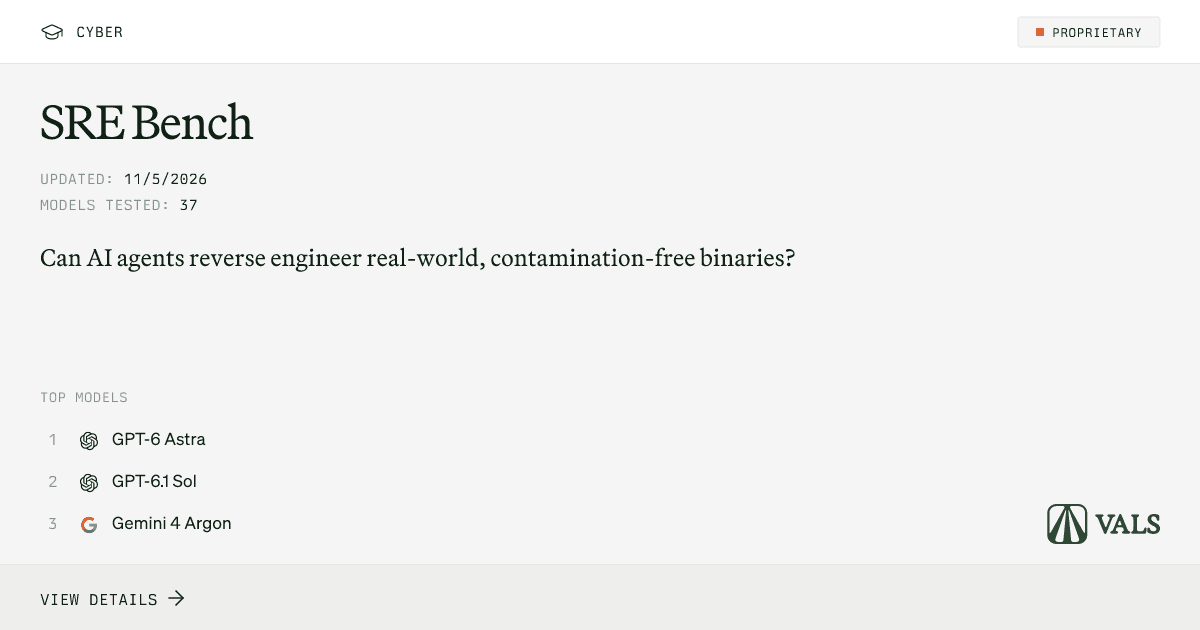
SRE Bench: Can AI Reverse Engineer Binaries?
SRE Bench tests whether AI agents can reverse engineer binaries without source code. GPT-6 Astra leads with 56.87%.
5 min