
Google DeepMind launched Gemini 4 Neon, the fourth model in the family in just seven weeks, and Artificial Analysis published the evaluation on November 18, 2026. Neon (xhigh) scores 61 points on the Intelligence Index, 3rd place overall, with a per task cost lower than Gemini 4 Carbon.
Benchmarks5 min
Gemini 4 Neon: 61 points on the Intelligence Index, lower cost
Gemini 4 Neon scores 61 on the Intelligence Index, ranks 3rd and costs about 17% less per task than Gemini 4 Carbon, according to Artificial Analysis.
The biggest AI newsletter in the World
Get AI articles in your inbox
Technical curation on models, agents and coding tools. No spam, unsubscribe anytime.
The intelligence gain is small, but the cost and speed gain is what stands out for people who use code agents day to day.
In this article you will see:
- How much Gemini 4 Neon scores on the Intelligence Index and where it ranks
- How much it costs per task and per token, compared to Carbon
- How it performs on code agents with Antigravity CLI
- Where to test the model today and what are the limits of the comparison
What is Gemini 4 Neon and what did Artificial Analysis measure
Gemini 4 Neon is the newest model in the Gemini 4 line from Google DeepMind. Artificial Analysis is an independent company that measures AI models on intelligence, cost, speed and use in agents.
The Intelligence Index is the company's composite index, which brings together several tests into a single score. Neon appears with 61 points on xhigh effort, the highest reasoning level.
This puts Neon 1 point ahead of Gemini 4 Carbon (high). It trails only GPT 6.2 Astra (max) and Claude Fable 5.2 (max). About Astra, see the post about GPT 6.2 Astra and the Intelligence Index.
What this score is not: it is not a new record holder for the index, and the source itself describes the advance as small. Neon is an incremental evolution of Carbon, not a leap.
Gemini 4 Neon costs about 17% less per task
Per task cost is the average spend to complete an index task, adding input and output tokens. Neon sits at US$ 6.44 per task, versus US$ 7.76 for Carbon at standard price, with no discount.
Time also drops: about 21 minutes per task on Neon, versus about 36 minutes on Carbon, a reduction of approximately 40%. Output speed rises from about 57 to about 110 tokens per second.
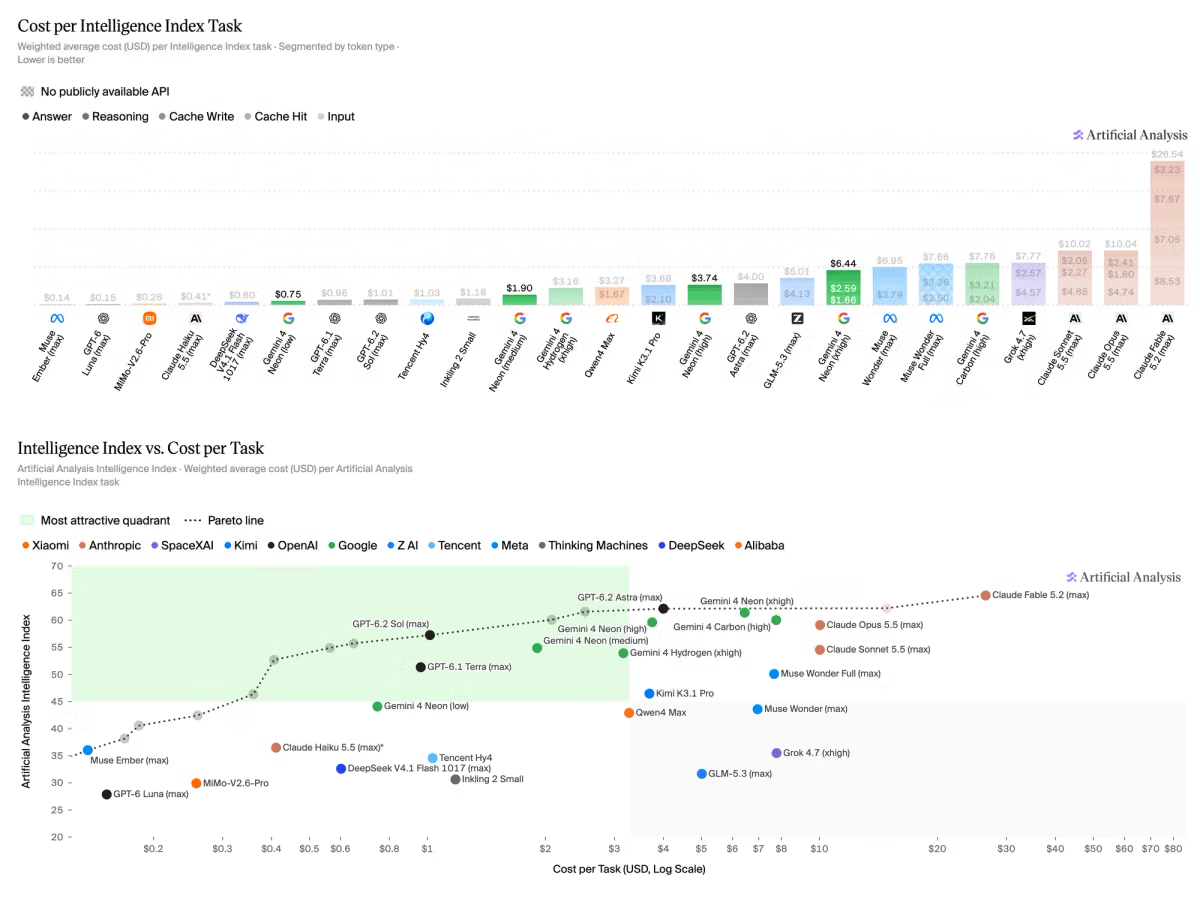
There is an important detail. Neon uses about 15% more output tokens per task. The saving comes only from the per token price, which is 25% lower, and the speed comes from higher output speed.
On high effort, Artificial Analysis says Neon ties Carbon (high) spending less than half per task, using Carbon's standard price.
Neon and Carbon price per token
Neon costs US$ 3 per 1 million input tokens and US$ 15 per 1 million output. Carbon's standard price is US$ 4 and US$ 20.
However, Carbon currently has a promotional price of US$ 2 and US$ 10, which ends on November 30. Against that value, Neon is 50% more expensive per token. Cached input tokens have the same 95% discount, at US$ 0.15.
How Gemini 4 Neon performs on code agents
A code agent is a tool that reads the repository, edits files and runs commands to complete a task. Artificial Analysis tests this on the Coding Agent Index, using Antigravity CLI in Google's case.
With Antigravity CLI, Neon (xhigh) scores 59 points, 3 points above Carbon (high), which scored 55. The result is in line with Claude Code using Claude Fable 5.2 (xhigh), with 58, and Claude Opus 5.5 (max), also with 58.
The difference shows up in cost. The average per task cost for Neon on Antigravity is US$ 6.86, versus US$ 12.61 for Opus 5.5 (max) and US$ 15.47 for Fable 5.2 (xhigh).
To understand the environment, read the post about the Antigravity orchestrator with Carbon and Hydrogen. Neon is available on Antigravity CLI for Pro and Ultra subscribers.
Visual reasoning and presentation quality
Neon also improves on work with visual files. On GDP.pdf, Neon (high) scores 33.4%, 5 points above Carbon (high) at 28.4%. Neon (xhigh) scores 28.0%.
On AA Briefcase, Neon (xhigh) reaches 1700 Elo overall. On presentation quality, it leads with 1771 Elo, 45 points above the previous leader, Claude Sonnet 5.5 (max), at 1726.
On Multimodal Knowledge Agent (MKA), an evaluation created by Google DeepMind, Neon reaches 56% Climb WSR. That is 2 points above Carbon and almost equal to the leader, Claude Fable 5.2 (max), at 57%. About MKA, see the post about Gemini 4 Carbon at the top of MKA.
Spec sheet for Gemini 4 Neon
- Context window: 1 million tokens
- Inputs: text, image, video and voice, with text output
- Reasoning effort: low, medium, high and xhigh, with xhigh arriving to Gemini models with Hydrogen
- Availability: Google API and Gemini Enterprise Agent Platform, plus Antigravity and Gemini app for Pro and Ultra
- Price: US$ 3 input and US$ 15 output per 1 million tokens
xhigh is the highest effort level, which spends more reasoning tokens in pursuit of better answers. For the history of this family, see the benchmark for Gemini 4 Hydrogen.
How to test Gemini 4 Neon today
The most direct path is the Google API or the Gemini Enterprise Agent Platform, where the model has been available since launch. Those subscribed to Pro or Ultra can select Neon in Antigravity and in the Gemini app.
To compare with your real use, run the same task on Neon and on Carbon and compare cost, time and quality. The index is a good starting point, but your repository is the test that matters.
Also use high effort as a starting point. Artificial Analysis shows it already ties Carbon for less than half the cost per task, and xhigh is only worth it when the task demands more reasoning.
Limits of the comparison
The numbers come from a single independent evaluator and standardized tasks. Performance on your project may be different, especially for languages, codebases and workflows that do not appear in the tests.
Cost per task depends on the price used as reference. With the current Carbon discount until November 30, Neon's cost advantage disappears or shrinks. After that date, it is worth recalculating.
Frequently asked questions about the Gemini 4 Neon
What is Gemini 4 Neon’s score on the Intelligence Index?
Gemini 4 Neon (xhigh) scores 61 points on the Artificial Analysis Intelligence Index. It is 1 point above Gemini 4 Carbon (high) and ranks 3rd overall, behind GPT 6.2 Astra and Claude Fable 5.2.
How much does Gemini 4 Neon cost on the API?
The price is US$ 3 per 1 million input tokens and US$ 15 per 1 million output tokens. That is 25% below Carbon’s standard price (US$ 4 and US$ 20), but above Carbon’s current promotional price (US$ 2 and US$ 10), which runs until November 30.
Is Gemini 4 Neon good for coding agents?
Yes, according to Artificial Analysis. With Antigravity CLI, it scores 59 on the Coding Agent Index, 3 points above Carbon, and ties with Claude Code using Fable 5.2 and Opus 5.5 (58), with a much lower cost per task.
Where can I use Gemini 4 Neon?
It is available on the Google API and on the Gemini Enterprise Agent Platform. Pro and Ultra subscribers can also access it on Antigravity and in the Gemini app. The context window is 1 million tokens.
Is Neon cheaper than Carbon in all cases?
No. The cost per task is lower (US$ 6.44 versus US$ 7.76 at standard pricing), but Neon uses about 15% more output tokens. Against Carbon’s promotional price, the comparison changes until November 30.
Neon changes model choice for agents
For those working with agents, Neon shows that this month's gain is in cost and speed, not raw intelligence. A model almost as capable as the leader, running in half the time, changes the math for teams that do many tasks per day.
The pace also matters: four models in seven weeks forces you to review your choice frequently. It is worth having a flow that lets you switch models without redoing all the work.
A single model solves one task. An agent squad delivers the whole project, and that is what you build on bridgecode.
Source: Artificial Analysis
Tags:#Gemini 4 Neon#Google DeepMind#Artificial Analysis#Intelligence Index#benchmark

Developer and creator of bridgecode, an agentic development environment for orchestrating squads of AI agents. Helps people going from vibe coding to professional development move from idea to shipped product.
Related articles
Benchmarks
Fable 5.2 vs Opus 5.5: which model to choose for each task
Compare Claude Fable 5.2 and Opus 5.5: self reported benchmarks, price, speed and recommendations by use case for developers using AI.
5 min
Benchmarks
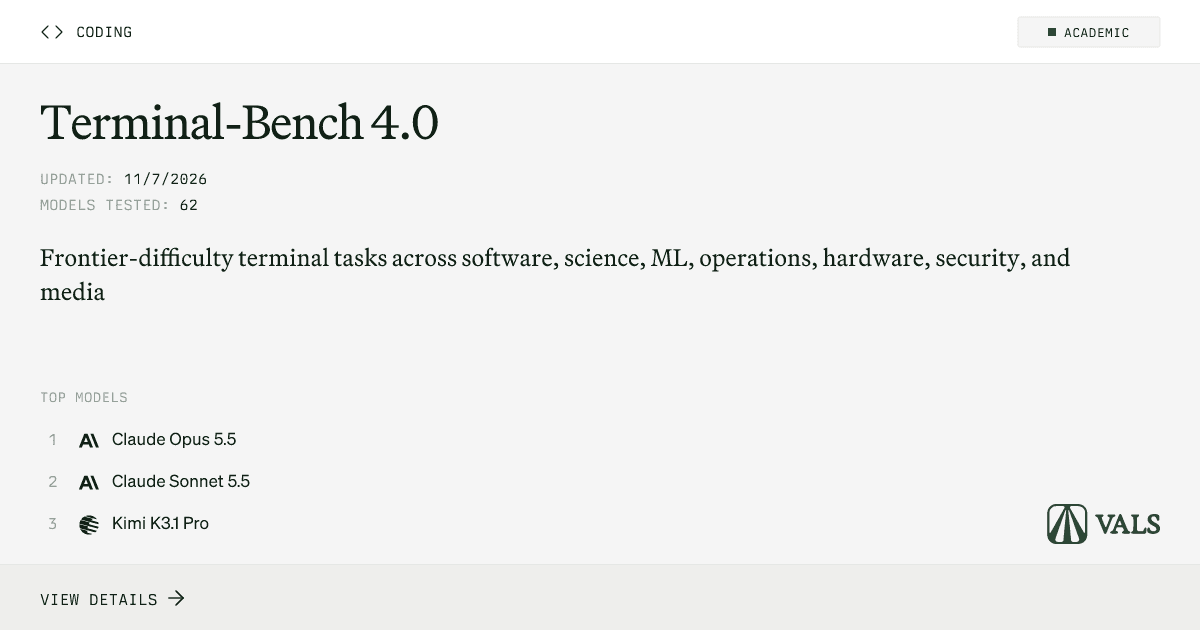
Terminal-Bench 4.0: Claude Opus 5.5 and Sonnet 5.5 lead terminal operations with 65%
Terminal-Bench 4.0 evaluates AI agents solving problems in a real Linux terminal. Claude Opus 5.5 leads with 65.15%, followed by Sonnet 5.5 with 64.14%.
5 min
Benchmarks
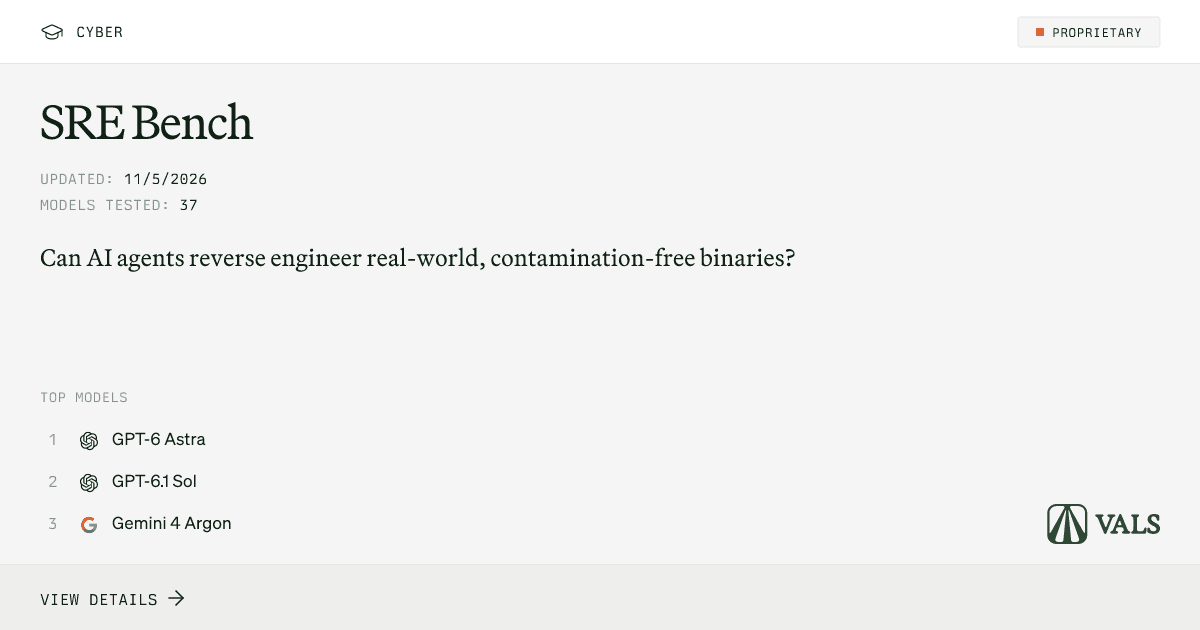
SRE Bench: Can AI Reverse Engineer Binaries?
SRE Bench tests whether AI agents can reverse engineer binaries without source code. GPT-6 Astra leads with 56.87%.
5 min