
Starting in December, use of ChatGPT and Codex will draw from a shared quota on Plus, Pro and Business plans. For people who switch between conversations with advanced models and programming tasks, this changes how usage is tracked, but OpenAI has not yet published the numeric limits for each plan or the exact start date.
Dicas6 min
OpenAI will share the ChatGPT and Codex quota in December
In December, OpenAI will share the ChatGPT and Codex usage quota across Plus, Pro and Business plans. Understand what has already been confirmed, what is still to be defined and why automatic credit top-up is a separate mechanism.

Marcelo Santiago
Criador do bridgecode
The biggest AI newsletter in the World
Get AI articles in your inbox
Technical curation on models, agents and coding tools. No spam, unsubscribe anytime.
The announcement also mentions credits to keep using eligible features when the included quota runs out. And there is an important difference: automatic credit top up, or auto top-up, does not increase the included allowance in the plan. It is an additional purchase that can be triggered automatically, if it is available and enabled on the account.
What changes to the ChatGPT and Codex quota
The OpenAI official page on usage limits states that, starting in December, Plus, Pro and Business will have a shared quota between ChatGPT and Codex. Consumption will be measured in tokens, not by a fixed number of messages: more advanced models and more complex tasks tend to use more of the allowance.
Instant mode will not consume this shared quota. This does not mean that all models, tools or ChatGPT features are unlimited, it only means that Instant is outside this specific limit.
OpenAI says it will be possible to check the combined balance and renewal times in Settings → Usage. If the quota runs out, the announced options are to wait for renewal, change plans or buy credits for eligible features.
The company says it expects most people will not need to wait for renewal more often than today. This is an OpenAI expectation, not a guarantee that each user will keep the same capacity: without the per plan limits and the complete usage rules, it is not yet possible to compare the experience of each account.
The notice also previews tasks inside ChatGPT
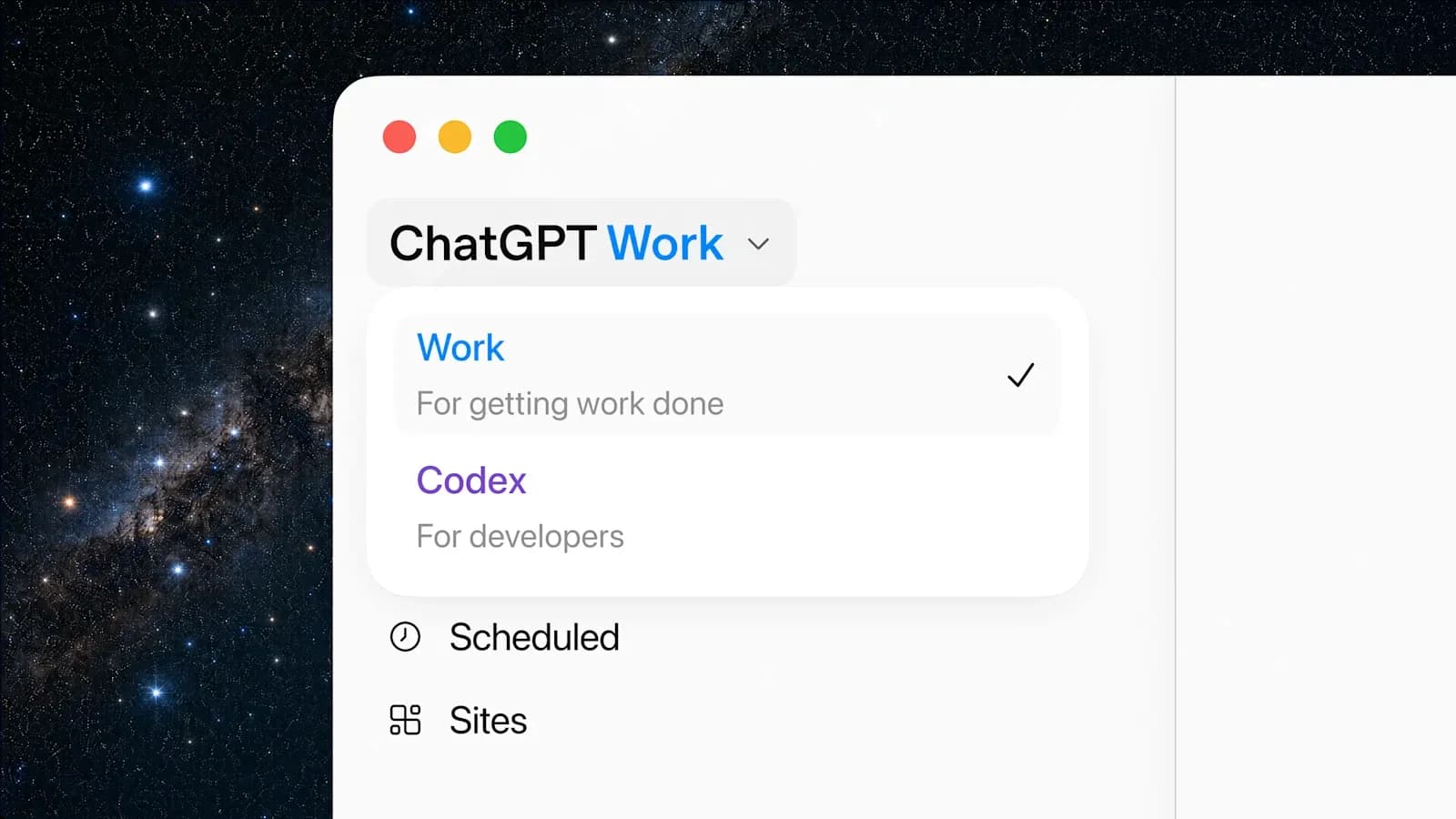
The email sent to subscribers also talks about bringing agent tasks inside ChatGPT, such as creating websites and presentations or taking actions on the web, without switching to the Work tab. According to the BleepingComputer report, which had access to the notice, the integrated experience will start as a test for a small group. Therefore, it is not correct to assume that this feature is already available to all accounts.
This interface change and the shared quota are related to the integration between Chat and Work, but they are different points: the first is about where tasks are started, the second is about how plan usage will be accounted for.
Auto top-up is not the same as shared quota
The OpenAI credits documentation explains that the included allowance is used first. After the limit is reached, credits can cover compatible features, depending on the plan and account availability. Credits are a paid add-on, not a permanent increase to the included allowance.
Auto top-up is a different mechanism, documented by OpenAI on the page for credits for flexible use and in the ChatGPT update notes. If the option is available for the account, the person sets a minimum balance and a target balance. When credits fall below the minimum, OpenAI automatically buys enough credits to reach the target, using the default payment method on file.
There is an important caveat: if the balance is already below the minimum when top-up is activated, a purchase may happen immediately. The function buys usage credits, it does not top up a dollar wallet nor replenish the included allowance in the plan. Availability and the features that accept credits vary by account, check the options shown in Settings → Usage before enabling.
In summary: the shared quota is the plan allowance that will be used by ChatGPT and Codex, credits are paid additional usage for compatible features, and auto top-up is an optional way to buy those credits automatically. Automatic recharge should not be interpreted as unlimited use nor as a guaranteed part of the new quota.
What OpenAI still needs to clarify
Public documentation confirms a December start, but it still does not provide the exact date, the quota values per plan, how current limits will be converted, or examples of consumption by model and task type. We should also not extrapolate the change to plans not mentioned in the announcement, the official page names Plus, Pro and Business.
API usage is a separate mode: OpenAI documentation distinguishes signing into Codex with a ChatGPT account from using your own key, which follows API billing. Check the official guidance on using Codex with the ChatGPT plan before comparing the two access methods.
How builders can prepare
- Before the change, check Settings → Usage and note the balance and renewal times shown for your account.
- Once the combined quota is active, track which models and tasks consume the most, documentation does not provide a fixed conversion from messages to tokens.
- For long work, split the request into verifiable steps. Use the model and reasoning level appropriate to the task instead of assuming each interaction costs the same.
- If you consider credits or auto top-up, check eligibility, covered features, minimum balance, target balance, payment method and any spending limit shown on your account. Remember that activation can trigger an immediate purchase if the balance is already below the minimum.
- If you build prototypes with Sites, the Codex documentation states that creating or editing a Site counts as Codex usage. Also see our step by step guide to build an AI app using ChatGPT Sites and the guide on hardware prototyping with Codex.
Frequently asked questions about the shared quota for ChatGPT and Codex
Which plans will have a shared quota between ChatGPT and Codex?
OpenAI's current documentation cites the Plus, Pro and Business plans, with a start date expected in December. It does not specify the exact day or the numeric limits for each plan.
Does Instant mode consume the shared quota?
No. OpenAI states that conversations in Instant mode do not consume this specific quota. That does not mean all other models or features are unlimited.
What is credit auto top-up?
If the option is available for the account, it automatically purchases credits when the balance falls below the defined minimum, up to the target balance, using the default payment method. A purchase can happen right after activation if the balance is already below the minimum.
Does auto top-up increase the included allowance in the plan?
No. Automatic top-up buys credits for eligible resources; it does not replenish the included allowance nor reload the wallet in dollars. Availability varies by plan and account.
Does Codex consumption via the API count toward the ChatGPT quota?
Documentation distinguishes Codex connected to the ChatGPT account from usage with a dedicated API key. A dedicated key follows API billing, which is separate from the usage included in the ChatGPT plan.
Conclusion
The shared quota changes the relationship between conversations in ChatGPT and work in Codex, but the numbers needed to estimate the impact on each plan are still missing. Until then, the best approach is to monitor the usage dashboard and not treat credits or auto top-up as part of the included allowance.
For those building with agents, understanding consumption is part of the workflow: define tasks, review results, and choose when it makes sense to use each tool. Learn about bridgecode to organize agents into planning, implementation and review stages.
Source: OpenAI Help Center: ChatGPT and Codex usage limits · OpenAI Help Center: credits for flexible use · BleepingComputer
Tags:#OpenAI#ChatGPT#Codex#cota compartilhada#créditos#auto top-up
Developer and creator of bridgecode, an agentic development environment for orchestrating squads of AI agents. Helps people going from vibe coding to professional development move from idea to shipped product.
Related articles
Dicas
5 tips for using Codex CLI in your workflow
The official openai/codex repository hosts Codex CLI. Here are 5 practical tips to use the tool with more control in your development workflow.
6 min
Dicas
How to test AI agents in cloud operations with CloudOpsBench
CloudOpsBench releases 45 cloud operation tasks to test your AI agent. See how to clone, validate and run against an emulator or real AWS.
6 min

Dicas
Tencent's Hy4: 1M context, vision and tool calling
Tencent's Hy4 brings 1 million tokens of context, vision and native tool calling for code agents and long duration tasks.
5 min