
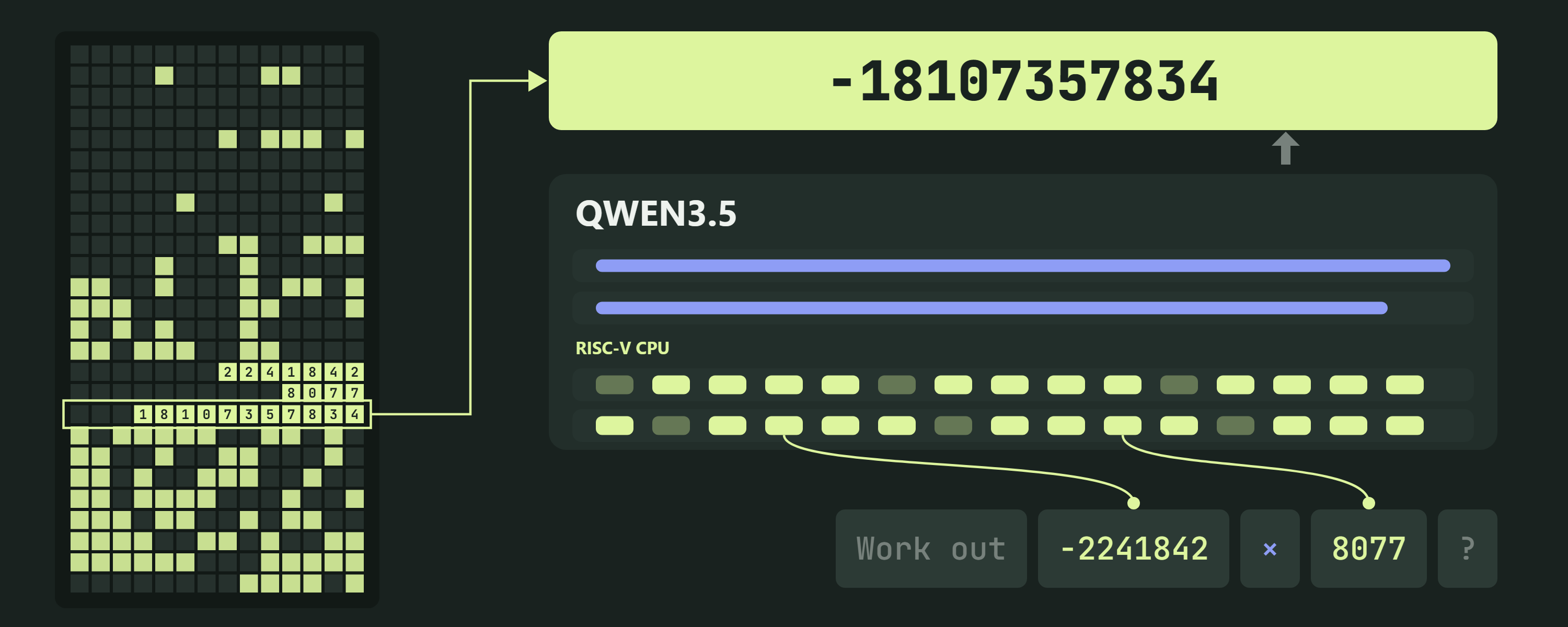
The announcement shows a practical demonstration of how a language model can contain a computing machine inside its own weights. The project, called Qwenputer, adds a 32 bit RISC-V CPU in extra layers of a Qwen3.5-4B checkpoint. Instead of asking a model to calculate, Qwenputer compiles a state machine inside the weights and executes instructions directly during inference.
Qwenputer puts a RISC-V processor inside the weights
The announcement shows a practical demonstration of how a language model can contain a computing machine inside its own weights. The project,

Marcelo Santiago
Criador do bridgecode
The biggest AI newsletter in the World
Get AI articles in your inbox
Technical curation on models, agents and coding tools. No spam, unsubscribe anytime.
In this article you will see:
- What Qwenputer is and how it works
- What changes for those following AI models
- How to access the code and weights
Instead of asking a model to calculate, Qwenputer compiles a CPU inside the weights. The architecture uses Gated DeltaNet layers as addressable memory, allowing the processor to store registers, memory and the program counter in attention lines. The result is an experimental checkpoint with a RISC-V RV32IM processor, with Zba extensions and a big number coprocessor. The system emits an execution trace as tokens, and each step identifies an address, a value and advances the processor.
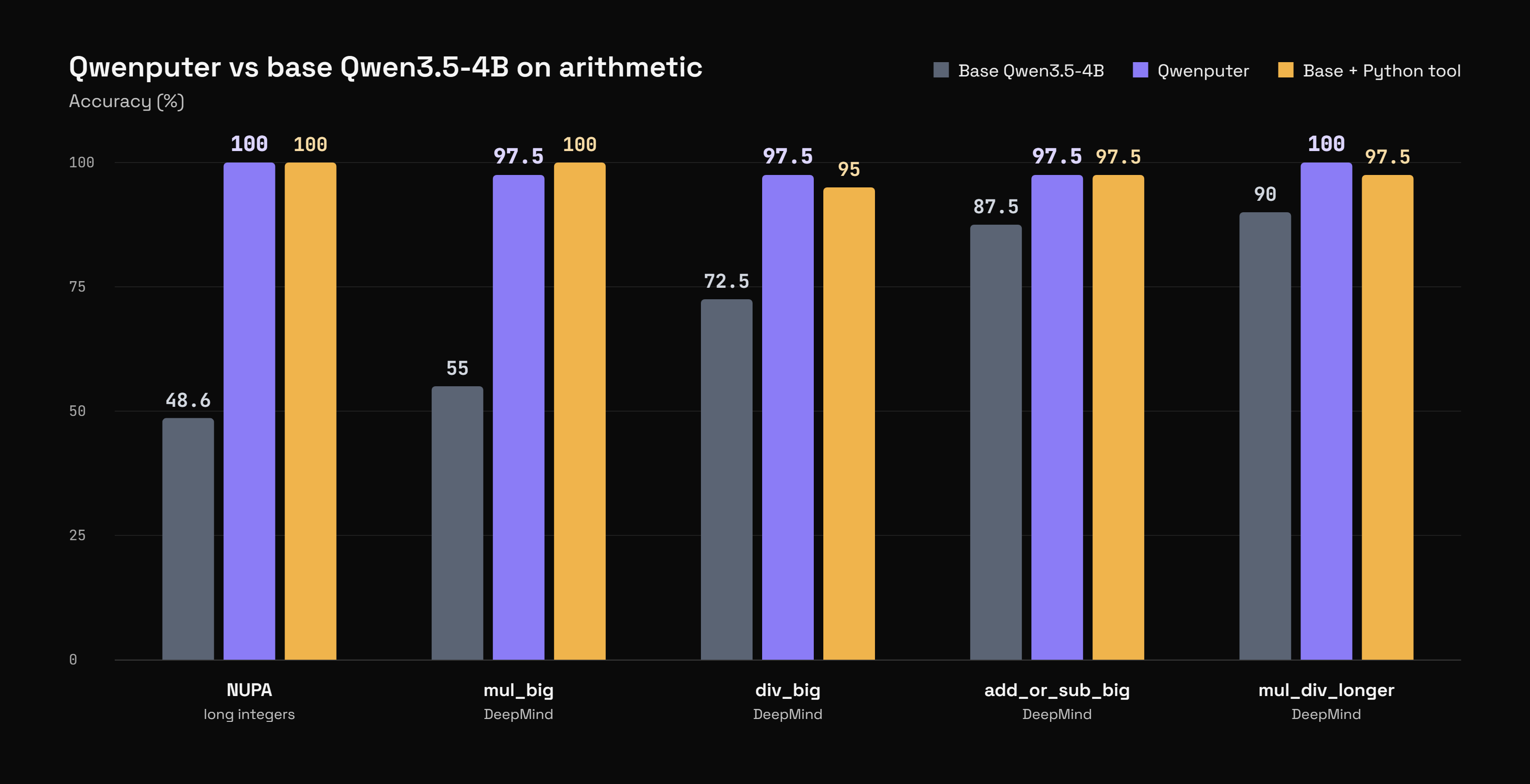
The author reports that the snapshot passes the official RISC-V tests, beats QEMU on tested programs and ran 18 million instructions without error. In the large integer arithmetic test, Qwenputer scored 100%, against 48.6% for the base model. For those following the Qwen ecosystem, the Qwen Code 0.26.1 shows how the same separate ecosystem is evolving model speed.
The checkpoint occupies about 18.8 GB in BF16 and the author recommends a single GPU with 24 GB for local experiments. It is an experimental demonstration, not an official Qwen release.
Technical sheet
| Item | Detail |
|---|---|
| What changed | A RISC-V processor compiled inside a Qwen3.5-4B checkpoint |
| Target audience | Researchers, engineers and people curious about model architecture |
| Where it is | Code and weights published on the author's blog |
| How to test | 24 GB GPU recommended (BF16) |
| Deployment forecast | No official release; it is an open experiment |
In the same territory, Nvidia brings Qwen3.8 to Open-SWE-Traces shows how the Qwen ecosystem extends to software engineering, uniting agents with test infrastructure.
Context
The demonstration mixes two themes that are gaining strength: heterogeneous models and the question of what happens when execution is done inside the weights. In traditional architectures, the model generates token by token and a separate program executes calculations. Qwenputer inverts the flow: the state machine lives in the neural graph itself, and memory is addressable by the attention network. The experiment does not replace a computer; it shows an interesting theoretical limit and a visually impressive demo.
For day to day use, the warning is to keep a clear distinction between production and research. Qwenputer is a research snapshot with open licenses and heavy compute. It is not an inference model ready for production.
Frequently asked questions
What is Qwenputer?
It is an experimental checkpoint of Qwen3.5-4B with a RISC-V CPU compiled inside the weights, capable of executing C and MicroPython during inference.
Does it replace a common language model?
No. The original model remains unchanged; the experiment adds extra layers that perform structured computation.
Does it need expensive hardware?
Yes. The version made available suggests a single 24 GB GPU to run the weights.
Is it an official Qwen release?
No. It is work by a developer, with code and weights published for reproduction.
What would this be used for in practice?
So far, it is an architecture demonstration: it shows that state, memory and execution can exist inside model layers.
How to test today
The project makes the code and weights available in the author's repository. The author recommends a single 24 GB GPU for local experiments. The RvChat app is still needed to load firmware and manage trace tokens.
Conclusion
Qwenputer is an example of how to think about AI models as programmable machines, not just text generators. Curiosity is legitimate, but reproducing it requires gaming hardware.
CTA
Get started today
Ideally, download the checkpoint and run the lightest version, 8-bit quantization, before increasing resolution. Report where execution fails, large integer, floating point arithmetic or memory, and adjust one hyperparameter at a time. The goal the first time is to see the RISC-V CPU inside the weights emit an execution trace, not to get a production result.
In summary
Qwenputer is not a model for daily use: it is a demonstration that execution can live inside the weights. For those following research, it is a hint at future architectures; for those wanting a product, wait for a more versatile and accessible version. The interest is concrete: it shows that computation can be nested inside the neural network itself.
Source
Tags:#radar#ia
Developer and creator of bridgecode, an agentic development environment for orchestrating squads of AI agents. Helps people going from vibe coding to professional development move from idea to shipped product.
Related articles

Newsletter
OpenAI creates a standard for responsible AI infrastructure
OpenAI published a standard for responsible AI infrastructure with commitments on energy, water, workforce and communities.
5 min

Newsletter
Cult.fit standardizes operations with Codex and builds internal apps
Cult.fit standardized development on Codex, built more than 20 internal apps with non-technical teams and cut support costs by over 50%.
6 min

Newsletter
Meta launches Spaces for the Muse agent
Meta launched Spaces for the Muse agent, creating persistent workspaces that update automatically. See how it works.
5 min