
CONFIRMED | OFFICIAL

OpenAI reports 948 flaws in the Linux kernel
OpenAI describes a pipeline that validated findings in the Linux kernel and generated candidate patches for 948 privilege escalation flaws.

Marcelo Santiago
Criador do bridgecode
The biggest AI newsletter in the World
Get AI articles in your inbox
Technical curation on models, agents and coding tools. No spam, unsubscribe anytime.
On November 4, 2026, at 5 a.m. Brasília time, OpenAI published results from a pipeline that found and validated flaws in the Linux kernel and generated patches for review by maintainers.
The company reports 948 local privilege escalation vulnerabilities. The number comes from OpenAI's own study, not from an independent assessment of all Linux systems.
What it is: a security research report with automated steps for discovery, triage and creation of candidate fixes. What it is not: confirmation that 948 fixes have already been incorporated into Linux distributions.
In this article you will see:
- How OpenAI described the Linux kernel research.
- What the discovery and validation numbers mean.
- Why generated patches still need review and distribution.
- How teams can use automation without skipping validation.
What OpenAI reported about the Linux kernel
The Linux kernel is the central layer that coordinates processes, memory, devices and access to system resources. A vulnerability in it can affect many kinds of products, but exposure depends on the version, configuration and code present in each system.
OpenAI's research focused on local privilege escalation flaws, known as LPE. In simple terms, it is a class of issue where a process with limited permissions can gain capabilities it should not have.
In the article, the company says an autonomous pipeline found candidates, checked which had reproducible impact and produced patches for review. The publication presents the results as a research step, not as a universal advisory for every Linux installation.
That distinction matters because a finding in kernel code does not mean all servers, phones or devices are vulnerable in the same way. Distributions may use different versions, configurations and fixes.
Triage separated candidate findings from confirmed results
OpenAI reports the process started with 2,308 candidate findings and moved 1,724 through validation. The article also organizes results by class; the diagram below highlights the triage steps through to human review.
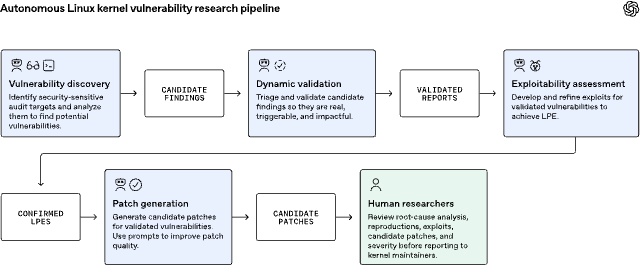
The diagram shows automation ends at candidate patches and human review, before any integration by Linux kernel maintainers.
These steps are not interchangeable. A candidate is a hypothesis produced by analysis; validation requires additional evidence; and a functional proof indicates an impact scenario was demonstrated in the considered environment.
OpenAI itself notes that in an earlier stage, 20 of 200 results the system classified as novel vulnerabilities were not new flaws. That experience led the company to strengthen independent validation before accepting a finding.
948 findings do not mean 948 distributed fixes
The 948 figure refers to local privilege escalation vulnerabilities that OpenAI says it identified and for which it generated candidate patches. The publication does not say that all of those changes have already been accepted, merged, and shipped in stable kernel releases.
A proposed fix still needs to be reviewed by whoever maintains the affected subsystem. Reviewers may ask for more evidence, adjust the solution, identify a common root cause, or conclude that the fix needs to be applied differently.
After merging into the main project, distributions and vendors need to select the relevant changes, test compatibility, and prepare their own updates. That work explains why a count of generated patches is not the same as the number of systems already protected.
For those who run software, the prudent approach is to follow advisories from the maintainers and vendors you use. Do not apply a research hypothesis directly in production, nor conclude that a specific installation is exposed just because it appears in the report.
The case connects to other security layers for agents. Our article on how OpenAI monitors misalignment signals in agents discusses detection and its limits. The report on the Brotli decoder flaw shows why the version actually running needs to be checked.
The Linux Kernel requires verifiable evidence and responsible disclosure
The official documentation for the Linux Kernel security process states that a report should identify the range of affected versions and provide enough analysis for maintainers to confirm the issue.
The team also asks that the analysis consider the kernel threat model. Not every software bug is a security vulnerability, and calling a common defect a critical flaw can divert triage time from truly urgent cases.
When a finding comes from an AI tool, maintainers need verifiable facts, the exact version, demonstrated impact, and a reviewable fix. A convincing write up or an automatic classification, without reproduction and context, does not prove the problem exists.
Kernel policy recommends avoiding premature publication of details that could facilitate abuse. OpenAI's research should be read alongside that responsibility: the goal is to confirm and fix flaws, not to turn counts into instructions for exploiting them.
Frequently asked questions about OpenAI's research on the Linux kernel
What did OpenAI report about the Linux kernel?
OpenAI described a pipeline to discover and validate flaws in the Linux kernel and generate candidate patches. The company reports 948 local privilege escalation flaws.
How many findings were validated by the pipeline?
The publication reports 2,308 candidate findings and 1,724 validated. These numbers describe OpenAI's research process, not a survey of all Linux systems.
Have the 948 flaws already been fixed in all Linux distributions?
No. The report refers to candidate patches for review; each fix still needs to be analyzed, integrated and distributed by maintainers and vendors.
What does local privilege escalation mean?
It is a class of vulnerability in which a process with limited permissions can obtain capabilities beyond what is authorized. Exposure depends on the system version and configuration.
Does the research prove that AI can replace security specialists?
No. OpenAI itself describes human validation and review in the process. The study does not replace independent reproduction, maintainer analysis or tracking of fixes.
Automation expands triage, but fixing requires review
The study shows how agents can increase the volume of code analyzed and speed up the search for defects. It also shows that quality depends on independent filters, technical validation, and communication with maintainers.
For product teams, a safe approach starts by separating tasks: automate the search for candidates, validate in a controlled environment, review the patch, and track the delivery of the fix. Each step needs to record evidence and an owner.
Automated discovery can increase coverage, but it does not prove the product is secure. OpenAI's report is a study from one organization, with numbers declared by the company itself; it does not measure all models, codebases, or maintenance practices.
You define the goal and the agents split the tasks: one analyzes, another proposes changes, and another reviews. See how to coordinate AI agents at bridgecode.
Source: OpenAI
Tags:#OpenAI#Linux Kernel#segurança de IA#cibersegurança#vulnerabilidades
Developer and creator of bridgecode, an agentic development environment for orchestrating squads of AI agents. Helps people going from vibe coding to professional development move from idea to shipped product.
Related articles

Newsletter
Ramp: AI spending stalls as Anthropic approaches IPO
Ramp data shows AI usage climbing while spending stalls. The picture challenges revenue expectations for OpenAI and Anthropic.
5 min

Newsletter
Merge uses GPT-6 Astra, ChatGPT and Codex in operations
OpenAI publishes a customer story about Merge, which uses GPT-6 Astra, ChatGPT and Codex for product, marketing and business planning.
5 min

Newsletter
Australian universities train AI-native graduates
OpenAI highlights Australian universities that are training AI-native graduates. Understand the movement and what it changes for technology teams.
5 min