
CONFIRMED · OFFICIAL

Microsoft separates training and grounding for websites
Microsoft splits preferences for training and grounding of pages; changes start in February 2027 and require migration of old tags.

Marcelo Santiago
Criador do bridgecode
The biggest AI newsletter in the World
Get AI articles in your inbox
Technical curation on models, agents and coding tools. No spam, unsubscribe anytime.
Microsoft announced on October 30, 2026 separate controls for the use of pages in model training and in response grounding.
The change does not alter site eligibility in Bing traditional search.
The new preferences take effect on February 1, 2027, as Bing crawls each page.
Sites that use NoArchive or NoCache need to plan migration before March 1, 2027 to keep their grounding choices.
In this article you will see:
- What Microsoft calls training and grounding.
- How the new preferences work in
robots.txtand on pages. - What changes for those who still use
NoArchiveorNoCache. - Why these rules do not block Bing traditional search.
Microsoft separates AI training and grounding
Training is the use of content to change the parameters learned by a generative model. Grounding is the use of a page as context to produce a response, typically with links that allow consulting the original source.
Microsoft says the two choices will be independent. A site can allow a page to help answer questions while at the same time preventing it from being used in model training.
The shared training preference can be set in robots.txt for the whole site or for a path. Microsoft will also allow this choice to be set on an individual page, overriding the general rule in the file.
Grounding will be a per page setting, in a meta tag or HTTP header. Microsoft offers Allow, Disallow and an intermediate option called DisallowExtended.
With DisallowExtended, the page can continue to be used in Microsoft experiences, but not in third party grounding services, such as Web IQ or API calls in Foundry.
Documentation lists Copilot and Microsoft 365 among examples of first party experiences.
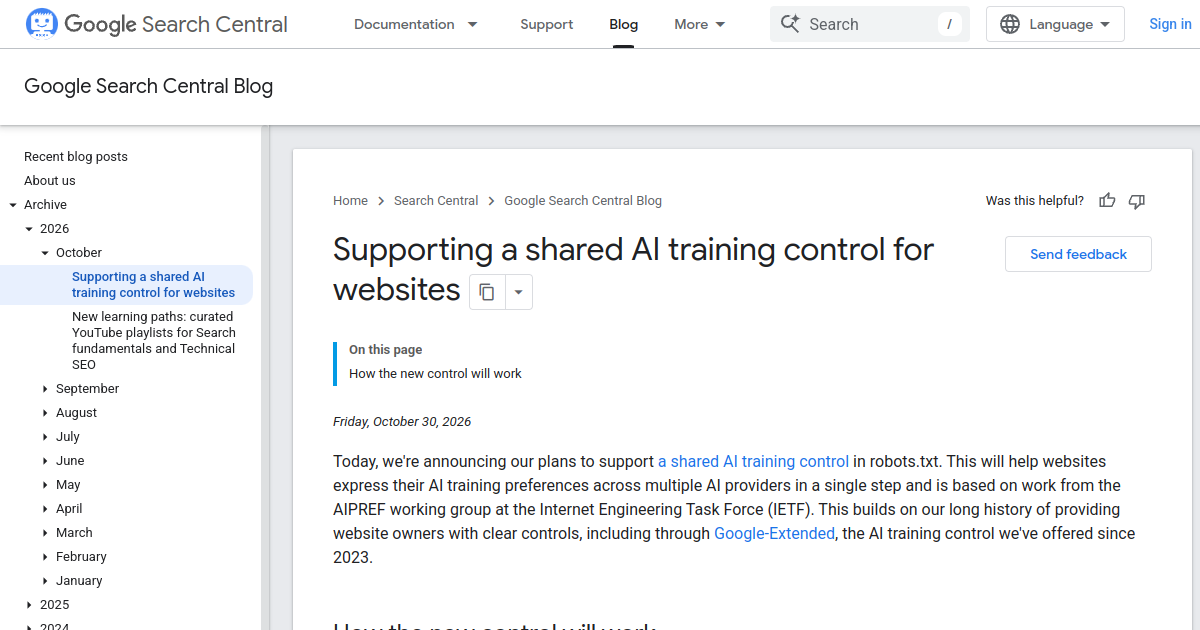
The training proposal is shared between providers. On October 30, Google also announced plans to adopt it.
Microsoft added its own choices for grounding and for individual pages.
The signal in robots.txt does not replace per page rules
For site or path training, Microsoft shows the token __usage_ai-training on the User-Agent line. For example, the rule below expresses the preference not to use the content in training:
Texto
User-Agent: __usage_ai-training
Disallow: /
This signal does not block Bingbot crawling. It communicates a usage preference to providers that decide to recognize it; rules that limit robot access continue to be handled separately.
For an individual page, Microsoft shows Bingbot specific controls. Official examples allow preferences to be registered in HTML or in a response header:
HTML
<meta name="Bingbot" content="ai-training:disallow">
<meta name="Bingbot" content="ai-grounding:disallow">
The new per page training setting overrides the general preference of robots.txt. There is no longer a site level grounding setting in the file: this choice is made page by page.
Both preferences are Allow by default. Without publishing a choice, the site does not block training or grounding.
This matters for pages that today rely on old tags.
Microsoft sets deadline to migrate NoArchive and NoCache
Microsoft has offered controls to publishers since 2023 with NoArchive and NoCache. The announcement says the new preferences will replace those tags for training and grounding decisions, with more granularity.
Starting February 1, 2027, Bing begins to respect the new settings as it crawls pages. A published rule does not take effect for the bot before it finds it in a new crawl.
For those using NoArchive or NoCache, Microsoft recommends publishing the new choices by March 1, 2027. After that date, old tags stop being read as training or grounding preferences.
The migration path for grounding has an extra step. Sites that still use the old tags on December 15, 2026 can register a temporary preference in Bing Webmaster Tools.
The temporary adjustment is valid while Bing has not yet crawled the new page configuration.
This preference is valid until Bing finds the new configuration or until September 30, 2027, whichever comes first.
The temporary feature is not needed for sites that do not use NoArchive nor NoCache.
Review which pages still use the old tags and define whether training and grounding will have the same preference.
Publish the choice per page, validate the HTML or header and register the temporary preference if it applies.
Bing keeps traditional search outside these preferences
Microsoft says the choices do not change eligibility in traditional Bing results, subject to normal crawling and indexing requirements.
A page can appear in search even when it cannot be used for training.
The settings do not guarantee inclusion in AI responses, traffic or payment.
Grounding connects answers to the consulted content, but each preference controls only the corresponding use.
Blocking grounding can reduce presence in AI responses; allowing it does not guarantee citation.
The choice does not replace editorial review, licensing agreements nor crawling controls.
Data policies are not model behavior rules. The OpenAI Model Spec update addresses the second layer.
The post about monitoring misaligned agents covers operational security.
Frequently asked questions about Microsoft's preferences for training and grounding
What did Microsoft announce for websites?
Microsoft announced independent controls to decide whether a page can be used for model training and for grounding answers. The change does not alter eligibility in traditional Bing results.
When do the new training and grounding preferences take effect?
The new preferences start being respected on February 1, 2027, as Bing crawls each page. Microsoft's page also sets specific deadlines for sites using old tags.
What happens to NoArchive and NoCache?
Microsoft recommends publishing the new choices by March 1, 2027. After that date, NoArchive and NoCache will no longer apply as training or grounding preferences.
Do the preferences change traditional Bing results?
No. Microsoft says the new preferences do not change eligibility in traditional Bing results, which remain subject to normal crawling and indexing rules.
What does DisallowExtended mean for a page?
DisallowExtended allows the page to be used in some Microsoft operated experiences, but not in third party grounding services. Documentation cites Copilot and Microsoft 365 among the first party experiences.
Web teams should review tags before March 2027
The change separates content use for training and for grounded responses.
The risk for web teams is keeping an old tag and assuming it will continue to be valid after March 2027.
Inventory NoArchive and NoCache, define preferences per page and monitor Bing Webmaster Tools.
Sites without these tags do not need the temporary migration.
The signal simplifies communication about training, but does not replace access rules nor control data already collected.
Include activation and the migration deadline in the editorial calendar.
From draft to finished product, split the work among specialist agents and track each step on bridgecode.
Source: Microsoft Bing
Tags:#Microsoft Bing#robots.txt#treinamento de IA#grounding#web publishers
Developer and creator of bridgecode, an agentic development environment for orchestrating squads of AI agents. Helps people going from vibe coding to professional development move from idea to shipped product.
Related articles

Newsletter
GitHub rebuilds Git storage for agents
GitHub announced its new Git storage architecture, Project Rubicon, capable of handling thousands of writes per second to a single repository.
6 min

Newsletter
Palette: IBM model learns to create slides in your style
IBM and Hugging Face released Palette, a 20 billion parameter model that generates presentations in code trained to follow the IBM Design Language.
7 min

Newsletter
OpenAI creates a standard for responsible AI infrastructure
OpenAI published a standard for responsible AI infrastructure with commitments on energy, water, workforce and communities.
5 min