
On November 4, 2026, OpenAI introduced Images 2.6, an update to create and edit images in ChatGPT and the API. The announcement adds GIF creation, visual quality adjustments and a complexity control to guide different requests.
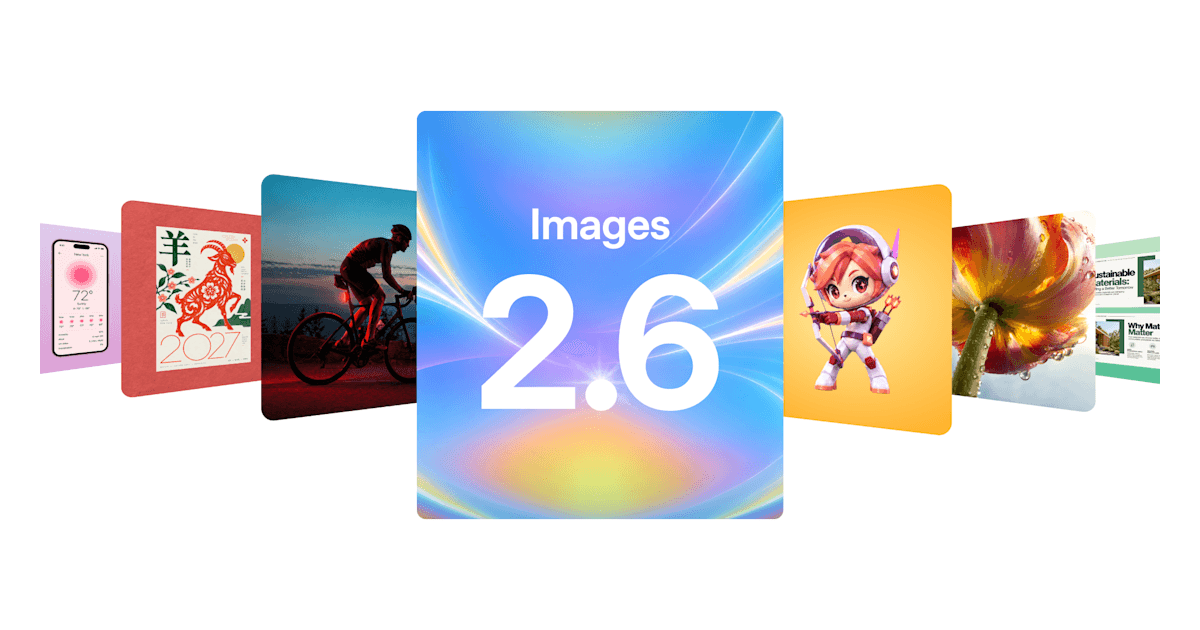
Images 2.6 lands in ChatGPT with GIFs and editing
OpenAI launched Images 2.6 on November 4: faster generation, GIFs, more precise editing and new controls in the API.

Marcelo Santiago
Criador do bridgecode
The biggest AI newsletter in the World
Get AI articles in your inbox
Technical curation on models, agents and coding tools. No spam, unsubscribe anytime.
The news is not an independent ranking nor a promise that every image will come out ready for publication. OpenAI says the ChatGPT, Codex and API ecosystem generates 4 billion images per week, but that volume does not specifically measure Images 2.6.
In this article you will see:
- What changes in the Sunburst and Flare variants.
- How GIF creation starts from an idea or sketch.
- What the API controls allow you to adjust.
- How to test quality and recognize limits.
What Images 2.6 changes in image creation and editing
Images 2.6 brings generation and editing features together in a release focused on faster iteration and professionally finished images. OpenAI describes two modes of the GPT Image 2.6 family, called Sunburst and Flare, with different focuses.
Sunburst prioritizes higher quality images and greater consistency between edits when quality is set to medium or high. This consistency is useful when a character, product or brand needs to keep recognizable traits across multiple versions.
Flare focuses on layout composition for posters, product images and other professional visual materials. The distinction helps you choose the model according to the task, instead of asking a single adjustment to solve fidelity, speed and composition at the same time.
OpenAI presents Images 2.6 as faster to iterate than the previous generation, but the page does not turn that description into an independent scoreboard. To compare models, it is also worth looking at different tasks and methods, such as in the article about the MAI Image 2.7 in editing rankings.
The 4 billion images per week figure gives context to the scale of OpenAI's products. It includes images created in ChatGPT, Codex and API, so it should not be read as a quality, speed or specific adoption result for Images 2.6.
The GIFs of Images 2.6 can start from a sketch
The announcement also describes the creation of animated GIFs from instructions and visual references. The OpenAI page shows a simple hand drawn owl on lined paper as a starting point for an animated character.

OpenAI uses the example to show that a visual reference does not need to be polished final art. A short description can guide the transformation of a draft into an expressive character for videos, games or other projects.
This opens room for motion prototypes, campaign pieces and style explorations before investing time in finishing. Still, the generated GIF needs to be reviewed frame by frame when details, text, visual identity or animation continuity matter.
The announcement does not promise that any static image will become a consistent animation in every attempt. The result depends on the quality of the reference, the instruction and the review of the parts that need to stay the same.
The Images 2.6 API offers controls for distinct tasks
The update includes a complexity parameter to adjust how much planning the model dedicates to the request. OpenAI says smaller settings can handle quick edits, while requests with more elements can benefit from greater elaboration.
Quality controls the level of detail and visual fidelity, while complexity guides the content and the number of elements in the scene. Separating these choices helps test whether the task asks for just a localized correction or a more worked composition.
For teams integrating image generation into a product, these controls allow comparing instructions without changing the whole flow. The team can keep the same input image, vary one parameter at a time and record whether the edit preserved the items that should not change.
The OpenAI page itself notes that Images 2.6 is available in ChatGPT and the API. For the exact parameter names and accepted formats, see the official announcement page and the images documentation linked by it.
How to test Images 2.6 today without confusing quality with preference
Start with a test image you have permission to use. Write a single desired change and list separately the elements that must remain intact, such as colors, text, framing or product position.
Then compare one edit with another using the same reference. Change only the instruction or one control per round, and check small details, edges, letters and consistency between versions before selecting an output.
To experiment with GIFs, use a sketch or an image without personal data and describe the motion in concrete terms. Evaluate whether the character keeps shape and style across frames, not just whether the first frame looks correct.
The news also connects to other multimodal applications from OpenAI. See how the company describes the use of models in CAD, simulation and physical engineering, a different context from image creation for media.
Frequently asked questions about OpenAI's Images 2.6
What is Images 2.6?
Images 2.6 is OpenAI's update for image creation and editing in ChatGPT and the API. The announcement also covers GIF creation and quality and complexity controls.
Can Images 2.6 create animated GIFs?
Yes. OpenAI introduces GIF creation from instructions and visual references, including an example that starts from a sketch.
What is the difference between Sunburst and Flare in Images 2.6?
Sunburst prioritizes visual quality and consistency across edits. Flare focuses on layouts for posters, product images and other professional materials.
What does the complexity parameter control in the API?
Complexity adjusts how much planning the model dedicates to the request. OpenAI says lower settings can be used for quick edits.
Is the 4 billion images per week number only for Images 2.6?
No. OpenAI reports that volume for ChatGPT, Codex and API combined; it does not measure usage or quality specific to Images 2.6.
Images 2.6 expands visual creation, but does not eliminate review
Images 2.6 adds more control over image generation, editing and animation. For product teams, the main gain is testing variations with instructions and detail levels that are better defined.
The usage scale published by OpenAI does not replace evaluation of your own flow. Check consistency, text, framing and brand requirements before incorporating any result into an interface, campaign or documentation.
Images 2.6 alone solves a visual task. An agent squad delivers the whole project, and that is what you build on bridgecode.
Source: OpenAI
Tags:#OpenAI#Images 2.6#GPT Image 2.6#geração de imagens#edição de imagens#GIF#API de imagens
Developer and creator of bridgecode, an agentic development environment for orchestrating squads of AI agents. Helps people going from vibe coding to professional development move from idea to shipped product.
Related articles

Newsletter
Ramp: AI spending stalls as Anthropic approaches IPO
Ramp data shows AI usage climbing while spending stalls. The picture challenges revenue expectations for OpenAI and Anthropic.
5 min

Newsletter
Merge uses GPT-6 Astra, ChatGPT and Codex in operations
OpenAI publishes a customer story about Merge, which uses GPT-6 Astra, ChatGPT and Codex for product, marketing and business planning.
5 min

Newsletter
Australian universities train AI-native graduates
OpenAI highlights Australian universities that are training AI-native graduates. Understand the movement and what it changes for technology teams.
5 min