
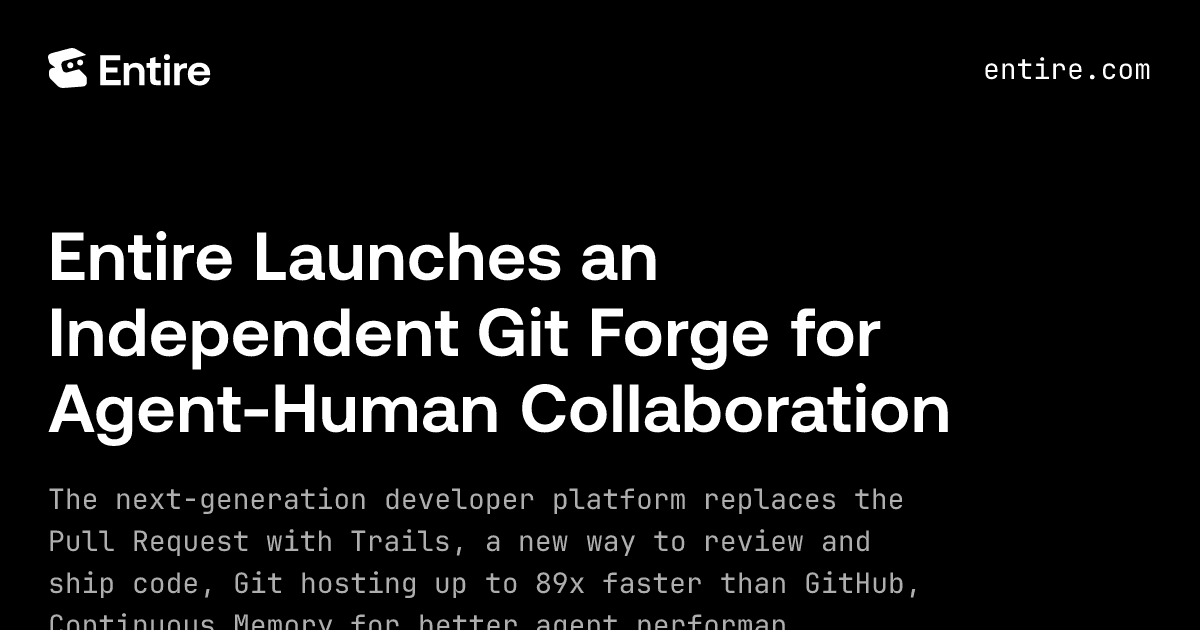
Entire announced on October 26, 2026 a Git hosting platform designed for projects where agents and people work together. The company calls the product an independent forge and presents Trails as a new way to track code, agent sessions and checks.
Entire launches a Git forge for agents and people
Entire launched a Git compatible forge that brings together code review, agent trails, automated evaluations, hosting and CI.

Marcelo Santiago
Criador do bridgecode
The biggest AI newsletter in the World
Get AI articles in your inbox
Technical curation on models, agents and coding tools. No spam, unsubscribe anytime.
The announcement is a workflow proposal, not a universal change to Git nor proof that pull requests are no longer useful. The Entire page does not list the publication time and the performance numbers are statements from the company itself.
In this article you will see:
- What Entire launched
- How Trail organizes review
- What Entire's numbers show and what they do not show
- How to evaluate the platform before migrating
What Entire launched
Entire describes the product as an independent Git forge for collaboration between programming agents and developers. A forge is a platform that hosts Git repositories and adds features for reviewing and integrating changes.
The announced differentiator is bringing the repository, the traces of agent sessions and automated evaluations into the same flow. Instead of showing only a difference between versions, the proposal is to record the goal, the agent's work and the result that the team needs to validate.
The company says the service is available to developers and that private repositories can be hosted in regions in the United States, the European Union, India and Australia. The same page lists self hosting of Git nodes, public repositories and more integrations as items planned, not as features already delivered.
Entire also announced CI integrations with Buildkite and Depot. CI, or continuous integration, runs build and test steps when code changes. The page says teams can adapt existing GitHub Actions workflows for these partners.
How Trail organizes review
Trail is the work unit presented by Entire. Each Trail brings together an idea, the changes made by the agent and the result produced, so that review follows more context than an isolated diff.
The platform can run evaluations on each code submission. According to the company, agents analyze the results and can work on fixes until the defined criteria are met. A person still needs to decide if the criteria are sufficient and if the change can be integrated.
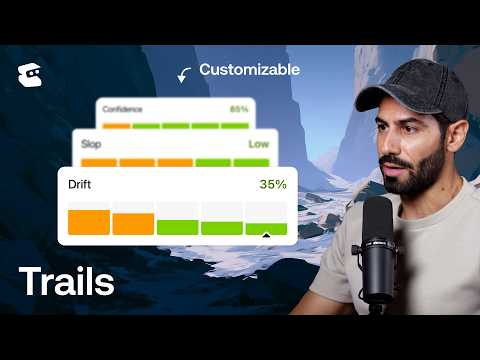
The official product demonstration shows visual indicators called Confidence, Slope and Drift. They show how Entire intends to present the state of an evaluation, but the video does not prove that these measures detect all possible defects.
The Cursor Agent SDK also treats agents as software components. The difference announced by Entire is placing the agent trail alongside Git hosting and the review process, instead of focusing only on agent definition.
What the Entire numbers demonstrate
Entire claims its pushes are up to 89 times faster than on GitHub and six times faster than on Cursor Origin. These are results published by the company itself in the product announcement, not an independent benchmark presented with the full methodology.
For that reason, these factors should not be read as a prediction for any repository. Performance can vary depending on project size, network, region, Git client and configuration. The team should measure its own workflow before assuming an operation will be faster.
Another component is Continuous Memory, a system that records sessions in the repository and allows agents to query that history. Entire describes a codebase graph that helps locate relationships between files and claims it can reduce token usage by up to 71 percent.
That percentage is also a company claim. The announcement does not present an external evaluation with the data and tasks needed to reproduce the result. It serves as a hypothesis to test, not as a guarantee of savings on all projects.
The package combines hosting, review and agent memory. For teams that already have mature processes on GitHub, the central question is not just push speed. It is whether data, permissions, automations and the audit trail remain adequate after the change.
How to evaluate the platform before migrating
Start with a test repository, not the most critical project. Push, create a small change, run CI and follow what Trail records. Compare the experience with the current flow without removing the original copy.
Define which checks are mandatory. Unit tests, integration tests, static analysis and review by one person answer different questions. An automated assessment only covers what was included in your criteria and can leave risks outside of them.
Check how permissions for agents, users and integrations work. Verify who can read a repository, start an action, approve a result and access session logs. For sensitive projects, confirm data retention, incident recovery and export options in Entire's documentation.
It is also worth testing portability. Use Git to clone and compare a repository, verify CI flows and confirm how to migrate history and automations. The announced compatibility reduces the entry barrier, but does not eliminate the work of validating hooks, keys and pipelines.
The team that uses Codex can compare this flow with a guide to building AI systems using Codex. The common point is to split implementation, tests and review, keeping explicit criteria so a person can check the delivery.
How to watch the official Entire Trails demo
Entire published a short video that shows the visual presentation of Trails and its evaluation indicators. It helps understand the proposed interface, but does not replace a security analysis, a migration test or reading the terms and documentation.
The new forge deserves a practical evaluation by teams that want to connect agent work to repositories and CI. The main care is to treat metrics, automations and review promises as resources to validate, not as automatic substitutes for the engineering process.
Frequently asked questions about Entire's Git forge
What is Entire's Git forge?
It is a Git hosting platform that combines repositories, agent session trails and automated evaluations in a review flow. This is Entire's own description.
Does Entire replace all pull requests?
Not necessarily. Entire presents Trails as an alternative to organize work, but the announcement does not show that pull requests are no longer useful in all projects.
Did Entire prove it is 89 times faster than GitHub?
No. The speed figures are results published by Entire, with no complete independent methodology in the announcement. Performance needs to be measured in each team's repository and configuration.
Does Entire work with GitHub Actions?
Entire's page advertises CI integration with Buildkite and Depot and claims Git compatibility. Teams should confirm the migration of automations, keys and history before moving a critical project.
What is Continuous Memory in Entire?
The company presents Continuous Memory as a session history searchable by agents. The token savings of up to 71 percent is an Entire claim, not an independent result confirmed in the announcement.
Entire's proposal puts the agent trail at the center of review
Entire tries to bring Git history, agent context and checks into a single unit of work. This can be useful when agents produce changes in parallel, but the value depends on the quality of tests, permissions and the clarity of acceptance criteria.
Entire caught your attention? [Put your next project to work with an agent squad at bridgecode], with each agent responsible for one step.
Source: Entire
Tags:#Entire#Git#agentes de código#CI
Developer and creator of bridgecode, an agentic development environment for orchestrating squads of AI agents. Helps people going from vibe coding to professional development move from idea to shipped product.
Related articles

Newsletter
GitHub rebuilds Git storage for agents
GitHub announced its new Git storage architecture, Project Rubicon, capable of handling thousands of writes per second to a single repository.
6 min

Newsletter
Palette: IBM model learns to create slides in your style
IBM and Hugging Face released Palette, a 20 billion parameter model that generates presentations in code trained to follow the IBM Design Language.
7 min

Newsletter
OpenAI creates a standard for responsible AI infrastructure
OpenAI published a standard for responsible AI infrastructure with commitments on energy, water, workforce and communities.
5 min