
The Verge published on October 28 at 5:34 PM EDT an interview about a sampler that Akai calls MPC Sample Key.

Akai readies MPC Sample Key for AI mods
Akai teasers show vibe coding mods on the MPC Sample Key. The CEO talks about early access and open software, but there is no license or SDK yet.

Marcelo Santiago
Criador do bridgecode
The biggest AI newsletter in the World
Get AI articles in your inbox
Technical curation on models, agents and coding tools. No spam, unsubscribe anytime.
CEO Jack O’Donnell talked about making room for mods made by developers, but the company has not yet presented a formal launch with complete specifications.
The new news is the intention reported by the executive and the official teasers, not a product already available. The videos show experimental modifications with AI help, without yet publishing a code license or an SDK for download.
In this article you will see:
- What Akai's teasers show about the MPC Sample Key
- What the CEO said about early access and open software
- How the device relates to the current MPC Sample
- What developers need to wait for before creating mods
What Akai's videos show about the MPC Sample Key
Akai published a first official video and a second teaser that present the Sample Key and some software modifications.
The clearest visual difference compared to the known MPC Sample is the presence of a compact keyboard on the device shown in the teasers.
One of the videos demonstrates a modified version of the sampler environment. The Verge report describes custom instruments made with Claude, including an experience that combines sounds and controls for musicians.
The second teaser shows other synthesis and navigation experiences on the instrument. These are demonstrations of what the team is exploring, not a list of features guaranteed in the final product version.
This limit matters. A prototype can run a modification made for a presentation without the public having access to the code, the tools used, or the same hardware conditions.
The images also do not confirm all the device's characteristics. Therefore, this text does not attribute number of keys, memory, formats, compatibility or launch date to the MPC Sample Key.
What Akai's CEO said about mods and software
In the interview published by The Verge, Jack O’Donnell described the intention to send early units to developers and open part of the software for modifications.
The company also mentioned the possibility of an SDK to create extensions.
This is a statement from an executive about the company's plans, not the publication of a repository or a license.
Up to the time of the article, there was no public documentation defining which components will be opened or how modifications will be installed.
The difference between "accepting mods" and "being fully open source" is important.
A company can allow changes to instruments or interfaces without releasing the complete firmware, drivers, operating system or all development tools.
The announcement also does not inform how creators will be able to share or distribute their projects.
For a community of musicians and programmers, license, compatibility and security updates are part of the experience, they are not details that can be assumed.
The confirmed point is more restricted: Akai presented modified prototypes in videos and its CEO talked about early access and opening part of the software. The technical scope remains to be defined.
How the Sample Key relates to the current MPC Sample
The MPC Sample already brings together sampling, sequencing and effects.
The Akai official FAQ lists more than 100 drum kits and melodic loops for the current model.
That number helps contextualize the variety of sounds musicians may want to adapt.
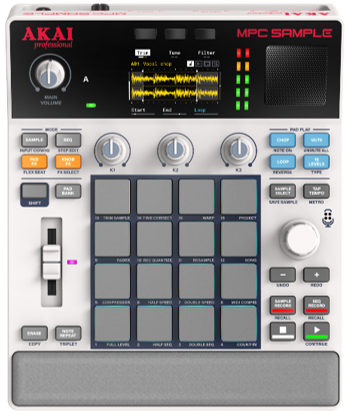
The image above shows the current MPC Sample, not the Sample Key. It helps visualize how the family combines physical controls with the screen and sampler software.
The new teaser suggests a different way to play, but it still does not clarify the final product.
The opening for mods can bring music creation and programming closer together.
A musician could request a custom instrument, test an idea with AI and adjust the result to the sampler workflow, if Akai really publishes the tools described by the CEO.
This path recalls other physical projects created with agent assistance.
In bridgecode, we already showed the showcase of physical projects made with Codex.
The example shows how software and devices can be built in short cycles.
The conversation also connects to vibe coding.
xAI and Cursor already appeared on the blog in a piece about models and tools for vibe coding.
In Akai's case, the novelty is bringing experimentation to a dedicated musical instrument.
What developers need to wait for before building mods
For now, there is no public installation step by step for the Sample Key. The videos are demonstrations and do not replace official instructions for updating firmware, unlocking the device or loading third party code.
Before building extensions, it will be necessary to know which interfaces Akai will document, how each mod accesses audio and controls, and what permissions the instrument will require.
Without this information, it is not possible to say that a mod will be safe, compatible or reversible.
Anyone who wants to follow the project can compare the official teasers with the information on the current MPC Sample and wait for the manufacturer's documentation.
The announcement does not confirm when there will be units for developers nor when an SDK will be published.
It is also worth separating what was produced with AI from what AI executes on the instrument.
A model can help write a synthesizer or an interface, but the hardware needs to load that code and offer compatible controls for the modification to work.
When the features are published, a useful test should record the exact model of the device, the firmware version, the code license and the audio and storage limits.
This data will allow other developers to reproduce the result instead of relying only on a short video.
Frequently asked questions about Akai's MPC Sample Key
Has the Akai MPC Sample Key been released?
No. The videos are teasers and The Verge reports that Akai has not made a formal launch with complete specifications.
Will Akai release the firmware as open source?
The CEO talked about opening part of the software and offering early access to developers, but there is no license or technical scope published for the full firmware.
What is the MPC Sample Key?
It is a sampler with a compact keyboard shown in official teasers. Akai has not yet published final specifications or a release date.
What do Akai's videos show?
They show prototypes with experimental software modifications and custom instruments, including experiences made with help from Claude according to the report.
How to test modifications for the MPC Sample Key?
There is no SDK or public firmware to install yet. For now, you can only follow the official demonstrations and wait for Akai's documentation.
Akai's proposal could turn the sampler into a platform
The Sample Key is still a proposal in development, but the videos and the CEO's remarks show an interesting direction: allowing musicians to adapt the instrument with software created by the community.
For programmers, the next decisive data point is not a general promise of openness.
It is the publication of a license, tools and clear limits for mods. Until then, teasers should be treated as demonstrations, not as product availability.
It is not just code. In bridgecode, you orchestrate AI agents to plan, build and test whatever you imagine.
Source: The Verge
Tags:#Akai#MPC Sample Key#vibe coding#sampler#Claude
Developer and creator of bridgecode, an agentic development environment for orchestrating squads of AI agents. Helps people going from vibe coding to professional development move from idea to shipped product.
Related articles

Newsletter
GitHub rebuilds Git storage for agents
GitHub announced its new Git storage architecture, Project Rubicon, capable of handling thousands of writes per second to a single repository.
6 min

Newsletter
Palette: IBM model learns to create slides in your style
IBM and Hugging Face released Palette, a 20 billion parameter model that generates presentations in code trained to follow the IBM Design Language.
7 min

Newsletter
OpenAI creates a standard for responsible AI infrastructure
OpenAI published a standard for responsible AI infrastructure with commitments on energy, water, workforce and communities.
5 min