
CONFIRMED · OFFICIAL

ThinkingBox boosts consistency of Qwen3.8-27B
On ThinkingBox-Bench with 507 tasks, fine-tuning Qwen3.8-27B raised tasks approved in all 20 attempts from 38 to 107.

Marcelo Santiago
Criador do bridgecode
The biggest AI newsletter in the World
Get AI articles in your inbox
Technical curation on models, agents and coding tools. No spam, unsubscribe anytime.
On October 22, 2026, at 7:24pm Brasília time, Microsoft and Hugging Face published results from ThinkingBox Training, which uses final database state checks as a reward to tune agents.
After 50 GRPO steps, Qwen3.8-27B went from 38 to 107 tasks approved in all 20 attempts on ThinkingBox-Bench, which includes 507 tasks. Artigo conjunto.
What it is: a post-training experiment evaluated by the authors. What it is not: an independent model ranking or proof of performance on any real task.
In this article you will see:
- how ThinkingBox-Bench verifies the agent's outcome
- which metrics changed after tuning
- why consistency and coverage need to be read together
How ThinkingBox-Bench verifies 507 tasks
The benchmark gives the agent a backend and MCP tools, then checks the final database state. The evaluator verifies whether the outcome was completed, instead of rewarding only tool calls that look correct.
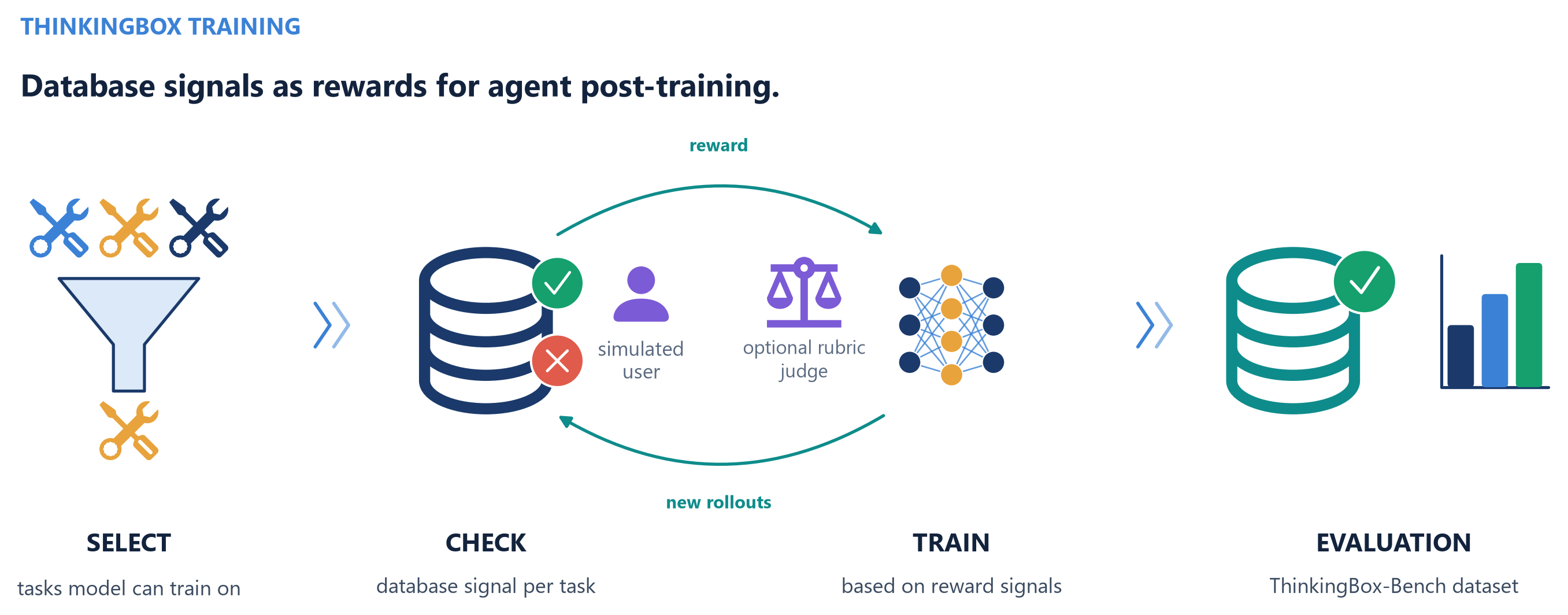
Credit: Microsoft and Hugging Face.
The authors evaluated 507 tasks 20 times each, for a total of 10,140 attempts. Training used tasks separate from the benchmark reserved for evaluation.
What changed in Qwen3.8-27B after 50 steps
Tuning with GRPO, a reinforcement learning technique that compares groups of responses, raised pass@1 from 51.70% to 60.78%.
- Tasks approved in all 20 attempts: 38, or 7.50%, before; 107, or 21.10%, after.
- Tasks solved at least once in 20 attempts: 453, or 89.35%, before; 446, or 87.97%, after.
Across the metrics, tuning raised repeatability but slightly reduced tasks solved at least once. See also NVIDIA Vera's test in agent loops and OpenAI's report on the critical PHP failure.
What the ThinkingBox result does not prove
The study is from the authors, not independent. The benchmark tasks were kept out of training, but the sets share the ThinkingBox structure, user simulation, final state checking and some tools.
For that reason, the result does not demonstrate that Qwen3.8-27B is better than other models in general. It shows that, in this scenario, tuning raised consistency measured across repeated attempts.
Frequently asked questions about ThinkingBox and Qwen3.8-27B
How does ThinkingBox-Bench work?
It evaluates the final state of a backend after the agent executes a task with tools, using executable checks on database records.
What does 20 out of 20 mean?
It is the number of tasks the model completed correctly in all 20 recorded attempts.
Did fine-tuning improve all metrics of Qwen3.8-27B?
No. The average success rate and tasks approved in all attempts increased, but pass@20 fell from 89.35% to 87.97%.
Does ThinkingBox-Bench prove that Qwen3.8-27B is the best model?
No. It is an evaluation by the authors on 507 tasks and not an independent ranking or proof of general superiority.
What is GRPO in this experiment?
It is a reinforcement learning technique that compares groups of responses. In the experiment, fine-tuning was done for 50 steps using rewards verified on the final state.
More consistency came with lower coverage on ThinkingBox-Bench
The clearest advance was in tasks approved in all 20 attempts. Since pass@20 fell from 89.35% to 87.97%, the correct read is higher repeatability with a small loss of coverage, not an improvement across all metrics.
Stop switching between AI tools. Coordinate agents and track tests on bridgecode.
Source: Microsoft and Hugging Face
Tags:#ThinkingBox#Qwen#benchmark#agentes de IA#GRPO
Developer and creator of bridgecode, an agentic development environment for orchestrating squads of AI agents. Helps people going from vibe coding to professional development move from idea to shipped product.
Related articles
Benchmarks
CloudOpsBench: AI agents in cloud operations
CloudOpsBench measures how AI agents perform real cloud operations tasks. The best agent solves 60.6% of the 45 tasks on AWS. See the numbers.
7 min

Benchmarks
GPT-5.1 tops tau2-Bench Airline with 80%
On the tau2-Bench Airline leaderboard from November 6, GPT-5.1 scored 80.0%. Learn about the method, minimum sample size and limitations before choosing an agent.
6 min

Benchmarks
RoleRouteBench: what routing reveals in multi-agent systems
RoleRouteBench is a reproducible environment for evaluating dynamic role routing in multi-step tasks. See the JEV 1.13 results across the four domains.
6 min